
Yomiuri Survey: Japan’s LDP Likely to See Big Gains in Proportional Representation Segment in Lower House Election
16:39 JST, January 29, 2026
The Liberal Democratic Party is likely to see significant gains in the proportional representation segment of the upcoming House of Representatives election on Feb. 8, according to a Yomiuri Shimbun survey.
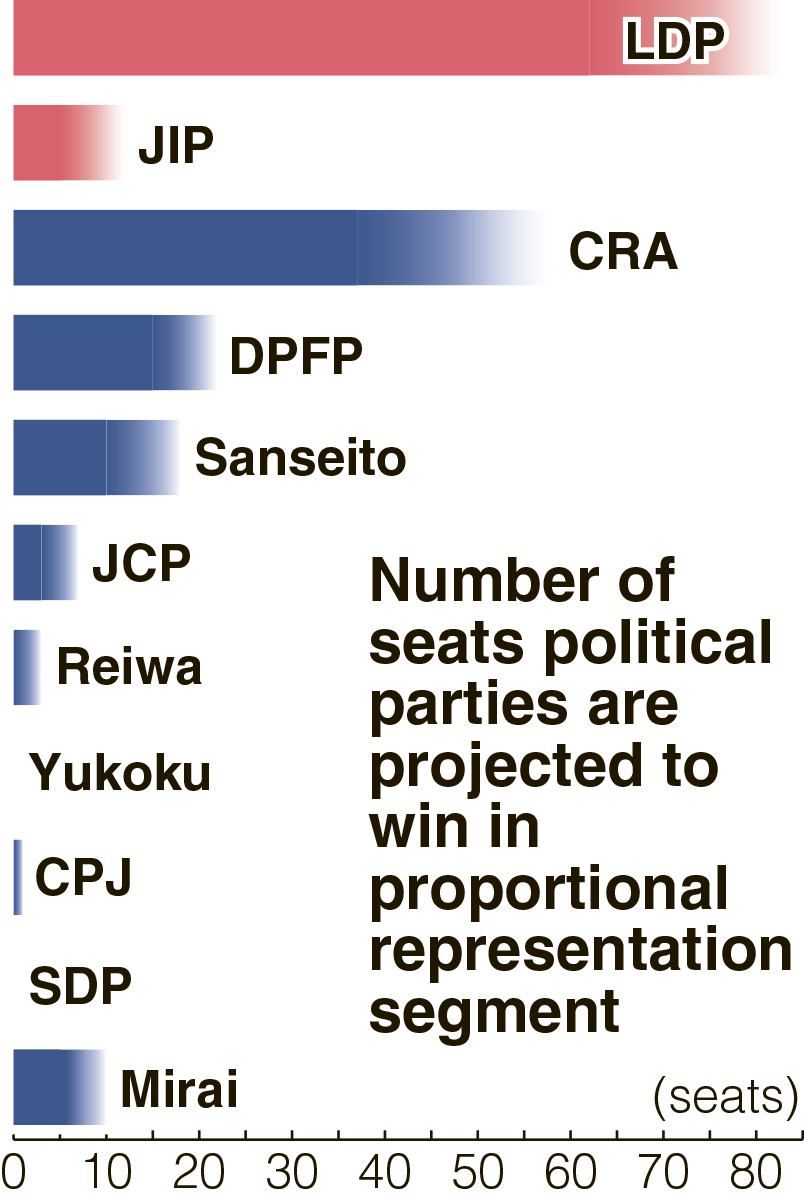
According to the survey to gauge voter sentiment in the early stages of campaigning, the number of LDP seats is likely to increase in the segment from the 59 it won in the previous lower house election in 2024. The figure could reach a level comparable to the 72 seats it won in the 2021 election, when the ruling party maintained a single party majority.
The LDP appears to have solidified support from about 50% of voters who approve of the Cabinet of Prime Minister Sanae Takaichi, who is also the LDP president. Of the voters who have no party affiliation, about 10% support the LDP while more than half are still undecided.
The LDP usually tends to trail opposition parties over support from independent voters, but it has been roughly on par with the Centrist Reform Alliance in the early stages of the campaign, according to the survey.
The survey also found that the LDP is backed by 10% of Japan Innovation Party supporters.
In contrast, the JIP, the LDP’s coalition partner, is projected to lose seats in the proportional representation segment from the 15 it won in the previous lower house election, potentially falling into single digits.
The CRA, a new party formed by the Constitutional Democratic Party of Japan and Komeito, looks to be struggling in the proportional representation segment. The CRA is highly likely to fall short of the number of seats the CDPJ and Komeito won in the previous election, when they had 64 seats in total.
Similar to single-seat constituencies, there appear to be no positive effects of the CDPJ-Komeito partnership in the proportional representation segment. Looking specifically at 11 regional blocs in the segment, the CRA could see its seats fall below the combined number of seats previously won by the CDPJ and Komeito in all these blocs except for Shikoku.
The CRA is strengthening its confrontational stance against the Takaichi administration, but it has secured support from only slightly less than half of voters who disapprove of her Cabinet, according to the survey. This indicates that the CRA has not fully attracted voters critical of the Takaichi administration, with opposition parties being in disarray.
As the percentage of support for the CRA among voters aged 18-39 is only about half of that of the Democratic Party for the People, the new party faces the challenge of attracting younger voters.
The DPFP is expected to see results similar to those of the previous lower house election, when it won 17 seats in the proportional representation segment.
However, in the early stages of the campaign, there is no indication of the party making significant gains, such as those seen in the 2024 lower house race and last summer’s House of Councillors election.
Among other opposition parties, Sanseito and Team Mirai are likely to increase their seats.
Sanseito is highly likely to make significant gains from the three seats it won in the previous lower house election.
As Team Mirai is seeing more support among younger voters, the possibility is high for the party to win two seats in the Tokyo bloc and possibly secure a third.


Related Tags




Most Read
Popular articles in the past 24 hours
-

Voters Using AI to Choose Candidates in Japan's Upcoming General ...
-

Japan's Snow-Clad Beauty: Camellia Flowers Seen in Winter Bloom a...
-

Monkey Strikes Junior High School Girl from Behind in Japan's Yam...
-

Genichiro Inokuma's Mural in Ueno Station That Gave Hope in Postw...
-

Senior Japanese Citizens Return to University to Gain Knowledge, ...
-

Heavy Snow Linked to 30 Deaths across Japan since Late Jan.; JMA ...
-

Tokyo Police Arrest Head of Resignation Assistance Firm
-

Foreign and Security Policy: Political Parties Must Discuss How T...
Popular articles in the past week
-

Japan Institute to Use Domestic Commercial Optical Lattice Clock ...
-

Australian Woman Dies After Mishap on Ski Lift in Nagano Prefectu...
-

Foreign Snowboarder in Serious Condition After Hanging in Midair ...
-

Chinese Embassy in Japan Reiterates Call for Chinese People to Re...
-

Narita Airport, Startup in Japan Demonstrate Machine to Compress ...
-

Toyota Motor Group Firm to Sell Clean Energy Greenhouses for Stra...
-

Sakie Yokota, Last Surviving Parent of a North Korea Abductee, Ur...
-

Beer Yeast Helps Save Labor, Water Use in Growing Rice; Govt Hope...
Popular articles in the past month
-

Univ. in Japan, Tokyo-Based Startup to Develop Satellite for Disa...
-

JAL, ANA Cancel Flights During 3-day Holiday Weekend due to Blizz...
-

China Confirmed to Be Operating Drilling Vessel Near Japan-China ...
-

China Eyes Rare Earth Foothold in Malaysia to Maintain Dominance,...
-
M6.2 Earthquake Hits Japan's Tottori, Shimane Prefectures; No Tsu...
-
Japan Institute to Use Domestic Commercial Optical Lattice Clock ...
-

Japan, Qatar Ministers Agree on Need for Stable Energy Supplies; ...
-

Japan, Italy to Boost LNG Cooperation; Aimed at Diversifying Japa...
Top Articles in Politics
-

Japan Seeks to Enhance Defense Capabilities in Pacific as 3 National Security Documents to Be Revised
-

Japan Tourism Agency Calls for Strengthening Measures Against Overtourism
-

Japan’s Prime Minister: 2-Year Tax Cut on Food Possible Without Issuing Bonds
-

Japan-South Korea Leaders Meeting Focuses on Rare Earth Supply Chains, Cooperation Toward Regional Stability
-

Japanese Government Plans New License System Specific to VTOL Drones; Hopes to Encourage Proliferation through Relaxed Operating Requirements
JN ACCESS RANKING
-
Univ. in Japan, Tokyo-Based Startup to Develop Satellite for Disaster Prevention Measures, Bears
-
JAL, ANA Cancel Flights During 3-day Holiday Weekend due to Blizzard
-
China Confirmed to Be Operating Drilling Vessel Near Japan-China Median Line
-
China Eyes Rare Earth Foothold in Malaysia to Maintain Dominance, Counter Japan, U.S.
-
Japan Institute to Use Domestic Commercial Optical Lattice Clock to Set Japan Standard Time