
Political Parties Take Varied Approaches to Constituency Race Lists; Allotment of Favorable Positions Reflects Internal, External Concerns
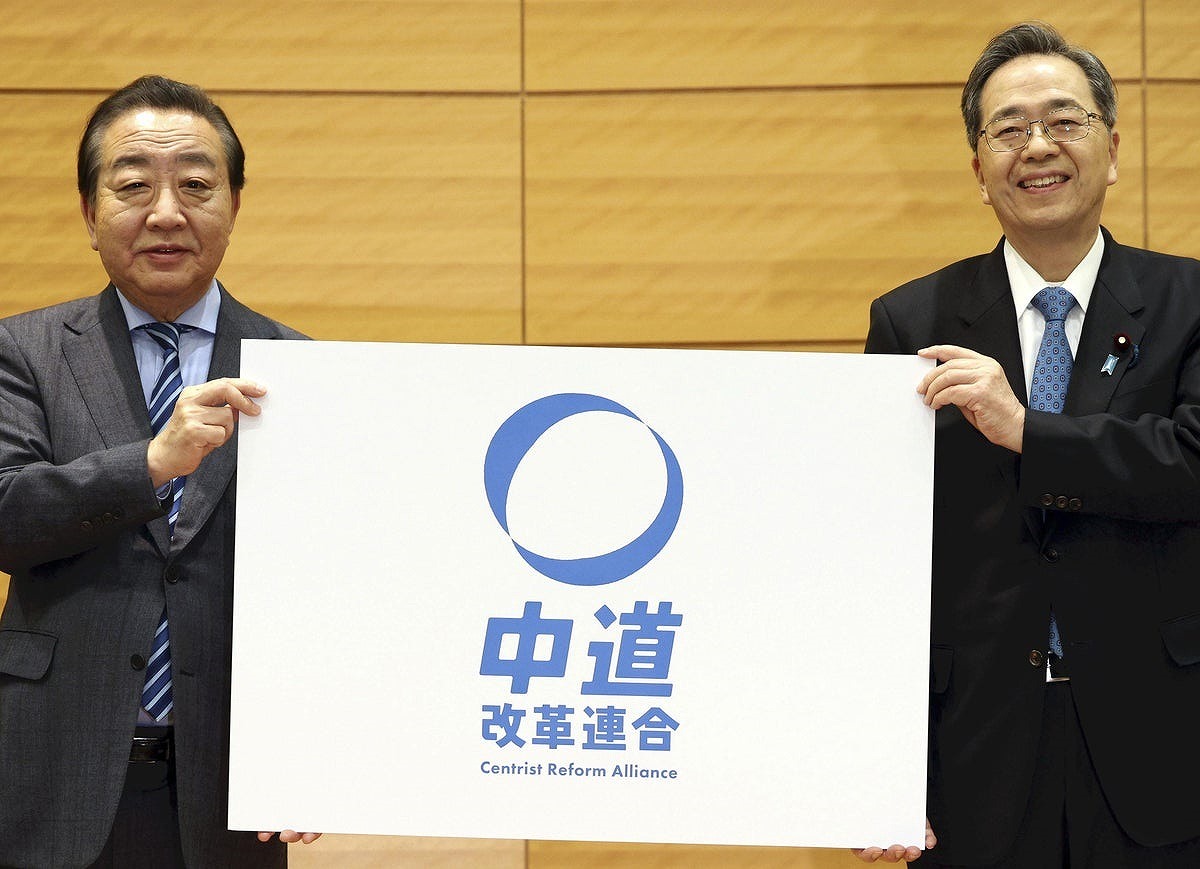
Constitutional Democratic Party leader Yoshihiko Noda, left, and Komeito leader Tetsuo Saito announce the name of their new party in the Diet building on Jan. 22.
17:51 JST, January 28, 2026
As February’s House of Representatives election approaches, one way in which Japan’s political parties have shown their distinct natures is in how they have each arranged the candidates in their party lists for the proportional representation segment of the vote.
For example, in the case of the Centrist Reform Alliance (CRA), which was created through a merger of the Constitutional Democratic Party of Japan and Komeito, higher positions were awarded to candidates who formerly belonged to Komeito.
Meanwhile, Liberal Democratic Party candidates who were involved in an earlier scandal in which some factions failed to report income from fundraising party ticket sales, in violation of the Political Funds Control Law, are being allowed by the party to run in both single-seat constituency races and the proportional representation segment.
Among these candidates, those who lose in their constituency races will still have a chance to secure a seat in the proportional representation segment. A total of 176 seats, in 11 blocks, will be contested in the proportional representation segment.
The CRA placed 28 candidates who joined the new party from Komeito on higher positions in the party lists across all 11 blocks. Since Komeito has withdrawn from the constituency races, candidates affiliated with it were given priority over those from the CDPJ in the proportional representation segment by the party.
Those from the CDPJ can expect members of Soka Gakkai, a lay Buddhist organization which supports Komeito, to vote for them en masse. However, those from CDPJ who are being allowed to run in both constituency and proportional representation races will have difficulty getting a proportional representation seat if they lose in their constituency. Some of them expressed dissatisfaction, including one who said, “Did we have to favor Komeito this heavily?”
Among CRA candidates listed at the same rank on the list, seats are allocated in order of those who come closest to winning in their single seat constituency.
An exception to this is Sumio Mabuchi, cochair of the CRA’s election campaign committee. Mabuchi, who is running in Nara Constituency No. 1 as well as the Kinki block in the proportional representation race, sits alone in the sixth-place spot on the CRA list for the Kinki block race, while the seventh spot is shared by 24 candidates.
CRA coleader Yoshihiko Noda explained to reporters on Tuesday: “The Democratic Party for the People unexpectedly fielded a candidate [in Nara Constituency No. 1], and if [Mabuchi] cannot focus on his job [as campaign chief] it will affect all our colleagues.” However, Mabuchi is close to Noda, and his being put in the sixth-place spot has caused ripples within the party.
In the previous general election, the LDP did not allow former Abe and Nikai faction members who were named in the Political Funds Control Law violation scandal to be listed in proportional representation lists even if they were fielded as official party candidates in constituency races. But this time, the LDP is allowing such dual candidacies, on the grounds that they have now been “washed clean.” Prime Minister Sanae Takaichi has sought understanding, saying, “These talented people with specialized knowledge should be given another chance to work.” But opposition parties are becoming increasingly critical of this move.
Dissatisfaction is also emerging within the LDP over the positions of some candidates in the proportional representation lists.
Three former ministers under the administration of former Prime Minister Shigeru Ishiba — former regional revitalization minister Yoshitaka Ito; former Education, Culture, Sports, Science and Technology Minister Toshiko Abe; and former Internal Affairs and Communications Minister Seiichiro Murakami — were positioned alone at the top of their respective lists in the previous lower house election. But this time Ito has been placed sixth in the Hokkaido block, Abe 20th in the Chugoku block and Murakami 10th in the Shikoku block. “The prime minister has opposing political beliefs to Ishiba, so it was likely difficult to favor them for a second consecutive election,” a mid-career LDP member pointed out.
The Japan Innovation Party did not allow dual candidacy in 18 of the 19 constituencies in its home prefecture of Osaka in the previous lower house election. However, it has reversed that policy and this time is allowing dual candidacy in 17 of the 19 Osaka constituencies. The exceptions are JIP Co-Representative Fumitake Fujita and former Representative Nobuyuki Baba, who are running only in constituency races. A mid-career party member said the decline in party momentum helped bring about the change.
DPFP leader Yuichiro Tamaki is running only in a constituency race this time. He ran in both constituency and proportional representation races in the previous election.


Related Tags



Most Read
Popular articles in the past 24 hours
-

Voters Using AI to Choose Candidates in Japan's Upcoming General ...
-

Japan's Snow-Clad Beauty: Camellia Flowers Seen in Winter Bloom a...
-
Monkey Strikes Junior High School Girl from Behind in Japan's Yam...
-

Genichiro Inokuma's Mural in Ueno Station That Gave Hope in Postw...
-
Senior Japanese Citizens Return to University to Gain Knowledge, ...
-
Heavy Snow Linked to 30 Deaths across Japan since Late Jan.; JMA ...
-

Foreign and Security Policy: Political Parties Must Discuss How T...
-
Tokyo Police Arrest Head of Resignation Assistance Firm
Popular articles in the past week
-

Japan Institute to Use Domestic Commercial Optical Lattice Clock ...
-
Australian Woman Dies After Mishap on Ski Lift in Nagano Prefectu...
-
Foreign Snowboarder in Serious Condition After Hanging in Midair ...
-

Chinese Embassy in Japan Reiterates Call for Chinese People to Re...
-

Narita Airport, Startup in Japan Demonstrate Machine to Compress ...
-

Toyota Motor Group Firm to Sell Clean Energy Greenhouses for Stra...
-
Sakie Yokota, Last Surviving Parent of a North Korea Abductee, Ur...
-

Beer Yeast Helps Save Labor, Water Use in Growing Rice; Govt Hope...
Popular articles in the past month
-

Univ. in Japan, Tokyo-Based Startup to Develop Satellite for Disa...
-

JAL, ANA Cancel Flights During 3-day Holiday Weekend due to Blizz...
-
China Confirmed to Be Operating Drilling Vessel Near Japan-China ...
-

China Eyes Rare Earth Foothold in Malaysia to Maintain Dominance,...
-
M6.2 Earthquake Hits Japan's Tottori, Shimane Prefectures; No Tsu...
-
Japan Institute to Use Domestic Commercial Optical Lattice Clock ...
-

Japan, Qatar Ministers Agree on Need for Stable Energy Supplies; ...
-

Japan, Italy to Boost LNG Cooperation; Aimed at Diversifying Japa...
Top Articles in Politics
-
Japan Seeks to Enhance Defense Capabilities in Pacific as 3 National Security Documents to Be Revised
-
Japan Tourism Agency Calls for Strengthening Measures Against Overtourism
-
Japan’s Prime Minister: 2-Year Tax Cut on Food Possible Without Issuing Bonds
-
Japan-South Korea Leaders Meeting Focuses on Rare Earth Supply Chains, Cooperation Toward Regional Stability
-

Japanese Government Plans New License System Specific to VTOL Drones; Hopes to Encourage Proliferation through Relaxed Operating Requirements
JN ACCESS RANKING
-
Univ. in Japan, Tokyo-Based Startup to Develop Satellite for Disaster Prevention Measures, Bears
-
JAL, ANA Cancel Flights During 3-day Holiday Weekend due to Blizzard
-
China Confirmed to Be Operating Drilling Vessel Near Japan-China Median Line
-
China Eyes Rare Earth Foothold in Malaysia to Maintain Dominance, Counter Japan, U.S.
-
Japan Institute to Use Domestic Commercial Optical Lattice Clock to Set Japan Standard Time