
Parties Launch Battle of Words Ahead of Lower House Election; Major Parties in Focus as Smaller Parties Seek to Distinguish Themselves
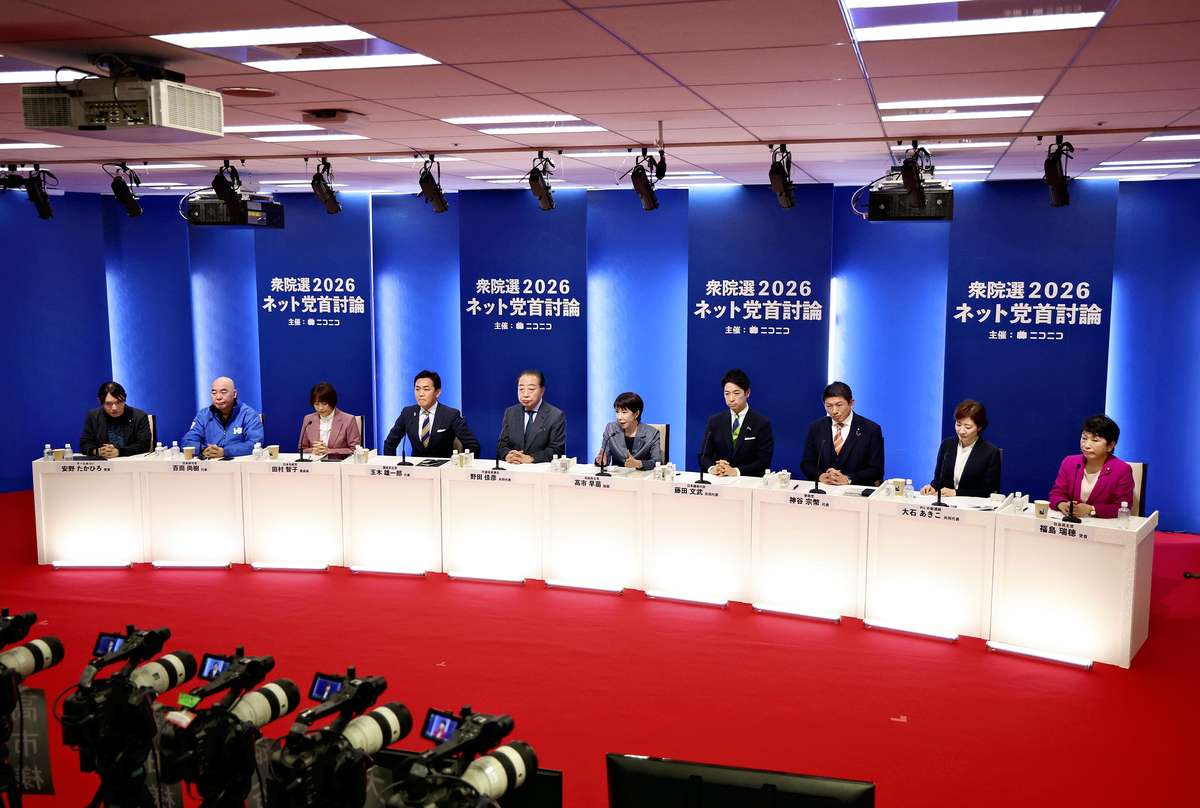
Party leaders take part in a panel discussion broadcast online from Chuo Ward, Tokyo, on Saturday.
15:20 JST, January 25, 2026
Party leaders and executives have begun a battle of words ahead of the House of Representatives election next month.
Official campaigning for the election starts on Tuesday, with voting and ballot counting set for Feb. 8.
The lower house election is shaping up to be a contest between two major forces: the ruling Liberal Democratic Party and the Centrist Reform Alliance, a new party formed by the main opposition parties — the Constitutional Democratic Party of Japan and Komeito — and involving other, smaller parties.
Both the ruling and opposition parties are putting their efforts into getting their election pledges across to voters.
On Saturday, party leaders debated their policies during a panel discussion broadcast online, the first such event since the lower house was dissolved last week.
“We will drastically boost security policies,” said Prime Minister Sanae Takaichi, who also serves as LDP president. “No one will protect a country that lacks the spirit and the strength to defend itself.”
Referring to establishing a law to penalize desecration of the national flag, a policy she has been calling for, Takaichi said, “We need [the law] to protect Japan’s honor, and I will surely realize that law.”
CRA coleader Yoshihiko Noda spoke about economic policy. “The middle class is increasingly suffering from poverty because of a failure to redistribute wealth,” he said. “We will promote policies that prioritize ordinary citizens.”
Takaichi and Noda traded blows over some issues, including the relocation of the U.S. military’s Futenma Air Station in Ginowan, Okinawa Prefecture.
“Komeito supported the relocation plan, so what stance will [the CRA] take?” Takaichi asked Noda.
Noda replied, “Taking into account the voices of the people in the prefecture is the way to respond to the broadest possible base of voters,” he said.
Takaichi, finding the response ambiguous, asked about the party’s position again, to which Noda replied, “We’re taking a cautious position.”
In relation to Takaichi’s remark in the Diet about a Taiwan contingency possibly constituting a “survival-threatening situation,” Noda said that Japan has been labelled as a militarist country and that the prime minister should “peel off” that label. The prime minister responded by saying she has been holding meetings with leaders of other countries and explaining her perspective.
Meanwhile, other parties are apparently trying to avoid being overshadowed by the two major parties by stressing their own unique characteristics.
On the same day, Fumitake Fujita, coleader of the LDP’s coalition partner the Japan Innovation Party, made a roadside speech in Koto Ward, Tokyo. “The LDP is not so fast to act,” he said. “The JIP’s role is to get the party to make a move. We are the engine and accelerator of the Takaichi administration.”
On a street in Kure, Hiroshima Prefecture, Democratic Party for the People leader Yuichiro Tamaki also spoke to the public. “The amount of money left in your hand isn’t increasing because of rising prices,” Tamaki said. “We will carry out policies that will increase your take-home pay.”
During the panel discussion, Sanseito, which is touting its “Japanese-First” policy, made its stance clear. “We will establish a system that allows Japanese people to play a central role in operating the country,” party leader Sohei Kamiya said. “We will make sure to limit the number of foreign workers accepted into the country.”


Related Tags



Most Read
Popular articles in the past 24 hours
-

Voters Using AI to Choose Candidates in Japan's Upcoming General ...
-

Japan's Snow-Clad Beauty: Camellia Flowers Seen in Winter Bloom a...
-

Monkey Strikes Junior High School Girl from Behind in Japan's Yam...
-
Genichiro Inokuma's Mural in Ueno Station That Gave Hope in Postw...
-

Senior Japanese Citizens Return to University to Gain Knowledge, ...
-
Heavy Snow Linked to 30 Deaths across Japan since Late Jan.; JMA ...
-

Foreign and Security Policy: Political Parties Must Discuss How T...
-

Tokyo Police Arrest Head of Resignation Assistance Firm
Popular articles in the past week
-

Japan Institute to Use Domestic Commercial Optical Lattice Clock ...
-
Australian Woman Dies After Mishap on Ski Lift in Nagano Prefectu...
-
Foreign Snowboarder in Serious Condition After Hanging in Midair ...
-

Chinese Embassy in Japan Reiterates Call for Chinese People to Re...
-

Narita Airport, Startup in Japan Demonstrate Machine to Compress ...
-

Toyota Motor Group Firm to Sell Clean Energy Greenhouses for Stra...
-

Sakie Yokota, Last Surviving Parent of a North Korea Abductee, Ur...
-

Beer Yeast Helps Save Labor, Water Use in Growing Rice; Govt Hope...
Popular articles in the past month
-
Univ. in Japan, Tokyo-Based Startup to Develop Satellite for Disa...
-
JAL, ANA Cancel Flights During 3-day Holiday Weekend due to Blizz...
-
China Confirmed to Be Operating Drilling Vessel Near Japan-China ...
-

China Eyes Rare Earth Foothold in Malaysia to Maintain Dominance,...
-
M6.2 Earthquake Hits Japan's Tottori, Shimane Prefectures; No Tsu...
-
Japan Institute to Use Domestic Commercial Optical Lattice Clock ...
-

Japan, Qatar Ministers Agree on Need for Stable Energy Supplies; ...
-

Japan, Italy to Boost LNG Cooperation; Aimed at Diversifying Japa...
Top Articles in Politics
-
Japan Seeks to Enhance Defense Capabilities in Pacific as 3 National Security Documents to Be Revised
-
Japan Tourism Agency Calls for Strengthening Measures Against Overtourism
-

Japan’s Prime Minister: 2-Year Tax Cut on Food Possible Without Issuing Bonds
-
Japan-South Korea Leaders Meeting Focuses on Rare Earth Supply Chains, Cooperation Toward Regional Stability
-

Japanese Government Plans New License System Specific to VTOL Drones; Hopes to Encourage Proliferation through Relaxed Operating Requirements
JN ACCESS RANKING
-
Univ. in Japan, Tokyo-Based Startup to Develop Satellite for Disaster Prevention Measures, Bears
-
JAL, ANA Cancel Flights During 3-day Holiday Weekend due to Blizzard
-
China Confirmed to Be Operating Drilling Vessel Near Japan-China Median Line
-
China Eyes Rare Earth Foothold in Malaysia to Maintain Dominance, Counter Japan, U.S.
-
Japan Institute to Use Domestic Commercial Optical Lattice Clock to Set Japan Standard Time