
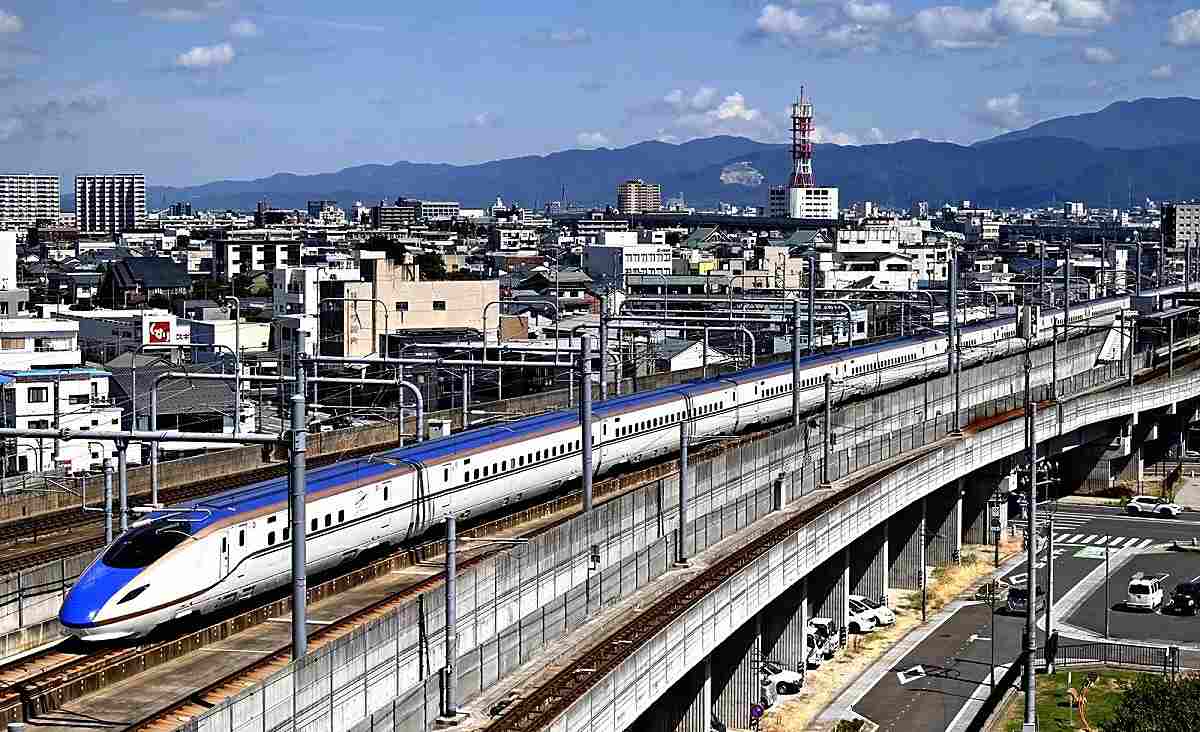
A Hokuriku Shinkansen train runs near Fukui Station in September 2024.
14:00 JST, January 25, 2026
TOKYO (Jiji Press) — Japan’s transport ministry is considering raising the leasing fees paid by Japan Railways group companies for some Shinkansen bullet train line facilities.
The ministry is looking to use the higher revenue for new construction projects based on Shinkansen development plans as well as for large-scale renovations of aging infrastructure.
It aims to reach a conclusion on the matter by this summer, but JR group firms are opposed to the fee hike.
JR firms that operate Shinkansen lines are paying leasing fees for railroads, tunnels and other facilities for five sections — the Hokkaido Shinkansen, the Tohoku Shinkansen section between Morioka and Shin-Aomori stations, the Hokuriku Shinkansen section between Takasaki and Tsuruga stations, the Kyushu Shinkansen and the Nishi Kyushu Shinkansen.
The facilities were built and are owned by the Japan Railway Construction, Transport and Technology Agency. When the agency leases facilities to JR firms, it sets fixed annual leasing fees for 30 years based on the companies’ expected gains within the leasing period. Fees for the 31st year and beyond remain undecided.
The transport ministry has been considering revising the fees, as the end of September 2027 will mark 30 years since the agency began leasing the Takasaki-Nagano leg of the Hokuriku Shinkansen, the first section to be leased under the system. The ministry established an expert panel in November 2025 to discuss the fee collection period and fee-setting method.
It is seeking to secure stable financial resources as many sections of planned Shinkansen lines have yet to be completed, including the Hokkaido Shinkansen section between Shin-Hakodate-Hokuto and Sapporo stations, the Hokuriku Shinkansen section between Tsuruga and Shin-Osaka stations, and the Nishi Kyushu Shinkansen section between Shin-Tosu and Takeo-Onsen stations.
The initial 30-year lease period is set based on the service life of the facilities, and large-scale renovations are necessary to ensure their future safety.
Japan’s Fiscal System Council, an advisory panel to the finance minister, has proposed that leasing fees be hiked, given that JR group firms are seeing growing revenue linked to the Shinkansen lines, including real estate income. A senior transport ministry official said that, if fees are to be hiked, they would only increase by a level that would not impact management at JR companies.
Meanwhile, the companies are intensifying their opposition to the possible fee increase. East Japan Railway Co., or JR East, said it has confirmed with the central government that the leasing fee for Hokuriku Shinkansen line’s Takasaki-Nagano section for the 31st year and beyond would not exceed the current fee.
“The [higher] real estate income and increasing number of passengers are the result of corporate efforts,” said a source from West Japan Railway Co., or JR West.






Most Read
Popular articles in the past 24 hours
-

Voters Using AI to Choose Candidates in Japan's Upcoming General ...
-

Japan's Snow-Clad Beauty: Camellia Flowers Seen in Winter Bloom a...
-
Monkey Strikes Junior High School Girl from Behind in Japan's Yam...
-
Genichiro Inokuma's Mural in Ueno Station That Gave Hope in Postw...
-
Senior Japanese Citizens Return to University to Gain Knowledge, ...
-

Foreign and Security Policy: Political Parties Must Discuss How T...
-
Heavy Snow Linked to 30 Deaths across Japan since Late Jan.; JMA ...
-

Tokyo Police Arrest Head of Resignation Assistance Firm
Popular articles in the past week
-

Japan Institute to Use Domestic Commercial Optical Lattice Clock ...
-
Australian Woman Dies After Mishap on Ski Lift in Nagano Prefectu...
-
Foreign Snowboarder in Serious Condition After Hanging in Midair ...
-

Chinese Embassy in Japan Reiterates Call for Chinese People to Re...
-
Narita Airport, Startup in Japan Demonstrate Machine to Compress ...
-

Toyota Motor Group Firm to Sell Clean Energy Greenhouses for Stra...
-

Sakie Yokota, Last Surviving Parent of a North Korea Abductee, Ur...
-

Beer Yeast Helps Save Labor, Water Use in Growing Rice; Govt Hope...
Popular articles in the past month
-

Univ. in Japan, Tokyo-Based Startup to Develop Satellite for Disa...
-
JAL, ANA Cancel Flights During 3-day Holiday Weekend due to Blizz...
-
China Confirmed to Be Operating Drilling Vessel Near Japan-China ...
-
China Eyes Rare Earth Foothold in Malaysia to Maintain Dominance,...
-
M6.2 Earthquake Hits Japan's Tottori, Shimane Prefectures; No Tsu...
-
Japan Institute to Use Domestic Commercial Optical Lattice Clock ...
-
Japan, Qatar Ministers Agree on Need for Stable Energy Supplies; ...
-

Japan, Italy to Boost LNG Cooperation; Aimed at Diversifying Japa...
Top Articles in News Services
-

Arctic Sees Unprecedented Heat as Climate Impacts Cascade
-

Prudential Life Expected to Face Inspection over Fraud
-

South Korea Prosecutor Seeks Death Penalty for Ex-President Yoon over Martial Law (Update)
-

Trump Names Former Federal Reserve Governor Warsh as the Next Fed Chair, Replacing Powell
-
Japan’s Nagasaki, Okinawa Make N.Y. Times’ 52 Places to Go in 2026
JN ACCESS RANKING
-
Univ. in Japan, Tokyo-Based Startup to Develop Satellite for Disaster Prevention Measures, Bears
-
JAL, ANA Cancel Flights During 3-day Holiday Weekend due to Blizzard
-
China Confirmed to Be Operating Drilling Vessel Near Japan-China Median Line
-
China Eyes Rare Earth Foothold in Malaysia to Maintain Dominance, Counter Japan, U.S.
-
Japan Institute to Use Domestic Commercial Optical Lattice Clock to Set Japan Standard Time