
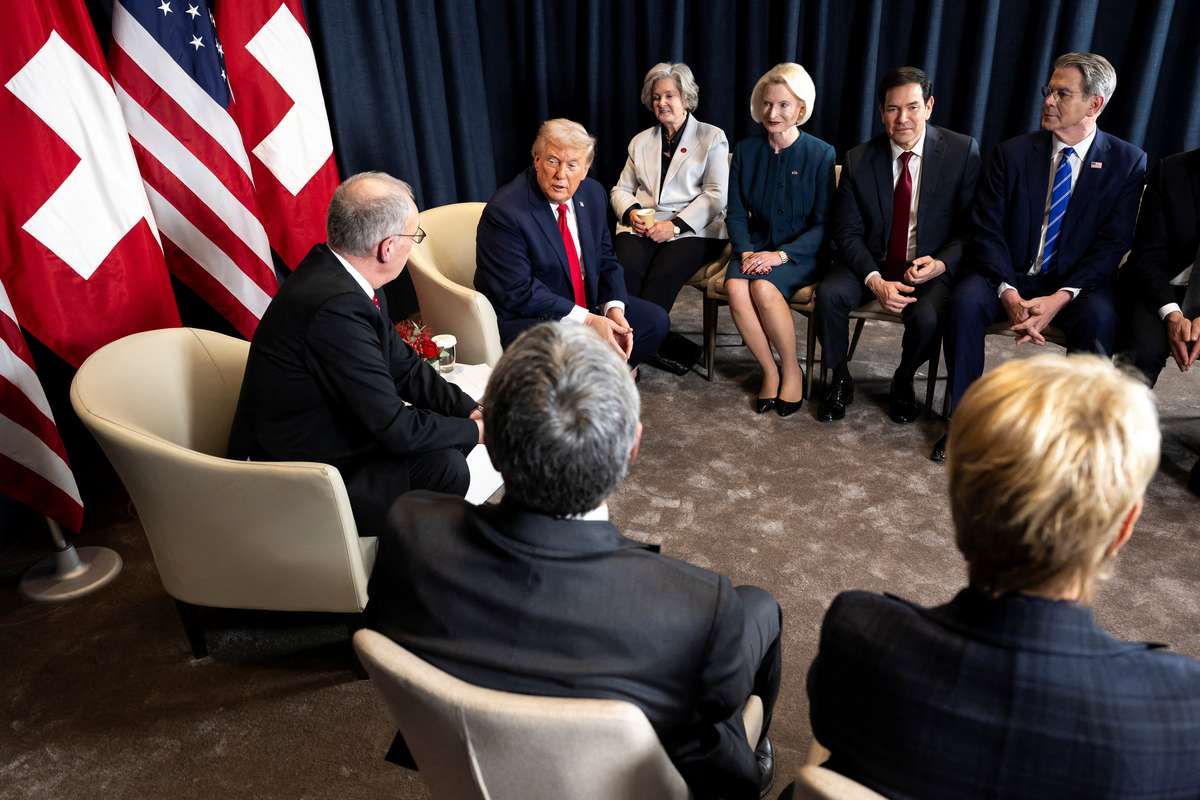
US President Donald Trump speaks with Switzerland’s Federal President Guy Parmelin next to Switzerland’s Foreign Minister Federal councillor Ignazio Cassis and Switzerland’s Economy Minister Federal councillor Karin Keller-Sutter and White House Chief of Staff Susie Wiles, the US Ambassador to Switzerland, Callista Gingrich, during to a bilateral meeting in Congress Centre on the sideline of the 56th annual meeting of the World Economic Forum, WEF, in Davos, Switzerland, Wednesday, January 21, 2026.
15:44 JST, January 23, 2026
WASHINGTON (AP) — Powered by strong consumer spending, the U.S. economy grew at the fastest pace in two years from July through September, the government said Thursday in a slight upgrade of its first estimate.
America’s gross domestic product — the nation’s output of goods and services — rose at a 4.4% annual pace in the third quarter, the Commerce Department reported Thursday, up from 3.8% in the April-June quarter and from the 4.3% growth the department initially estimated. The economy hasn’t grown faster since third-quarter 2023.
Consumer spending, which accounts for 70% of U.S. GDP, grew at a healthy 3.5% pace. Spending on services such as healthcare rose 3.6% versus a 3% uptick on goods spending, including an increase of just 1.6% on so-called durable goods such as cars that are meant to last at least three years. A surge in exports and a drop in imports also contributed to robust third-quarter growth.
Business investment (excluding homebuilding) rose at a 3.2% clip, partly reflecting bets on artificial intelligence.
The economy has remained resilient despite uncertainty caused by President Donald Trump’s economic policies, particularly his double-digit taxes on imports from almost every country on Earth.
Despite the strong growth numbers, many Americans are dissatisfied with the state of the economy and especially the high cost of living.
The gap between how consumers say they feel and the strong spending numbers might reflect what is known as a “ K-shaped economy.” Wealthier Americans are spending more, their incomes boosted by market gains and growing investments, while lower-income households struggle with stagnant pay and high prices.
The job market also looks a lot weaker than the overall economy. Employers have added a lackluster 28,000 jobs a month since March. In the 2021-2023 hiring boom that followed COVID-19 lockdowns, by contrast, they were creating 400,000 jobs a month. Still, the unemployment rate remains low at 4.4%, suggesting a no-hire, no-fire labor market with companies hesitant to bring on new employees but reluctant to let go of the ones they have.
“The United States is experiencing a jobless boom where strong growth is powered by AI investments and consumption by wealthier families, but there is almost no hiring,” said Heather Long, chief economist at Navy Federal Credit Union. “It’s an uneasy situation for many middle-class families. One of the big questions for 2026 is whether the middle class will start to feel the uplift from the boom.”







Most Read
Most read in the last 24 hours
-

Shifts Startup Focus to Nurturing Global Winners
-

Princess Aiko Enjoys Imperial Court Music, Dance; Production, Cos...
-

Bibimbap with Spring Vegetables and Asari Clam Miso a Rich Taste ...
-

Mother Supports My Sister Too Much, Gives Her Kids Much More Than...
-

Umami History: Kyoto Chef Murata Worked to Share Japan’s Scientif...
-

Appeal of Japanese Food: Make Good Use of ‘Discoveries’ by People...
-
Official App to Help Startups Meet Other Participants
-

Okinawa Gubernatorial Election: Candidates Should Advocate Realis...
Most read in the last 7 days
-
Earthquake Hits Japan's Tohoku Region; 3-meter Tsunami Warning Is...
-
China, South Korea Object to Japanese PM Takaichi's Ritual Offeri...
-

Trump Extends the Ceasefire with Iran but Keeps the Blockade
-

India's Arms Indigenization Quest for Self-Reliance / New Delhi S...
-

¥1,000 Coins to Be Issued to Mark Anniversary of Beginning of Jap...
-

Most Serious Cyberattacks against the UK Now from Russia, Iran an...
-

Trump Opposes United–American Merger, Signals Support for Spirit
-

System Malfunction in Haneda Airport Causes 83 Flight Cancelation...
Most read in the last 30 days
-
Earthquake Hits Japan's Tohoku Region; 3-meter Tsunami Warning Is...
-

Police Find Child's Shoe During Search for Missing Boy in Nantan,...
-

Body Found in Nantan, Kyoto Prefecture, During Search for 11-Year...
-
China, South Korea Object to Japanese PM Takaichi's Ritual Offeri...
-

Cherry Blossoms, Rapeseed Flowers Perform Colorful ‘Duet’ in Niig...
-
Trump Extends the Ceasefire with Iran but Keeps the Blockade
-

Olympic Gold Medal-Winning Figure Skaters Riku-Ryu Announce Retir...
-
Japanese Prime Minister Takaichi Speaks to Pakistani Prime Minist...
Top Articles in News Services
-
Trump Extends the Ceasefire with Iran but Keeps the Blockade
-
Most Serious Cyberattacks against the UK Now from Russia, Iran and China, Cyber Chief Says
-
Trump Opposes United–American Merger, Signals Support for Spirit
-

Florida Launches Criminal Probe into OpenAI and ChatGPT over Deadly Shooting
-

Trump Picks a University of Minnesota Professor to Lead His Economic Council
JN ACCESS RANKING
-
Earthquake Hits Japan’s Tohoku Region; 3-meter Tsunami Warning Issued (Update 1)
-
Police Find Child’s Shoe During Search for Missing Boy in Nantan, Kyoto Prefecture
-
Body Found in Nantan, Kyoto Prefecture, During Search for 11-Year-Old Boy in Area (Update 1)
-
China, South Korea Object to Japanese PM Takaichi’s Ritual Offering to Yasukuni Shrine
-
Cherry Blossoms, Rapeseed Flowers Perform Colorful ‘Duet’ in Niigata
Most read in the last 24 hours
-
Shifts Startup Focus to Nurturing Global Winners
-
Princess Aiko Enjoys Imperial Court Music, Dance; Production, Cos...
-
Bibimbap with Spring Vegetables and Asari Clam Miso a Rich Taste ...
-
Mother Supports My Sister Too Much, Gives Her Kids Much More Than...
-
Umami History: Kyoto Chef Murata Worked to Share Japan’s Scientif...
Most read in the last 7 days
-
Earthquake Hits Japan's Tohoku Region; 3-meter Tsunami Warning Is...
-
China, South Korea Object to Japanese PM Takaichi's Ritual Offeri...
-
Trump Extends the Ceasefire with Iran but Keeps the Blockade
-
India's Arms Indigenization Quest for Self-Reliance / New Delhi S...
-
¥1,000 Coins to Be Issued to Mark Anniversary of Beginning of Jap...
Most read in the last 30 days
-
Earthquake Hits Japan's Tohoku Region; 3-meter Tsunami Warning Is...
-
Police Find Child's Shoe During Search for Missing Boy in Nantan,...
-
Body Found in Nantan, Kyoto Prefecture, During Search for 11-Year...
-
China, South Korea Object to Japanese PM Takaichi's Ritual Offeri...
-
Cherry Blossoms, Rapeseed Flowers Perform Colorful ‘Duet’ in Niig...