
13:30 JST, December 16, 2025
Hong Kong newspaper founder Jimmy Lai, a leading figure in the city’s pro-democracy movement and an ardent critic of the Chinese Communist Party, was convicted Monday on three charges of sedition and collusion with foreign forces in a landmark national security ruling.
The case has become a symbolic test of Hong Kong’s 2020 national security law and its reach, exemplifying the Communist Party’s intense crackdown on the once-freewheeling territory.
The 855-page verdict, handed down by three government-approved judges, will be seen as further proof that Beijing has swept away any last remaining press freedoms and judicial independence in the city, essentially ruling that one man was responsible for a mass movement that saw almost a third of Hong Kong’s 7 million people take to the streets.
The 78-year-old Lai – who is a British citizen and does not hold any other citizenships, according to his family – has been in detention since December 2020, almost all of it in solitary confinement, and could spend the rest of his life in jail. The sentence is expected at a later date, with hearings beginning Jan. 12.
He was accused of using his Apple Daily media outlet to call for sanctions on Hong Kong and Chinese officials as punishment for cracking down on pro-democracy demonstrations in 2019. He was also accused of funding international campaigns to garner support for such sanctions.
Dozens of supporters slept outside the courthouse overnight in the hopes of attending the hearing. A police van carrying Lai arrived at West Kowloon Magistrates’ Court before 7:30 a.m. local time, and members of Lai’s family, accompanied by Cardinal Joseph Zen, who served as bishop of Hong Kong until 2009, were seen entering the court.
Armed police from Hong Kong’s counterterrorism unit patrolled nearby, according to local media.
In their decision Monday, the judges ruled that there was “indisputable evidence” that Lai conspired to undermine national security. His “only intent” was to seek the downfall of the Chinese Communist Party, for which Lai had shown “deep resentment and hatred,” Judge Esther Toh told the court.
Much of the case against Lai hung on his efforts to lobby governments in Taiwan, Britain, Japan and the United States to impose “sanctions, blockades or hostile activities” against Hong Kong after the city’s national security law took effect in June 2020.
The judges named a number of foreign individuals and entities they believed help Lai in his efforts, particularly one of his former staffers, American citizen Mark Simon, whom they described as a “mysterious character” who set up meetings with U.S. officials and lobbied in Washington for sanctions against Hong Kong.
In their verdict, the judges said there was no doubt in their minds that Lai intended to “destabilize the governance” of the Chinese Communist Party. He was repeatedly portrayed as a “mastermind” who controlled young activists and longtime pro-democracy champions in Hong Kong as well as entities abroad, a characterization that those individuals and organizations say does not reflect reality.
Among those accused alongside Lai was the Inter-Parliamentary Alliance on China, a global alliance of lawmakers across the political spectrum critical of Beijing. IPAC, in a statement Monday, said that Lai was “falsely accused” of participating in its activities, and that it repeatedly offered evidence to the court to refute those claims.
“The authorities chose to ignore these offers, preferring fabrication over fact,” the statement said.
‘A warning shot’
Press watchdogs, human rights groups and Lai’s family decried the decision as evidence of the city’s eroding freedoms and as an attempt to send a message to others calling for democracy.
“My family and I are saddened but not surprised by the guilty verdict in my father’s case,” said his son Sebastien Lai. “We have always known that my father was being prosecuted solely for his courageous journalism and unwavering commitment to democracy.”
Samuel Chu, president of the Campaign for Hong Kong, a Washington-based advocacy group, called the verdict “a warning shot to journalists, publishers, lawyers, and civil society everywhere in Hong Kong.” A day before the verdict, Hong Kong’s last remaining opposition party, the Democratic Party, voted to disband, one of the many groups that have disappeared in recent years as Beijing has remade the city.
Lai’s activities before the 2020 national security law took effect were meant to be excluded from the case, but activists noted that such actions made up a substantial portion of the verdict. Those activities – lobbying foreign governments – were not illegal until that law.
“When a person’s beliefs, associations and past speech become the evidence through which guilt is inferred, the law is no longer judging acts,” Chu said. “It is judging a life.”
Sebastien Lai said the prosecutors had tried to paint his father, a devout Catholic, as a violent person motivated by money. “But all they have uncovered is that he is a peaceful man who stands by his principles,” Sebastien Lai told The Washington Post before the verdict was released.
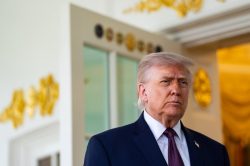
Before his election in November 2024, President Donald Trump pledged to free Lai: “100 percent I’ll get him out. He’ll be easy to get out,” Trump said in a podcast with Hugh Hewitt in October of last year. Trump raised concerns with Chinese leader Xi Jinping during their first face-to-face meeting of Trump’s second term, held in South Korea in October of this year, according to a report by Reuters.
Trump on Monday told reporters he had asked Xi to free Lai. “I feel so badly. I spoke to President Xi about it, and I asked to consider his release. He’s not well. He’s an older man and he’s not well, so I did put that request out. We’ll see what happens,” said Trump, who is expected to visit China in April.
During his trial, Lai said he had never met, spoken to or exchanged messages with Trump, but confirmed while giving testimony late last year that he had hoped the U.S. president could stop Hong Kong’s national security law from taking effect in 2020.
That year, Beijing imposed the national security law on Hong Kong, loosely defining terms including “inciting subversion” and “collusion” and allowing sentences of life in prison. Over the five years since, media outlets and civil organizations have been disbanded and critics of the government have gone silent.
Almost every prominent opposition figure in Hong Kong is either in jail or in exile now.
In addition to the national security charges, Lai has faced a raft of other charges. At the end of 2022, he was sentenced to more than five years in prison for violating terms of a lease contract, a punishment that human rights activists called “incredibly heavy.” He was also handed a prison term for attending an “unauthorized assembly” in 2021.
Lai pleaded not guilty to all charges and was denied bail, meaning he was held in custody during the repeated delays to his trial.
Lai’s daughter Claire Lai this month told The Post that her father has lost significant weight, is experiencing heart problems and is not receiving proper medical care in detention. The Hong Kong government rejected the allegations and said that Lai has received appropriate treatment.
“This verdict proves that the authorities still fear our father, even in his weakened state, for what he represents,” Claire Lai said Monday.
Claire Lai and Jonathan Price, a member of Lai’s international legal team, were in Washington on Monday but declined to comment on whether they were meeting with U.S. administration officials. “We are all extremely, extremely grateful for the support we have gotten from President Trump and his administration,” Claire Lai said at a news conference Monday in Washington.
Democracy advocate
Born in southern China in 1947, Lai arrived in Hong Kong as a 12-year-old stowaway and later founded the clothing brand Giordano. In 1989, he supported the Tiananmen Square pro-democracy protests by printing more than 200,000 T-shirts and banners, prompting Beijing to crack down on his business in China.
In 1995, he launched the pro-democracy newspaper Apple Daily, two years before Britain passed control of the territory back to China, although with the caveat that its freedoms under the “one country, two systems” framework must be respected for 50 years. The paper quickly became one of Hong Kong’s most-read publications and a thorn in Beijing’s side.
With calls for greater independence for Hong Kong growing during the 2000s, culminating in huge pro-democracy protests in 2019, Beijing swiftly moved to impose draconian controls in the territory, including on the media.
The shrinking civil liberties took a toll on the city’s annual Tiananmen vigil held at Victoria Park, which used to draw tens of thousands each year to remember those killed by the Chinese military on June 4, 1989. The park now hosts pro-China carnivals celebrating mainland culture around the anniversary date, while police arrest passersby who attempt to commemorate the incident.
Two months after the national security law took effect in 2020, 200 police officers raided Apple Daily’s headquarters, arresting Lai and several senior managers. Within a year, the newspaper was forced to shut down.
International condemnation
Lai’s trial has drawn condemnation from Western countries, including Britain, where he is a citizen. Supporters are now hoping that those countries will intervene to secure his release.
Yvette Cooper, Britain’s foreign secretary, condemned the “politically motivated prosecution” of Lai and called Monday for his immediate release.
British Prime Minister Keir Starmer raised Lai’s case during his meeting with Xi at the Group of 20 summit in November, saying that he was “concerned by reports of Jimmy Lai’s deterioration [of] health in prison.”
“The verdict provided final confirmation, although confirmation was not needed, that press freedom no longer exists in Hong Kong, and that the protections supposedly afforded by the Basic Law that uphold press freedom are effectively meaningless,” Jodie Ginsberg, CEO of the Committee to Protect Journalists, said at news conference Monday in Washington.
Secretary of State Marco Rubio in March told Hewitt, the podcast host, that getting Lai out of prison was “a priority.” “We’ve raised it in every possible form and they know that it’s important to us, and I think there are other countries as well that are very involved in raising this issue,” Rubio said.
In August 2020, under the first Trump administration, the U.S. placed sanctions on 11 Hong Kong and mainland officials, including current Chief Executive John Lee, for undermining Hong Kong’s autonomy.
“Today’s verdict is a stain on a once enviable Hong Kong legal system,” Caoilfhionn Gallagher, lead counsel of Lai’s international legal team, said in a statement Monday. “If China fails to release him immediately and unconditionally, the international community must hold China to account.”




Most Read
Most read in the last 24 hours
-
India’s Arms Indigenization Quest for Self-Reliance / Big Firms, ...
-
Shifts Startup Focus to Nurturing Global Winners
-
Princess Aiko Enjoys Imperial Court Music, Dance; Production, Cos...
-
Bibimbap with Spring Vegetables and Asari Clam Miso a Rich Taste ...
-

Mother Supports My Sister Too Much, Gives Her Kids Much More Than...
-
Umami History: Kyoto Chef Murata Worked to Share Japan’s Scientif...
-

Appeal of Japanese Food: Make Good Use of ‘Discoveries’ by People...
-
Official App to Help Startups Meet Other Participants
Most read in the last 7 days
-
Earthquake Hits Japan's Tohoku Region; 3-meter Tsunami Warning Is...
-
China, South Korea Object to Japanese PM Takaichi's Ritual Offeri...
-
Trump Extends the Ceasefire with Iran but Keeps the Blockade
-

India's Arms Indigenization Quest for Self-Reliance / New Delhi S...
-
¥1,000 Coins to Be Issued to Mark Anniversary of Beginning of Jap...
-
Most Serious Cyberattacks against the UK Now from Russia, Iran an...
-
Trump Opposes United–American Merger, Signals Support for Spirit
-
System Malfunction in Haneda Airport Causes 83 Flight Cancelation...
Most read in the last 30 days
-
Earthquake Hits Japan's Tohoku Region; 3-meter Tsunami Warning Is...
-
Police Find Child's Shoe During Search for Missing Boy in Nantan,...
-
Body Found in Nantan, Kyoto Prefecture, During Search for 11-Year...
-
China, South Korea Object to Japanese PM Takaichi's Ritual Offeri...
-
Cherry Blossoms, Rapeseed Flowers Perform Colorful ‘Duet’ in Niig...
-
Trump Extends the Ceasefire with Iran but Keeps the Blockade
-
Olympic Gold Medal-Winning Figure Skaters Riku-Ryu Announce Retir...
-
Japanese Prime Minister Takaichi Speaks to Pakistani Prime Minist...
Top Articles in News Services
-
Trump Extends the Ceasefire with Iran but Keeps the Blockade
-
Most Serious Cyberattacks against the UK Now from Russia, Iran and China, Cyber Chief Says
-
Trump Opposes United–American Merger, Signals Support for Spirit
-
Florida Launches Criminal Probe into OpenAI and ChatGPT over Deadly Shooting
-
Trump Picks a University of Minnesota Professor to Lead His Economic Council
JN ACCESS RANKING
-
Earthquake Hits Japan’s Tohoku Region; 3-meter Tsunami Warning Issued (Update 1)
-
Police Find Child’s Shoe During Search for Missing Boy in Nantan, Kyoto Prefecture
-
Body Found in Nantan, Kyoto Prefecture, During Search for 11-Year-Old Boy in Area (Update 1)
-
China, South Korea Object to Japanese PM Takaichi’s Ritual Offering to Yasukuni Shrine
-
Cherry Blossoms, Rapeseed Flowers Perform Colorful ‘Duet’ in Niigata
Most read in the last 24 hours
-
India’s Arms Indigenization Quest for Self-Reliance / Big Firms, ...
-
Shifts Startup Focus to Nurturing Global Winners
-
Princess Aiko Enjoys Imperial Court Music, Dance; Production, Cos...
-
Bibimbap with Spring Vegetables and Asari Clam Miso a Rich Taste ...
-
Mother Supports My Sister Too Much, Gives Her Kids Much More Than...
Most read in the last 7 days
-
Earthquake Hits Japan's Tohoku Region; 3-meter Tsunami Warning Is...
-
China, South Korea Object to Japanese PM Takaichi's Ritual Offeri...
-
Trump Extends the Ceasefire with Iran but Keeps the Blockade
-
India's Arms Indigenization Quest for Self-Reliance / New Delhi S...
-
¥1,000 Coins to Be Issued to Mark Anniversary of Beginning of Jap...
Most read in the last 30 days
-
Earthquake Hits Japan's Tohoku Region; 3-meter Tsunami Warning Is...
-
Police Find Child's Shoe During Search for Missing Boy in Nantan,...
-
Body Found in Nantan, Kyoto Prefecture, During Search for 11-Year...
-
China, South Korea Object to Japanese PM Takaichi's Ritual Offeri...
-
Cherry Blossoms, Rapeseed Flowers Perform Colorful ‘Duet’ in Niig...