
Govt to Abolish Support for New Mga Solar Plants in Reversal of Policy in Place Since 2011 Earthquake (Update 1)

Photovoltaic panels are seen near Kushiro Wetlands in Hokkaido in October.
7:07 JST, December 15, 2025
The government and the ruling Liberal Democratic Party starting in fiscal 2027 plan to abolish support for new large-scale solar power projects, it has been learned.
Environmental damage caused by mega solar power plants has become a societal issue, and terminating the support would mark a fundamental change in policy, which has promoted mega solar power plants since the 2011 Great East Japan Earthquake.
Under their envisioned plan, mega solar power plants with an output of 1,000 kilowatts or more, as well as ground-mounted solar power plants for commercial use with an output of 10 kilowatts or more, would become ineligible for the support program in which producers receive an amount higher than market price for electricity generated using renewable energy.
The LDP was to compile a set of proposals as early as Monday and will submit them to the government later. The government is considering holding a Cabinet meeting before the end of this year to decide whether to abolish the support system in fiscal 2027, according to sources.
The government plans to continue supporting roof-mounted commercial solar power equipment, which has less of an impact on the environment, as well as solar power equipment for household use.
A mega solar power plant is a large-scale power generation plant covered with photovoltaic panels. Such plants have been built in various parts of the country since the 2011 earthquake.
Following the accident at the Fukushima No. 1 nuclear power plant that year, the government, led by the now defunct Democratic Party of Japan, launched a renewable energy support program in fiscal 2012 as part of its policy of zero nuclear power. The program was introduced as a feed-in tariff (FIT) system, meaning utility companies purchased electricity generated by wind, solar and other renewable energy companies at a fixed price.
Since fiscal 2022, however, the FIT system has transitioned into a feed-in premium system, in which a subsidy is provided based on the unit price of electricity sold at market value and a portion of the purchase cost is passed on to consumers as a renewable energy surcharge.
To install the tens of thousands of solar panels found on large-scale solar farm, mountain forests are often felled, and this process has recently been facing criticism. The critics point to increased disaster risks of deforestation-related ecological destruction as well as landscape degradation. Disputes between local residents and mega solar power companies have occurred in such areas as Kushiroshitsugen National Park in Hokkaido and Kamogawa in Chiba Prefecture.
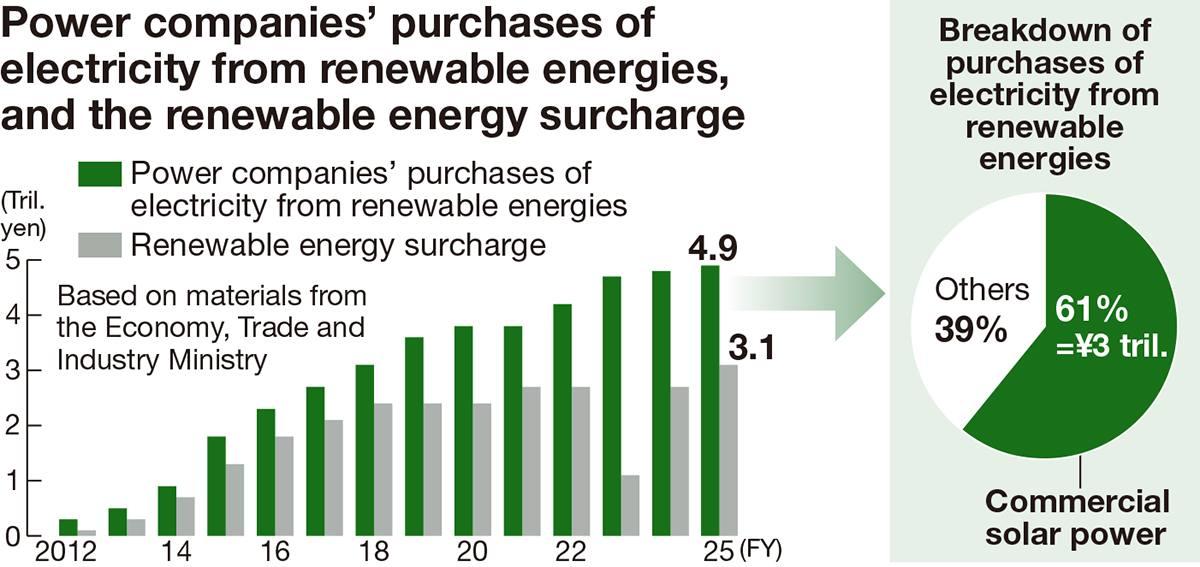
In fiscal 2025, power companies are expected to pay a total of ¥4.9 trillion for electricity generated from renewable energy sources. Payments for commercial solar power, including mega solar power projects, are expected to reach ¥3 trillion, or 60% of that figure. The renewable energy surcharge is expected to cover ¥3.1 trillion of the ¥4.9 trillion for electricity generated from renewable energy sources, .
The government will also expand the scope of its environmental impact assessment, a requirement before a mega solar company starts operating. Currently, the government requires companies with an output of 40,000 kilowatts or more to undergo the assessment, but that threshold will be lowered.






Most Read
Most read in the last 24 hours
-

India’s Arms Indigenization Quest for Self-Reliance / Big Firms, ...
-

Shifts Startup Focus to Nurturing Global Winners
-

Princess Aiko Enjoys Imperial Court Music, Dance; Production, Cos...
-

Bibimbap with Spring Vegetables and Asari Clam Miso a Rich Taste ...
-

Mother Supports My Sister Too Much, Gives Her Kids Much More Than...
-

Umami History: Kyoto Chef Murata Worked to Share Japan’s Scientif...
-

Appeal of Japanese Food: Make Good Use of ‘Discoveries’ by People...
-

Official App to Help Startups Meet Other Participants
Most read in the last 7 days
-
Earthquake Hits Japan's Tohoku Region; 3-meter Tsunami Warning Is...
-

China, South Korea Object to Japanese PM Takaichi's Ritual Offeri...
-

Trump Extends the Ceasefire with Iran but Keeps the Blockade
-

India's Arms Indigenization Quest for Self-Reliance / New Delhi S...
-

¥1,000 Coins to Be Issued to Mark Anniversary of Beginning of Jap...
-

Most Serious Cyberattacks against the UK Now from Russia, Iran an...
-

Trump Opposes United–American Merger, Signals Support for Spirit
-

System Malfunction in Haneda Airport Causes 83 Flight Cancelation...
Most read in the last 30 days
-
Earthquake Hits Japan's Tohoku Region; 3-meter Tsunami Warning Is...
-
Police Find Child's Shoe During Search for Missing Boy in Nantan,...
-

Body Found in Nantan, Kyoto Prefecture, During Search for 11-Year...
-
China, South Korea Object to Japanese PM Takaichi's Ritual Offeri...
-
Cherry Blossoms, Rapeseed Flowers Perform Colorful ‘Duet’ in Niig...
-
Trump Extends the Ceasefire with Iran but Keeps the Blockade
-

Olympic Gold Medal-Winning Figure Skaters Riku-Ryu Announce Retir...
-

Japanese Prime Minister Takaichi Speaks to Pakistani Prime Minist...
Top Articles in Politics
-
India’s Arms Indigenization Quest for Self-Reliance / New Delhi Sticks to Its ‘All-Alignment’ Guns Even after Iran Warship Attack
-

Japan Aims to Enhance Deterrence, Defense Industry by Allowing Exports of Weapons
-

Former Japan PM Murayama’s Farewell Ceremony Held; Former Deputy PM Kono Vows to ‘Carry on Path Toward Peace’
-

Japan Monitoring Situation Surrounding Revocation of Taiwan President’s Flight Permit by 3 Island Countries
-

Chinese Warships Cruise Past Japanese Islands in Retaliation for MSDF Ship Using Taiwan Strait
JN ACCESS RANKING
-
Earthquake Hits Japan’s Tohoku Region; 3-meter Tsunami Warning Issued (Update 1)
-
Police Find Child’s Shoe During Search for Missing Boy in Nantan, Kyoto Prefecture
-
Body Found in Nantan, Kyoto Prefecture, During Search for 11-Year-Old Boy in Area (Update 1)
-
China, South Korea Object to Japanese PM Takaichi’s Ritual Offering to Yasukuni Shrine
-
Cherry Blossoms, Rapeseed Flowers Perform Colorful ‘Duet’ in Niigata
Most read in the last 24 hours
-
India’s Arms Indigenization Quest for Self-Reliance / Big Firms, ...
-
Shifts Startup Focus to Nurturing Global Winners
-
Princess Aiko Enjoys Imperial Court Music, Dance; Production, Cos...
-
Bibimbap with Spring Vegetables and Asari Clam Miso a Rich Taste ...
-
Mother Supports My Sister Too Much, Gives Her Kids Much More Than...
Most read in the last 7 days
-
Earthquake Hits Japan's Tohoku Region; 3-meter Tsunami Warning Is...
-
China, South Korea Object to Japanese PM Takaichi's Ritual Offeri...
-
Trump Extends the Ceasefire with Iran but Keeps the Blockade
-
India's Arms Indigenization Quest for Self-Reliance / New Delhi S...
-
¥1,000 Coins to Be Issued to Mark Anniversary of Beginning of Jap...
Most read in the last 30 days
-
Earthquake Hits Japan's Tohoku Region; 3-meter Tsunami Warning Is...
-
Police Find Child's Shoe During Search for Missing Boy in Nantan,...
-
Body Found in Nantan, Kyoto Prefecture, During Search for 11-Year...
-
China, South Korea Object to Japanese PM Takaichi's Ritual Offeri...
-
Cherry Blossoms, Rapeseed Flowers Perform Colorful ‘Duet’ in Niig...