
Japan’s Ruling Bloc Submits Bill to Shrink Lower House, Drawing the Ire of the Opposition

Katsunobu Kato, center, head of the LDP’s Political System Reform Headquarters, and Yasuto Urano, left, acting head of the JIP’s Election Strategy Committee, submit a bill for shrinking the number of lower house seats, at the Diet on Friday.
15:44 JST, December 6, 2025
The Liberal Democratic Party and its coalition partner, the Japan Innovation Party, submitted a bill to reduce the number of House of Representatives seats on Friday. The core provision of the bill would cut at least 45 seats, or about 10% of the current total of 465 seats.
Specifics on how the cut will be made are to be negotiated between the ruling and opposition parties. If no conclusion is reached in a year, the bill says that a total of 45 seats will automatically be cut in the constituency and proportional representation segments.
The LDP and JIP intend to pass the bill during the current Diet session, which ends on Dec. 17, but opposition parties are strongly opposed.
The bill says the goal is a 10% reduction in the current number of seats, so that the total does not exceed 420 seats. Specifics such as how many seats are to be cut in each segment are to be discussed in a ruling-opposition consultative body.
The ruling parties want more than to merely discuss seat reduction; they hope to link this to reform of the current electoral system that combines single-seat constituencies with proportional representation.
The bill also includes a provision saying that if the ruling and opposition parties do not agree on concrete ways to reduce seats within a year, 25 seats will automatically be cut in single-seat constituencies and 20 in the proportional representation segment.
In that case, a government council on redistricting constituencies for lower house elections will begin drafting a revised electoral district plan and submit a recommendation to the government within a year.
On the other hand, if ruling and opposition parties reach a decision, legislation will be passed that incorporates the seat cut and the methods for the cut that are agreed on. And if constituencies need to be redrawn, the council will discuss this.
Considering the time that parties will need to come to an agreement and that the council will need to make its recommendation, it is expected to take more than two years to actually reduce the number of seats.
After submitting the bill on Friday, Katsunobu Kato, chairperson of the LDP’s political system reform headquarters, told reporters, “The number of seats and the electoral system have a fundamental relation to our democracy. We hope the law will be enacted through broad discussion.”
Yasuto Urano, acting chairperson of the JIP’s election strategy committee, said, “We want to thoroughly deliberate on the bill in this Diet session and get it passed.”
At a press conference also on Friday, Yoshihiko Noda, president of the Constitutional Democratic Party of Japan, agreed in principle with reducing the number of seats, but criticized the ruling coalition’s approach. “It’s not good to have the ruling bloc deciding on everything itself, including about the period [for making a decision] and the number of seats to be reduced,” he said. “We strongly object.”





Most Read
Popular articles in the past 24 hours
-

Voters Using AI to Choose Candidates in Japan's Upcoming General ...
-

Japan's Snow-Clad Beauty: Camellia Flowers Seen in Winter Bloom a...
-

Monkey Strikes Junior High School Girl from Behind in Japan's Yam...
-
Genichiro Inokuma's Mural in Ueno Station That Gave Hope in Postw...
-

Senior Japanese Citizens Return to University to Gain Knowledge, ...
-

Foreign and Security Policy: Political Parties Must Discuss How T...
-

Heavy Snow Linked to 30 Deaths across Japan since Late Jan.; JMA ...
-

Tokyo Police Arrest Head of Resignation Assistance Firm
Popular articles in the past week
-

Japan Institute to Use Domestic Commercial Optical Lattice Clock ...
-
Australian Woman Dies After Mishap on Ski Lift in Nagano Prefectu...
-
Foreign Snowboarder in Serious Condition After Hanging in Midair ...
-

Chinese Embassy in Japan Reiterates Call for Chinese People to Re...
-
Narita Airport, Startup in Japan Demonstrate Machine to Compress ...
-

Toyota Motor Group Firm to Sell Clean Energy Greenhouses for Stra...
-

Sakie Yokota, Last Surviving Parent of a North Korea Abductee, Ur...
-

Beer Yeast Helps Save Labor, Water Use in Growing Rice; Govt Hope...
Popular articles in the past month
-

Univ. in Japan, Tokyo-Based Startup to Develop Satellite for Disa...
-

JAL, ANA Cancel Flights During 3-day Holiday Weekend due to Blizz...
-
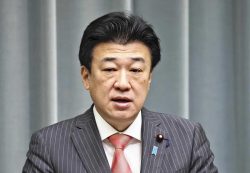
China Confirmed to Be Operating Drilling Vessel Near Japan-China ...
-

China Eyes Rare Earth Foothold in Malaysia to Maintain Dominance,...
-
M6.2 Earthquake Hits Japan's Tottori, Shimane Prefectures; No Tsu...
-
Japan Institute to Use Domestic Commercial Optical Lattice Clock ...
-

Japan, Qatar Ministers Agree on Need for Stable Energy Supplies; ...
-

Japan, Italy to Boost LNG Cooperation; Aimed at Diversifying Japa...
Top Articles in Politics
-

Japan Seeks to Enhance Defense Capabilities in Pacific as 3 National Security Documents to Be Revised
-

Japan Tourism Agency Calls for Strengthening Measures Against Overtourism
-

Japan’s Prime Minister: 2-Year Tax Cut on Food Possible Without Issuing Bonds
-

Japan-South Korea Leaders Meeting Focuses on Rare Earth Supply Chains, Cooperation Toward Regional Stability
-

Japanese Government Plans New License System Specific to VTOL Drones; Hopes to Encourage Proliferation through Relaxed Operating Requirements
JN ACCESS RANKING
-
Univ. in Japan, Tokyo-Based Startup to Develop Satellite for Disaster Prevention Measures, Bears
-
JAL, ANA Cancel Flights During 3-day Holiday Weekend due to Blizzard
-
China Confirmed to Be Operating Drilling Vessel Near Japan-China Median Line
-
China Eyes Rare Earth Foothold in Malaysia to Maintain Dominance, Counter Japan, U.S.
-
Japan Institute to Use Domestic Commercial Optical Lattice Clock to Set Japan Standard Time