
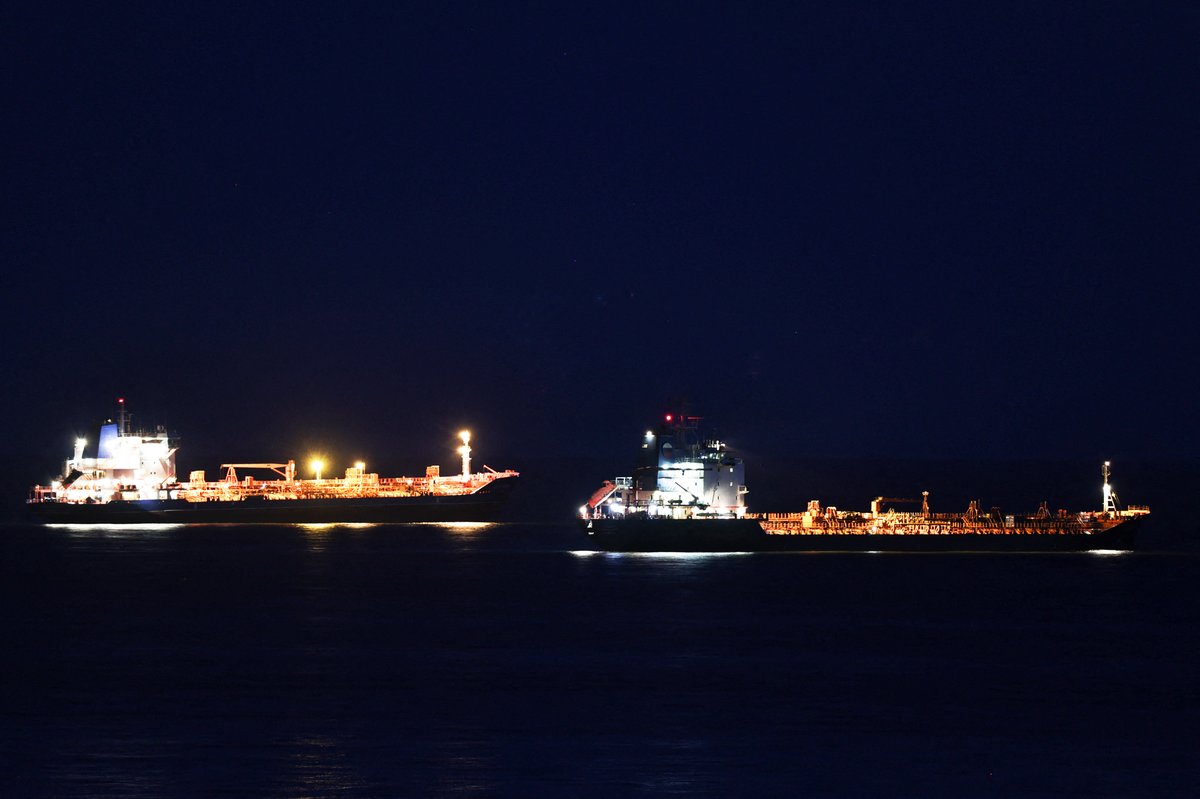
Oil product tankers sail along Nakhodka Bay near the port city of Nakhodka, Russia August 12, 2022.
11:34 JST, December 6, 2025
BRUSSELS/LONDON/OTTAWA, Dec 5 (Reuters) – The Group of Seven countries and the European Union are in talks to replace a price cap on Russian oil exports with a full maritime services ban in a bid to reduce the oil revenue that helps finance Russia’s war in Ukraine, six sources familiar with the matter said.
Russia exports over a third of its oil in Western tankers – mostly to India and China – with the use of Western shipping services. The ban would end that trade, which is mostly done through the fleets of EU maritime countries including Greece, Cyprus and Malta.
The other two thirds of exported Russian oil goes out in a fleet of hundreds of tankers operating outside Western scrutiny and maritime standards, known as the dark or shadow fleet. Russia would need to expand that fleet if the G7 and the EU impose the maritime services ban.
BAN COULD BE IN NEXT SANCTIONS PACKET
The ban could be part of the EU’s next package of sanctions against Russia, slated for early 2026, three out of the six sources told Reuters. The 27-nation EU would like to approve the ban together with a broader G7 agreement before proposing the ban in the package, two of the six sources said.
The sources declined to be named due to the sensitivity of the matter.
British and American officials are pushing forward the idea in technical G7 meetings, the sources said. Any final U.S. decision would depend on the pressure tactics President Donald Trump’s administration chooses amid ongoing peace talks it is brokering between Ukraine and Russia, four sources said.
While the G7 and EU have almost fully cut imports of Russian oil since 2022, the new measure would mark the closest they have ever come to a total ban on dealing with Russian crude and fuel not only at the level of imports but also transportation and maritime services.
The U.S. State Department, the White House, Cyprus’s shipping ministry, European Commission, Britain’s foreign office and Canada’s foreign ministry did not immediately respond to requests for comment. Greek government officials were not immediately available for comment.
The G7 imposed a price cap for Russian oil in 2022 after Russia invaded Ukraine to curb the Kremlin’s income while allowing third countries to buy Russian oil using Western services – but only if buyers paid Russia less than the price cap.
DODGING PRICE CAP
To avoid the cap, Russia re-routed much of its oil to Asia on its own ships, many of which have since been sanctioned by the West. These vessels are old, their ownership is opaque, and they sail without Western insurance cover.
The administration of former U.S. President Joe Biden argued that if Russia spent more money on tankers it would have less money for waging war in Ukraine.
The Trump administration has been more skeptical about the price cap and declined to support Britain, the EU and Canada when they agreed to lower the cap on crude from $60 per barrel to $47.6 per barrel in September 2025.
Russia exported 44% of its oil in sanctioned shadow-fleet tankers in October, according to analysis from the Finland-based independent Centre for Research on Energy and Clean Air.
Some 18% of oil sailed in non-sanctioned shadow fleet tankers while tankers with links to G7 countries, the EU and Australia transported 38% of Russian oil.
The overall fleet working with sanctioned oil from Russia, Iran and Venezuela encompasses 1,423 tankers, of which 921 are subject to U.S., UK or EU sanctions, according to maritime data specialist Lloyd’s List Intelligence.






Most Read
Popular articles in the past 24 hours
-

Voters Using AI to Choose Candidates in Japan's Upcoming General ...
-

Japan's Snow-Clad Beauty: Camellia Flowers Seen in Winter Bloom a...
-
Monkey Strikes Junior High School Girl from Behind in Japan's Yam...
-

Genichiro Inokuma's Mural in Ueno Station That Gave Hope in Postw...
-

Senior Japanese Citizens Return to University to Gain Knowledge, ...
-

Foreign and Security Policy: Political Parties Must Discuss How T...
-
Heavy Snow Linked to 30 Deaths across Japan since Late Jan.; JMA ...
-

Tokyo Police Arrest Head of Resignation Assistance Firm
Popular articles in the past week
-

Japan Institute to Use Domestic Commercial Optical Lattice Clock ...
-
Australian Woman Dies After Mishap on Ski Lift in Nagano Prefectu...
-
Foreign Snowboarder in Serious Condition After Hanging in Midair ...
-
Chinese Embassy in Japan Reiterates Call for Chinese People to Re...
-

Narita Airport, Startup in Japan Demonstrate Machine to Compress ...
-

Toyota Motor Group Firm to Sell Clean Energy Greenhouses for Stra...
-

Sakie Yokota, Last Surviving Parent of a North Korea Abductee, Ur...
-

Beer Yeast Helps Save Labor, Water Use in Growing Rice; Govt Hope...
Popular articles in the past month
-
Univ. in Japan, Tokyo-Based Startup to Develop Satellite for Disa...
-
JAL, ANA Cancel Flights During 3-day Holiday Weekend due to Blizz...
-
China Confirmed to Be Operating Drilling Vessel Near Japan-China ...
-

China Eyes Rare Earth Foothold in Malaysia to Maintain Dominance,...
-
M6.2 Earthquake Hits Japan's Tottori, Shimane Prefectures; No Tsu...
-
Japan Institute to Use Domestic Commercial Optical Lattice Clock ...
-
Japan, Qatar Ministers Agree on Need for Stable Energy Supplies; ...
-

Japan, Italy to Boost LNG Cooperation; Aimed at Diversifying Japa...
Top Articles in News Services
-
Arctic Sees Unprecedented Heat as Climate Impacts Cascade
-

Prudential Life Expected to Face Inspection over Fraud
-

South Korea Prosecutor Seeks Death Penalty for Ex-President Yoon over Martial Law (Update)
-
Trump Names Former Federal Reserve Governor Warsh as the Next Fed Chair, Replacing Powell
-
Japan’s Nagasaki, Okinawa Make N.Y. Times’ 52 Places to Go in 2026
JN ACCESS RANKING
-
Univ. in Japan, Tokyo-Based Startup to Develop Satellite for Disaster Prevention Measures, Bears
-
JAL, ANA Cancel Flights During 3-day Holiday Weekend due to Blizzard
-
China Confirmed to Be Operating Drilling Vessel Near Japan-China Median Line
-
China Eyes Rare Earth Foothold in Malaysia to Maintain Dominance, Counter Japan, U.S.
-
Japan Institute to Use Domestic Commercial Optical Lattice Clock to Set Japan Standard Time