
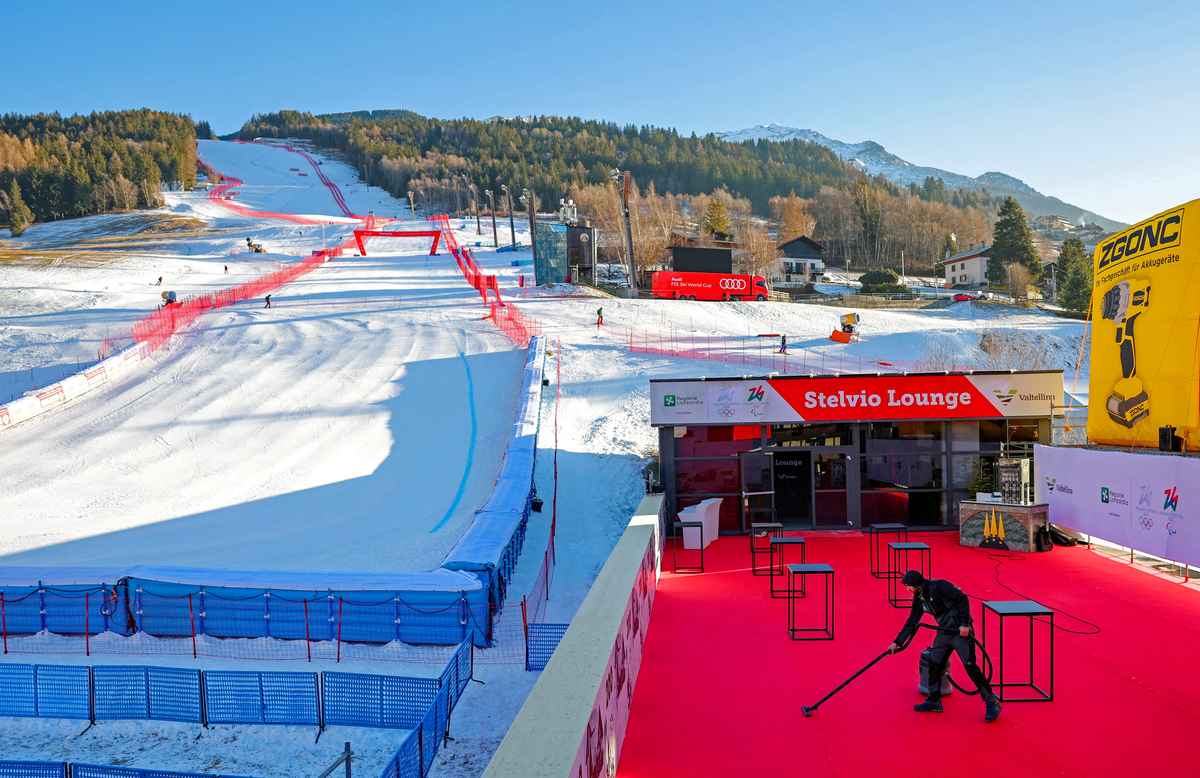
The finish area of the Stelvio track, a venue for the Winter Olympic Games 2026, is seen in Bormio, Italy, in December 2024.
17:39 JST, November 19, 2025
Melting glaciers and shrinking snow cover could have a devastating impact on Alpine skiing and snowboarding, but athletes can help drive the message about the need to address climate change, according to FIS chief Urs Lehmann.
“The ripple effect of climate change on every aspect of society is truly terrifying,” Lehmann, CEO of the International Ski and Snowboard Federation, said during an event held on Switzerland’s Great Aletsch Glacier.
“It turns out that the realm of snow sports — not only at a competitive level, but for all the communities that revolve around ski resorts — is among the first to experience this devastating impact directly.”
Lehmann was part of an FIS delegation that was joined by scientists and the World Meteorological Organisation (WMO) on Switzerland’s Jungfraujoch to raise awareness about the changing climate in Alpine regions.
According to Stefan Uhlenbrook, WMO Director of Hydrology, Water Resources and Cryosphere, the accelerating retreat of glaciers since the 1990s is already having serious impacts in Alpine skiing towns.
“Climate data for Switzerland shows a reduced number of days with snow cover, particularly in lower altitudes, making winter snow sport in these regions increasingly uncertain,” he said.
Data from Glacier Monitoring Switzerland said Swiss glaciers have lost one-quarter of their ice volume in the last 10 years.
While the outlook is gloomy, Lehmann said skiing and snowboarding can encourage action.
“There is only one way to do this in a credible and effective manner: through science and knowledge. That is what today is about,” he said during the event.
Twice world champion Alexandra Meissnitzer, now responsible for Special Projects at FIS, said that while athletes were not scientists, they had a role to play.
“Elite athletes are fully committed to results and performance, and it is easy to lose sight of the broader picture,” she said.
“This is why it is so important that the FIS–WMO partnership builds this bridge between snow sports and science.
“Athletes cannot contribute the scientific expertise required to tackle the climate crisis, but they can be a strong voice to drive awareness and action.”





Most Read
Popular articles in the past 24 hours
-

Voters Using AI to Choose Candidates in Japan's Upcoming General ...
-

Japan's Snow-Clad Beauty: Camellia Flowers Seen in Winter Bloom a...
-

Monkey Strikes Junior High School Girl from Behind in Japan's Yam...
-
Genichiro Inokuma's Mural in Ueno Station That Gave Hope in Postw...
-

Senior Japanese Citizens Return to University to Gain Knowledge, ...
-
Heavy Snow Linked to 30 Deaths across Japan since Late Jan.; JMA ...
-

Tokyo Police Arrest Head of Resignation Assistance Firm
-

Japan’s Nikkei Stock Average Jumps near 4%, Closes at Record High...
Popular articles in the past week
-

Japan Institute to Use Domestic Commercial Optical Lattice Clock ...
-
Australian Woman Dies After Mishap on Ski Lift in Nagano Prefectu...
-
Foreign Snowboarder in Serious Condition After Hanging in Midair ...
-
Chinese Embassy in Japan Reiterates Call for Chinese People to Re...
-

Narita Airport, Startup in Japan Demonstrate Machine to Compress ...
-

Toyota Motor Group Firm to Sell Clean Energy Greenhouses for Stra...
-

Sakie Yokota, Last Surviving Parent of a North Korea Abductee, Ur...
-

Beer Yeast Helps Save Labor, Water Use in Growing Rice; Govt Hope...
Popular articles in the past month
-
Univ. in Japan, Tokyo-Based Startup to Develop Satellite for Disa...
-
JAL, ANA Cancel Flights During 3-day Holiday Weekend due to Blizz...
-
China Confirmed to Be Operating Drilling Vessel Near Japan-China ...
-

China Eyes Rare Earth Foothold in Malaysia to Maintain Dominance,...
-
M6.2 Earthquake Hits Japan's Tottori, Shimane Prefectures; No Tsu...
-
Japan Institute to Use Domestic Commercial Optical Lattice Clock ...
-
Japan, Qatar Ministers Agree on Need for Stable Energy Supplies; ...
-

Japan, Italy to Boost LNG Cooperation; Aimed at Diversifying Japa...
Top Articles in Science & Nature
-
Univ. in Japan, Tokyo-Based Startup to Develop Satellite for Disaster Prevention Measures, Bears
-
Japan Institute to Use Domestic Commercial Optical Lattice Clock to Set Japan Standard Time
-

Space Mission Demonstrates Importance of International Cooperation, Astronaut Kimiya Yui Says
-
Japan to Face Shortfall of 3.39 Million Workers in AI, Robotics in 2040; Clerical Workers Seen to Be in Surplus
-
Japanese Astronaut Suwa to Stay Aboard ISS Until Around 2027; Japan’s 8th Astronaut to Have Long-Term Stay Aboard ISS
JN ACCESS RANKING
-
Univ. in Japan, Tokyo-Based Startup to Develop Satellite for Disaster Prevention Measures, Bears
-
JAL, ANA Cancel Flights During 3-day Holiday Weekend due to Blizzard
-
China Confirmed to Be Operating Drilling Vessel Near Japan-China Median Line
-
China Eyes Rare Earth Foothold in Malaysia to Maintain Dominance, Counter Japan, U.S.
-
Japan Institute to Use Domestic Commercial Optical Lattice Clock to Set Japan Standard Time