
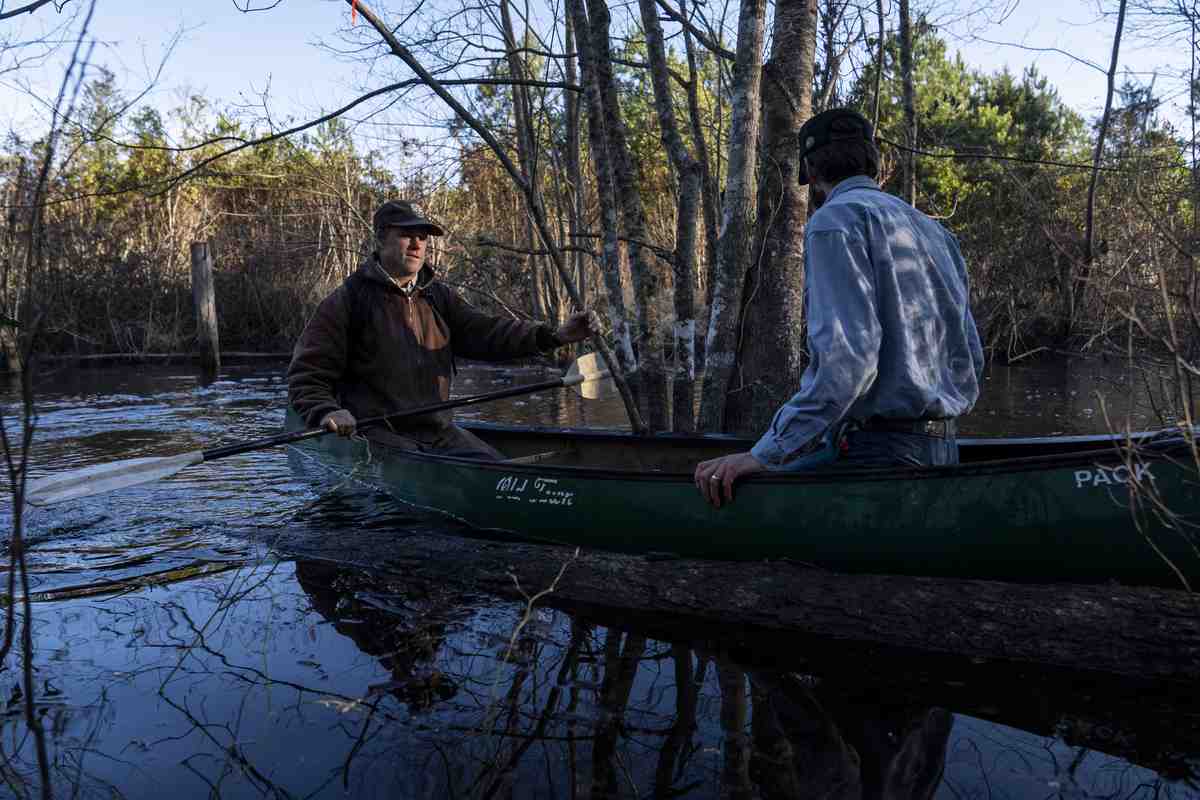
A hydrologist for the U.S. Fish and Wildlife Service and a wetland restoration specialist for the Nature Conservancy navigate the Great Dismal Swamp National Wildlife Refuge near South Mills, North Carolina, in March 2022.
13:42 JST, November 18, 2025
The Trump administration on Monday unveiled a rule that could significantly decrease the amount of federally protected wetlands, the latest chapter in a high-stakes policy fight that has played out over decades and has implications for communities across the nation.
The proposal would once again change the criteria for which waterways are subject to federal oversight – the details of which have been altered repeatedly in recent years amid legal challenges, a landmark Supreme Court ruling and changing administrations in Washington.
In announcing the changes to the rule, commonly known as “Waters of the United States,” the Environmental Protection Agency said it would focus on regulating mostly permanent bodies of water such as streams, oceans, rivers and lakes, while curtailing broader definitions of wetlands embraced by the Obama and Biden administrations. The result, the agency said in a release, would “cut red tape and provide predictability, consistency, and clarity” to farmers, ranchers, energy producers, and other U.S. landowners and developers.
“EPA has an important responsibility to protect water resources while setting clear and practical rules of the road that accelerate economic growth and opportunity,” the agency’s administrator, Lee Zeldin, said in a statement, in which he accused Democratic administrations of having “weaponized the definition of navigable waters” to impose oversight in more places.
The proposed changes, which will remain open for comment for 45 days, drew swift praise from business groups such as the National Association of Manufacturers.
The organization’s president, Jay Timmons, said in a statement that the shifting definitions of waters subject to regulation have “created legal uncertainty for manufacturers in the U.S., undermining our ability to invest and build across the country.” The new rule, he argued, would “bring certainty and predictability.”
But some environmental groups bristled at the changes, insisting that the result will be more water pollution and fewer critical wetlands in parts of the country.
“This proposed rule is unnecessary and damaging, and ignores the scientific reality of what is happening to our nation’s water supply,” Leda Huta, vice president of government relations for American Rivers, said in a statement. “It would likely make things worse for flood-prone communities and industries dependent on clean, reliable water. The EPA is taking a big swipe at the Clean Water Act, our greatest tool for ensuring clean water nationwide.”
Soon after President Donald Trump took office this year, his administration made clear that the long-fought-over rule was among the dozens of Biden-era climate and environmental regulations it was intent on dismantling or overhauling.
In March, Zeldin said the EPA planned to narrow the definition of U.S. waterways – including wetlands, rivers and streams – that receive federal protections under the Clean Water Act.
The Biden administration had sought to expand the scope of what was covered in an effort to protect all “waters of the United States” from pollutants such as livestock waste, construction runoff and industrial effluent.
But in 2023, the Supreme Court’s conservative majority weakened the EPA’s power to more broadly define its authority, ruling that the law “extends to only those wetlands with a continuous surface connection to bodies that are ‘waters of the United States’ in their own right.”
The latest proposal from the Trump administration attempts to more closely abide by that decision, and to leave more regulatory decisions about certain bodies of water in the hands of state and local officials.
It is an approach that environmentalists argue could remove millions of acres of waterways from federal oversight – and ultimately allow such critical landscapes to vanish.
“Without the protection of the federal Clean Water Act, these wetlands are much more vulnerable to being dug up and filled in and drained,” said Andrew Wetzler, senior vice president of nature at the Natural Resources Defense Council. “That’s really bad news for communities, and it’s really bad news for wildlife.”
In a detailed analysis this year, the NRDC found the 2023 Supreme Court decision, known as Sackett v. EPA, could remove federal protections from 60 to 95 percent of wetlands across the nation – a change that “would be deeply harmful to our nation’s waters,” the group wrote.
Monday’s proposed overhaul attempts to rectify previous versions of the rule under the Obama and Biden administrations, which critics argue represented an overreach by the federal government that sowed confusion among farmers, ranchers, home builders and other landowners.
Damien Schiff, a senior attorney at the Pacific Legal Foundation, a libertarian group that aims to fight government overreach, said the Trump administration’s proposal aligns far better with what the Supreme Court required under its Sackett decision. He said the latest rule would offer newfound clarity in situations around the country where it doesn’t exist today.
Schiff cited cases from North Carolina, Colorado and Idaho where landowners have run afoul of federal regulators for violating the Clean Water Act but have challenged the government’s determinations.
“I think the proposal will provide real relief to a lot of people,” he said, adding, “Is it going as far as it should? I don’t think so. But it is going a good long ways.”
Schiff also argued that having fewer wetlands with federal protection doesn’t necessarily “portend a disaster for water policy.” The Clean Water Act allows states to regulate wetlands, he said, and while some states have more robust oversight than others, “There’s no reason state and local governments could not fill that gap.”
Monday’s proposal marked the latest twist in a conflict that has stretched for several administrations over what U.S. waters are deserving of federal protection.
In 2015, the Obama administration significantly – and controversially – widened the scope of the Clean Water Act to cover even ephemeral streams that flow only after it rains. Trump sought to weaken the EPA’s water pollution authority during his first term.
The Clean Water Act makes it unlawful to pollute a “water of the United States” without a permit, but precisely what constitutes that sort of water been the subject of lengthy litigation even before the Obama era.
In a 2006 decision, Rapanos v. United States, the Supreme Court’s four most conservative justices at the time offered a constrained view that only “navigable waters” met this test. But Justice Anthony M. Kennedy, who refused to join the conservatives or the liberals on the court, said the government could intervene when there was a “significant nexus” between large water bodies and smaller ones.
The 2023 Supreme Court ruling in Sackett eliminated that test, instead finding that a standard promoted by Justice Antonin Scalia, who argued that the law should apply to wetlands connected to “relatively permanent” bodies of water, was more appropriate.
Since the beginning, environmental groups have argued that a broader definition of what constitutes a U.S. waterway is integral to safeguarding wetlands, protecting drinking-water supplies and maintaining wildlife habitats across the country.
But those who have opposed such a sweeping definition complain that legal confusion over what is covered and what isn’t creates regulatory chaos for farmers, ranchers, landowners and home developers.
Even Monday, despite the latest proposal, there were signs that the long-running fight will continue in some form.
Drew Caputo, a vice president of litigation for the environmental group Earthjustice, said in a statement that the Trump rollback would result in a “serious reduction” in legal protections for waters across the U.S. that have been protected for more than a half century.
“Earthjustice, along with our clients and partners, will carefully evaluate today’s proposal,” he said, “and not hesitate to go to court to protect the cherished rivers, lakes, streams, and wetlands that all Americans need and depend on.”






Most Read
Popular articles in the past 24 hours
-

Voters Using AI to Choose Candidates in Japan's Upcoming General ...
-

Japan's Snow-Clad Beauty: Camellia Flowers Seen in Winter Bloom a...
-
Monkey Strikes Junior High School Girl from Behind in Japan's Yam...
-

Genichiro Inokuma's Mural in Ueno Station That Gave Hope in Postw...
-

Senior Japanese Citizens Return to University to Gain Knowledge, ...
-

Foreign and Security Policy: Political Parties Must Discuss How T...
-
Heavy Snow Linked to 30 Deaths across Japan since Late Jan.; JMA ...
-

Tokyo Police Arrest Head of Resignation Assistance Firm
Popular articles in the past week
-

Japan Institute to Use Domestic Commercial Optical Lattice Clock ...
-
Australian Woman Dies After Mishap on Ski Lift in Nagano Prefectu...
-
Foreign Snowboarder in Serious Condition After Hanging in Midair ...
-

Chinese Embassy in Japan Reiterates Call for Chinese People to Re...
-

Narita Airport, Startup in Japan Demonstrate Machine to Compress ...
-

Toyota Motor Group Firm to Sell Clean Energy Greenhouses for Stra...
-

Sakie Yokota, Last Surviving Parent of a North Korea Abductee, Ur...
-

Beer Yeast Helps Save Labor, Water Use in Growing Rice; Govt Hope...
Popular articles in the past month
-

Univ. in Japan, Tokyo-Based Startup to Develop Satellite for Disa...
-
JAL, ANA Cancel Flights During 3-day Holiday Weekend due to Blizz...
-
China Confirmed to Be Operating Drilling Vessel Near Japan-China ...
-

China Eyes Rare Earth Foothold in Malaysia to Maintain Dominance,...
-
M6.2 Earthquake Hits Japan's Tottori, Shimane Prefectures; No Tsu...
-
Japan Institute to Use Domestic Commercial Optical Lattice Clock ...
-

Japan, Qatar Ministers Agree on Need for Stable Energy Supplies; ...
-
Japan, Italy to Boost LNG Cooperation; Aimed at Diversifying Japa...
Top Articles in News Services
-
Arctic Sees Unprecedented Heat as Climate Impacts Cascade
-

Prudential Life Expected to Face Inspection over Fraud
-

South Korea Prosecutor Seeks Death Penalty for Ex-President Yoon over Martial Law (Update)
-
Trump Names Former Federal Reserve Governor Warsh as the Next Fed Chair, Replacing Powell
-

Japan’s Nagasaki, Okinawa Make N.Y. Times’ 52 Places to Go in 2026
JN ACCESS RANKING
-
Univ. in Japan, Tokyo-Based Startup to Develop Satellite for Disaster Prevention Measures, Bears
-
JAL, ANA Cancel Flights During 3-day Holiday Weekend due to Blizzard
-
China Confirmed to Be Operating Drilling Vessel Near Japan-China Median Line
-
China Eyes Rare Earth Foothold in Malaysia to Maintain Dominance, Counter Japan, U.S.
-
Japan Institute to Use Domestic Commercial Optical Lattice Clock to Set Japan Standard Time