
Takaichi’s Summit with Economics-Minded Trump Successfully Advanced Japan’s Security Interests
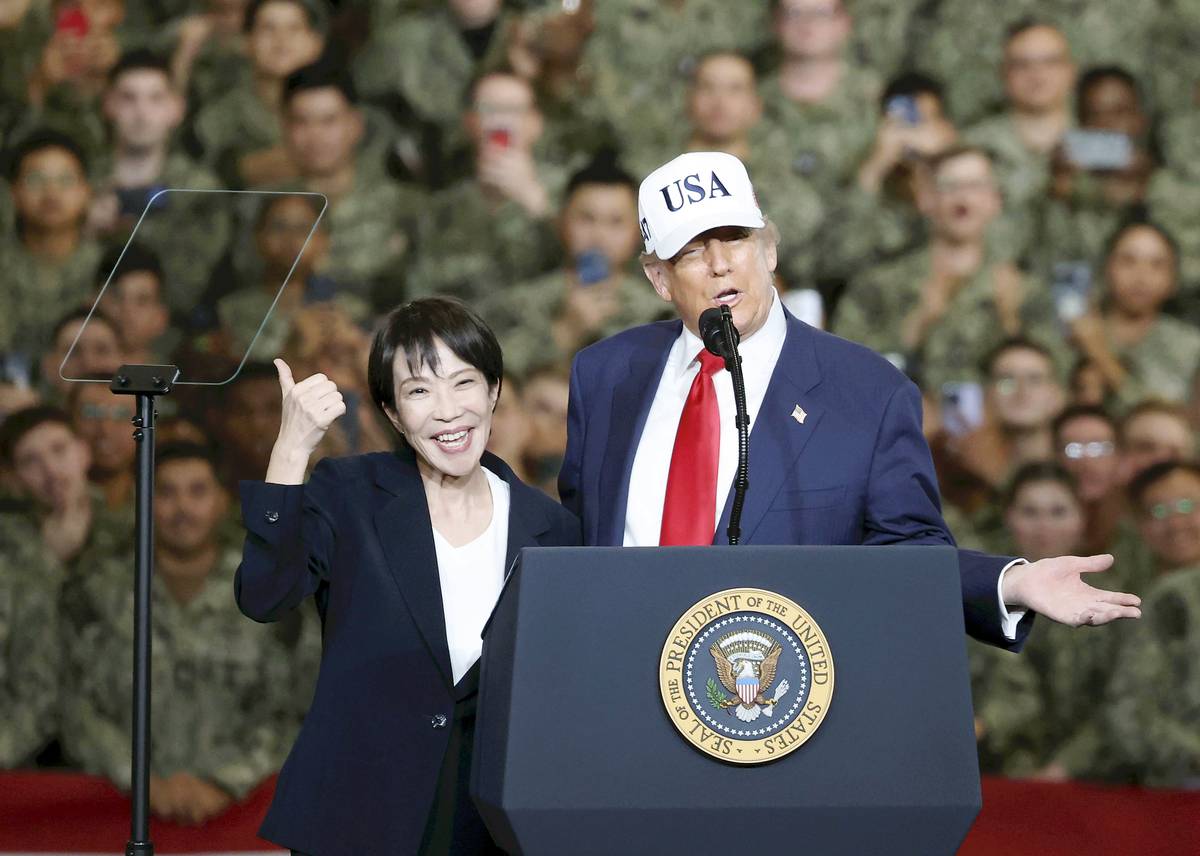
Prime Minister Sanae Takaichi, left, and U.S. President Donald Trump appear together aboard the USS George Washington nuclear-powered aircraft carrier in Yokosuka, Kanagawa Prefecture, on Oct. 28.
8:00 JST, November 15, 2025
Sanae Takaichi, who became Japan’s first female prime minister on Oct. 21, spent the first 12 days of her tenure racing through meetings with foreign leaders, including those of the United States and China. Takaichi’s diplomatic efforts are widely seen as successful. This is evident from her approval ratings in polls conducted after all the diplomatic events concluded, one of which put her approval as high as 82%. This approval rating immediately after her Cabinet’s formation ranks as the second highest on record, surpassed only by that of the Junichiro Koizumi Cabinet in 2001.
The highlight of this series of diplomatic engagements was likely the visit to Japan by President Donald Trump of the United States, Japan’s only ally. It was particularly symbolic when the president took the prime minister with him to deliver a speech together aboard the nuclear-powered aircraft carrier USS George Washington, deployed in Yokosuka, Kanagawa Prefecture. Trump emphasized, “The cherished alliance between the United States and Japan is one of the most remarkable relationships in the entire world.”
In response, Takaichi referred to Trump’s 2019 Yokosuka visit with then Prime Minister Shinzo Abe, whom she regarded as her political mentor, saying, “Now, as the two commanders-in-chief of Japan and the United States stand together once again, I have renewed my determination to carry forward that resolve and to make the Indo-Pacific free and open so that it will serve as the foundation of peace and prosperity for the entire region.”
Both Tokyo and Washington acknowledged Takaichi’s success. William Chou, a senior fellow at the Hudson Institute, a Washington-based think tank, stated: “It was a strong debut for Prime Minister Takaichi when she met with President Trump in Tokyo. Their shared policy similarities — strong defense, pro-growth economy, strong borders — and shared affection for former Prime Minister Abe suggested they would get along. But it was clear that the two shared personal chemistry, which bodes well for the working relationship going forward.”
However, after Trump visited South Korea following Japan and met with Chinese President Xi Jinping there, a sense of unease has emerged in Tokyo. This is because Trump described the U.S.-China summit as a “G2” meeting in two of his social media posts.
The term G2, short for “Group of 2,” was coined by U.S. economist C. Fred Bergsten in 2005. It primarily refers to the symbiotic relationship between the U.S. and China in economics and trade and later developed to include a geopolitical meaning. Japan’s heightened vigilance stems from the similarity to the concept of “a new type of great power relations” that Xi proposed during his 2013 meeting with then U.S. President Barack Obama. At the time, Xi told Obama, “The vast Pacific Ocean has enough space for the two large countries.” In 2023, Xi also stated in his meeting with then U.S. President Joe Biden, “The world is big enough to accommodate both countries.”
The true intent behind Trump’s description of U.S.-China relations as a “G2” remains unclear, and it may not be something that Japan should be too concerned about. But it is evident that China aims for a relationship in which the two nations recognize each other’s spheres of influence under a G2 framework. When Trump and Xi temporarily agreed at the summit to de-escalate their intensifying trade war, Xi stated, “China’s development does not contradict the vision of ‘Make America Great Again.’” This can be understood to express the same intent as his past remarks on “a new type of great power relations.”
In other words, when China refers to “coexistence” or “win-win” relations, it is intended to get the U.S. to recognize China’s own sphere of influence. Japan’s foreboding stems from fears of this ultimate scenario: the U.S. retreating from the Pacific region, including Japan, and the Indo-Pacific falling into China’s sphere of influence. This is a nightmare for Japan, especially as the United States, having sent “America First” champion Trump to the White House for a second time, is shifting its approach to the world.
The Japan-U.S. summit appeared to be a great success, but several elements were missing. A more traditional joint statement containing security policy references — such as reaffirmations of peace and stability in the Taiwan Strait and the application of the Japan-U.S. Security Treaty to the Senkaku Islands in Okinawa Prefecture — was not issued. Takaichi mentioned the “Free and Open Indo-Pacific (FOIP)” during the summit and the Japanese government announced “the two leaders affirmed their commitment to work closely together to strongly advance the FOIP,” but Trump did not mention it, at least not in public. Instead, the two leaders signed a document titled “Implementation of the Agreement Toward a NEW GOLDEN AGE for the U.S.-Japan Alliance,” which explicitly states: “The Agreement will help both countries to strengthen economic security, promote economic growth, and thereby continuously lead to global prosperity.” A joint statement by the leaders regarding the stable supply of rare earths was also released.
China’s export restrictions on rare earths are a hard-line policy introduced ahead of talks with Trump. While the Trump administration treats both allies and non-allies with almost equal severity in trade negotiations, Treasury Secretary Scott Bessent called on allies to “work together” on this issue. The sudden appeal for cooperation to allies it had previously treated with relative indifference demonstrates how China’s restrictions have unsettled the United States and made it feel the need for friends.
Shihoko Goto, director of the Asia Program at the Foreign Policy Research Institute, a Philadelphia-based think tank, commented on the recent talks aimed at easing U.S.-China tensions: “The trade war truce between China and the United States clearly shows that neither can dominate the other.” She added: “Looking ahead, Beijing’s industrial policy is expected to be focused on longer-term dominance in critical sectors that it can leverage as power … China’s economic security policy will focus on the dual circulation strategy of increasing domestic resilience on the one hand and boosting global dependence on China on the other.”
Trump is clearly placing greater emphasis on the economic side of relationships with nations around the world. In Trump’s eyes, allies and adversaries seem to be on equal footing when it comes to economic relations. In a recent Fox News interview, when asked to agree that China is not a friend, Trump stated, “Well, a lot of our allies aren’t our friends, either. Our allies took advantage of us on trade more than China did.” The president has adopted a more conciliatory stance toward China, which is America’s greatest competitor, to pursue economic benefits and avoid conflicts that could adversely affect the United States. Trump’s approach potentially suggests that for allies, becoming a good economic partner can lead to achieving the status of a better security partner.
Let’s not forget that as an outcome of this visit to Japan, the White House published a document titled “President Donald J. Trump Drives Forward Billions in Investments from Japan,” listing Japanese investments. This document further specified the investment commitments already agreed upon with Japan. The Japanese government did not domestically promote this document. This clearly shows that both leaders had different objectives for this summit. Without economic satisfaction, Trump would not have taken Takaichi aboard a U.S. aircraft carrier.
Mira Rapp-Hooper, the senior director for East Asia and Oceania at the National Security Council in the Biden administration and currently a partner at The Asia Group, said: “Prime Minister Takaichi has a huge charge – to inject dynamism into Japan’s economy and advance its national security all alongside a less predictable United States. In her first visit with President Trump, she performed admirably, protecting Japan’s interests while building a personal relationship with her counterpart. The economic demands of the moment may prove to be her biggest challenge. If she can handle these with the deftness, she has shown in her early weeks she has the chance to be a prime minister of significant impact.”
This time, Takaichi skillfully navigated the talks. The sight of Trump and Takaichi both delivering speeches aboard a U.S. aircraft carrier during this visit spoke more eloquently about U.S. commitment than repeated assertions about the FOIP. Japan’s primary objective going forward is to demonstrate that it remains a valuable economic partner contributing to U.S. prosperity. This will help build a relationship that sustains de facto U.S. engagement with the region, even if Trump does not explicitly mention it. Indeed, the greatest challenge for Takaichi is not in diplomacy but in successfully implementing an economic growth strategy that revitalizes Japan’s long-stagnant economy. Achieving what even her role model, Shinzo Abe, failed to accomplish will be the key to her true success.
Political Pulse appears every Saturday.
Yuko Mukai
Yuko Mukai is a Washington correspondent of The Yomiuri Shimbun.


Related Tags

Most Read
Popular articles in the past 24 hours
-

Japan's Snow-Clad Beauty: Camellia Flowers Seen in Winter Bloom a...
-
Monkey Strikes Junior High School Girl from Behind in Japan's Yam...
-
Genichiro Inokuma's Mural in Ueno Station That Gave Hope in Postw...
-

Foreign and Security Policy: Political Parties Must Discuss How T...
-
Senior Japanese Citizens Return to University to Gain Knowledge, ...
-

Heavy Snow Linked to 30 Deaths across Japan since Late Jan.; JMA ...
-
Tokyo Police Arrest Head of Resignation Assistance Firm
-
Japan’s Nikkei Stock Average Jumps near 4%, Closes at Record High...
Popular articles in the past week
-

Japan Institute to Use Domestic Commercial Optical Lattice Clock ...
-
Australian Woman Dies After Mishap on Ski Lift in Nagano Prefectu...
-
Foreign Snowboarder in Serious Condition After Hanging in Midair ...
-
Chinese Embassy in Japan Reiterates Call for Chinese People to Re...
-
Narita Airport, Startup in Japan Demonstrate Machine to Compress ...
-
Toyota Motor Group Firm to Sell Clean Energy Greenhouses for Stra...
-
Sakie Yokota, Last Surviving Parent of a North Korea Abductee, Ur...
-
Beer Yeast Helps Save Labor, Water Use in Growing Rice; Govt Hope...
Popular articles in the past month
-
Univ. in Japan, Tokyo-Based Startup to Develop Satellite for Disa...
-
JAL, ANA Cancel Flights During 3-day Holiday Weekend due to Blizz...
-
China Confirmed to Be Operating Drilling Vessel Near Japan-China ...
-

China Eyes Rare Earth Foothold in Malaysia to Maintain Dominance,...
-
M6.2 Earthquake Hits Japan's Tottori, Shimane Prefectures; No Tsu...
-
Japan Institute to Use Domestic Commercial Optical Lattice Clock ...
-
Japan, Qatar Ministers Agree on Need for Stable Energy Supplies; ...
-
Japan, Italy to Boost LNG Cooperation; Aimed at Diversifying Japa...
Top Articles in Editorial & Columns
-
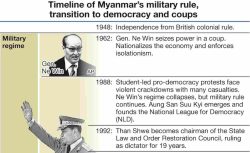
Myanmar Will Continue Under Military Rule Even After Election, Ex-Ambassador Maruyama Says in Exclusive Interview
-
40 Million Foreign Visitors to Japan: Urgent Measures Should Be Implemented to Tackle Overtourism
-

Expansion of New NISA: Devise Ways to Build up Household Assets
-
China Criticizes Sanae Takaichi, but China Itself Is to Blame for Worsening Relations with Japan
-
Withdrawal from International Organizations: U.S. Makes High-handed Move that Undermines Multilateral Cooperation
JN ACCESS RANKING
-
Univ. in Japan, Tokyo-Based Startup to Develop Satellite for Disaster Prevention Measures, Bears
-
JAL, ANA Cancel Flights During 3-day Holiday Weekend due to Blizzard
-
China Confirmed to Be Operating Drilling Vessel Near Japan-China Median Line
-
China Eyes Rare Earth Foothold in Malaysia to Maintain Dominance, Counter Japan, U.S.
-
Japan Institute to Use Domestic Commercial Optical Lattice Clock to Set Japan Standard Time