
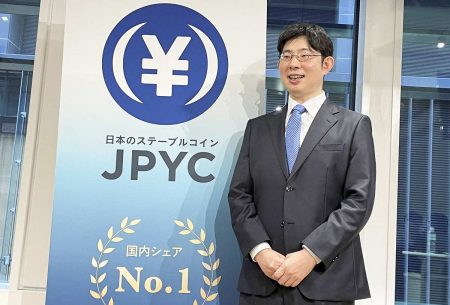
Noritaka Okabe, head of Japanese startup JPYC, poses for a picture during a news conference about the launch of its stable coin pegged to the yen, first in the world, in Tokyo, Japan, October 27, 2025.
18:00 JST, November 12, 2025
TOKYO (Reuters) — Stablecoin issuers could become major buyers of Japanese government bonds in several years and influence the central bank’s control over monetary policy, the head of Japan’s first domestic issuer of yen-pegged stablecoins told Reuters.
Japanese startup JPYC began issuing stablecoins pegged to the yen — also called JPYC — on Oct. 27 in a significant move in a country where many consumers still prefer traditional payment methods such as cash and credit cards.
The company has rolled out about ¥143 million worth of JPYC so far with the number of account holders hitting 4,707 as of Nov. 12. It has said it aims to issue ¥10 trillion ($66.32 billion) worth of JPYC over three years.
While still a drop in the ocean of a $290-billion stablecoin market, JPYC will help the yen hold a presence in a rapidly growing digital market where stablecoins pegged to the U.S. dollar make up 99% of global supply, the company’s CEO Noritaka Okabe said in an interview on Tuesday.
“Various assets are now traded on blockchains real-time across the world. But the stablecoin market is dominated by the dollar, which is a disadvantage to Japanese firms that need to pay extra hedging and transaction costs,” he said on Tuesday.
“Japan must ensure the yen has a presence in the global stablecoin market,” Okabe said.
Blockchain-based stablecoins are typically pegged to a fiat currency and offer faster and cheaper transactions.
JPYC is fully convertible to the yen and backed by domestic savings and Japanese government bonds (JGBs). The company plans to invest 80% of its proceeds in JGBs and 20% in bank savings.
Given the rapid growth of stablecoins, issuers of the assets could become major buyers of bonds and in Japan help fill a hole left by the diminishing presence of the BOJ, Okabe said.






Most Read
Popular articles in the past 24 hours
-

Voters Using AI to Choose Candidates in Japan's Upcoming General ...
-

Japan's Snow-Clad Beauty: Camellia Flowers Seen in Winter Bloom a...
-
Monkey Strikes Junior High School Girl from Behind in Japan's Yam...
-
Genichiro Inokuma's Mural in Ueno Station That Gave Hope in Postw...
-
Senior Japanese Citizens Return to University to Gain Knowledge, ...
-

Foreign and Security Policy: Political Parties Must Discuss How T...
-
Heavy Snow Linked to 30 Deaths across Japan since Late Jan.; JMA ...
-
Tokyo Police Arrest Head of Resignation Assistance Firm
Popular articles in the past week
-

Japan Institute to Use Domestic Commercial Optical Lattice Clock ...
-
Australian Woman Dies After Mishap on Ski Lift in Nagano Prefectu...
-
Foreign Snowboarder in Serious Condition After Hanging in Midair ...
-
Chinese Embassy in Japan Reiterates Call for Chinese People to Re...
-
Narita Airport, Startup in Japan Demonstrate Machine to Compress ...
-

Toyota Motor Group Firm to Sell Clean Energy Greenhouses for Stra...
-
Sakie Yokota, Last Surviving Parent of a North Korea Abductee, Ur...
-

Beer Yeast Helps Save Labor, Water Use in Growing Rice; Govt Hope...
Popular articles in the past month
-
Univ. in Japan, Tokyo-Based Startup to Develop Satellite for Disa...
-
JAL, ANA Cancel Flights During 3-day Holiday Weekend due to Blizz...
-
China Confirmed to Be Operating Drilling Vessel Near Japan-China ...
-

China Eyes Rare Earth Foothold in Malaysia to Maintain Dominance,...
-
M6.2 Earthquake Hits Japan's Tottori, Shimane Prefectures; No Tsu...
-
Japan Institute to Use Domestic Commercial Optical Lattice Clock ...
-
Japan, Qatar Ministers Agree on Need for Stable Energy Supplies; ...
-

Japan, Italy to Boost LNG Cooperation; Aimed at Diversifying Japa...
Top Articles in News Services
-
Arctic Sees Unprecedented Heat as Climate Impacts Cascade
-

Prudential Life Expected to Face Inspection over Fraud
-

South Korea Prosecutor Seeks Death Penalty for Ex-President Yoon over Martial Law (Update)
-

Trump Names Former Federal Reserve Governor Warsh as the Next Fed Chair, Replacing Powell
-

Japan’s Nagasaki, Okinawa Make N.Y. Times’ 52 Places to Go in 2026
JN ACCESS RANKING
-
Univ. in Japan, Tokyo-Based Startup to Develop Satellite for Disaster Prevention Measures, Bears
-
JAL, ANA Cancel Flights During 3-day Holiday Weekend due to Blizzard
-
China Confirmed to Be Operating Drilling Vessel Near Japan-China Median Line
-
China Eyes Rare Earth Foothold in Malaysia to Maintain Dominance, Counter Japan, U.S.
-
Japan Institute to Use Domestic Commercial Optical Lattice Clock to Set Japan Standard Time