
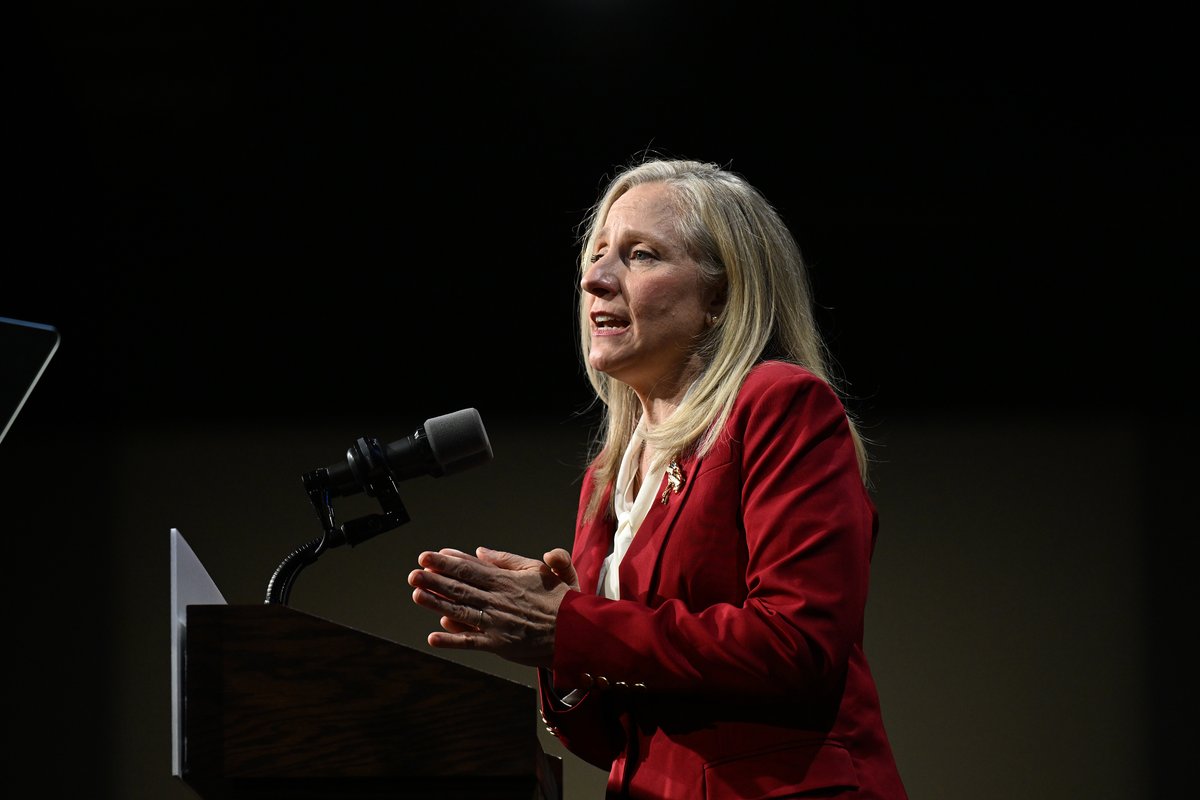
Abigail Spanberger addresses the crowd Tuesday at an election night event in Richmond before she was declared the winner of the Virginia governor’s race.
12:20 JST, November 10, 2025
RICHMOND – More than three decades after she last ran for office, Mary Sue Terry sat in front of the television on the farm where she grew up and watched Abigail Spanberger make the history she was denied.
It took only an hour after polls closed Tuesday for Spanberger, a Democrat, to be declared the first woman elected governor of Virginia. Terry almost achieved that milestone in 1993, but fell short in a sometimes-ugly campaign that still leaves her feeling wounded.
“I think of where Virginia might be, had the circumstances following my loss been different,” Terry, 78, said in an interview this week. With this election, she said, “it’s almost like Virginia is coming home to its true self.”
Much has changed since the days when Terry was criticized for running as an unmarried woman with no children. This week, Virginia was going to elect a female governor no matter what, with Winsome Earle-Sears as the Republican rival to Spanberger.
But for Democrats, the change goes even deeper. Women candidates have powered the party’s resurgence in Virginia since 2017, when voters tipped the state blue in response to Donald Trump’s initial White House victory. That year, Democrats took all three statewide offices and came within one seat of control of the House of Delegates, which they achieved two years later.
On Tuesday, Democratic state Sen. Ghazala Hashmi also won as lieutenant governor, marking the first time women will occupy two of Virginia’s three statewide offices simultaneously. And in the House of Delegates, where Democrats gained 13 seats and will enjoy a 64-36 majority in next year’s legislative session, more than half of the blue winners were women.
How big is that record number? For perspective, there will be more female Democrats (37) in the House than total Republicans (36).
Five of the Republican House winners are women, for a total of 42 female members of both parties – another all-time high, according to House Clerk G. Paul Nardo. As recently as spring of 2017, there were only 17 women in the 100-member House; the total had hovered between 14 and 19 for the previous two decades until it started climbing in the 2018 General Assembly session.
The rise of women candidates has been fueled by groups formed to encourage and train them, such as Emerge, Emily’s List and Moms Demand Action. “Women are the base of the Democratic Party. … We are not only powering these campaigns, I want to see us be the candidates, as well,” said A’shanti F. Gholar, president and CEO of Emerge. Spanberger is an Emerge alumna, as are more than two dozen of the delegates who won this week, Gholar said.
Women are often the family members most likely to shop for groceries, take someone to the doctor or volunteer at a child’s school, Gholar said, making them crucial players in a political era when cost of living, access to health care and quality of education are top issues.
“Having more women changes the perspective, it changes the priorities,” said former delegate Eileen Filler-Corn, who in 2020 became the first woman to serve as speaker of the Virginia House of Delegates since its formation in 1619. One of her highlights: shepherding passage of the Equal Rights Amendment through the General Assembly, then signing the measure in a ceremony alongside Suzette Denslow, the first woman to serve as clerk of the House; Sen. L. Louise Lucas (D-Portsmouth), the first woman to serve as president pro tempore of the state Senate; and Susan Clarke Schaar, the second woman to be clerk of the Senate.
A key player who had persisted for years in trying to get Virginia to ratify the ERA was nurse and activist Eileen Davis – the mother of Spanberger. “This was her issue – just women and equal rights for women,” Filler-Corn said of Davis.
Watching Spanberger thank her mother, father, sisters and three daughters on election night was an emotional moment for Filler-Corn. “I was thinking what this would mean for kids,” she said. “Women have always been told to, you know, wait their turn. And I think one of the things this shows is that this year, the people of Virginia are ready for leadership that looks like them.”
On Election Day, voters around the state mentioned their sense of history in selecting either Earle-Sears or Spanberger for governor. At Westridge Elementary School in Woodbridge, for instance, Kenyata Clark, 23, brought her 20-month-old daughter Amara along to cast her ballot for Spanberger. Being able to choose between two women “made me feel like I could run for governor one day,” Clark said.
In Norfolk, Theresa Clarke, 39, voted at Norview Middle School alongside her 19-year-old daughter, who cast her first ballot. They supported Spanberger, driven in part by a concern for women’s rights. “I want to be able to have a choice in what I do,” Clarke said. “I don’t want to go back to the 1950s when we’re just seen and not heard. I like how this society has progressed for us women where we can become independent, we can be whatever we want to be.”
Schaar, who has worked in the state Senate clerk’s office for more than half a century and has held the top job since 1990, remembers when no women served in that chamber. Today, 11 of the 40 seats are held by women.
For nearly four years, Schaar has watched Earle-Sears preside over the Senate as the first woman elected lieutenant governor. The governor’s race was “really exciting, we had two capable women running,” Schaar said.
A few years ago, Schaar helped spearhead an effort to commemorate women’s history on Richmond’s Capitol Square, resulting in an installation of 12 bronze statues called “Voices from the Garden.” The figures of diverse trailblazers such as Pamunkey Indian Chief Cockacoeske, Colonial printer Clementina Rind and suffragist Adèle Clark stand as if in conversation, and Schaar said she sometimes strolls among them and thinks about all they accomplished.
But she had almost given up on the idea of seeing a female governor in her lifetime. When Schaar was a freshman at Westhampton College in Richmond in the 1960s, she said, her parents came to a reception and were impressed to meet the confident, well-spoken senior class president. “That young woman is going somewhere,” Schaar remembers her father saying.
The woman’s name was Mary Sue Terry. In 1985, Terry, a Democrat, became the first woman elected statewide in Virginia when she won her first of two terms as attorney general. She was only the second woman to hold that office in any state.
In 1993, Schaar and many others expected Terry to become governor. Her loss seemed like a major setback.
“Some would say, and I wouldn’t disagree, that I ran too soon,” Terry said this week. “It was very early on during the time that women were emerging as political leaders.”
According to news reports at the time, Republicans established a tip line for “intelligence reports” on Terry’s personal life, and then-U.S. Senate candidate Oliver North suggested the governor’s mansion should be a place for a husband, a wife and “the pitter patter” of children’s feet.
“Today I would never have had to go through the indignity and the pain of what I had to go through,” Terry said.
Instead, on Tuesday night, Adam Spanberger stood wiping tears from his eyes as his wife addressed a cheering crowd in Richmond upon her election as governor.
In far southern Virginia, along the North Carolina line, Terry watched the speech with a swelling sense of pride. And then she heard Spanberger say, “The history Virginia is making tonight is yours – and I thank those who have come before me – and Mary Sue Terry in particular.”
It caught Terry off guard. “That was unexpected,” she said later. “But it felt good. Over 30 years – think of that. That’s how long it’s been. It was a good feeling.”







Most Read
Popular articles in the past 24 hours
-

Japan's Snow-Clad Beauty: Camellia Flowers Seen in Winter Bloom a...
-

Monkey Strikes Junior High School Girl from Behind in Japan's Yam...
-

Genichiro Inokuma's Mural in Ueno Station That Gave Hope in Postw...
-

Foreign and Security Policy: Political Parties Must Discuss How T...
-

Senior Japanese Citizens Return to University to Gain Knowledge, ...
-

Heavy Snow Linked to 30 Deaths across Japan since Late Jan.; JMA ...
-

Tokyo Police Arrest Head of Resignation Assistance Firm
-

Japan’s Nikkei Stock Average Jumps near 4%, Closes at Record High...
Popular articles in the past week
-

Japan Institute to Use Domestic Commercial Optical Lattice Clock ...
-

Australian Woman Dies After Mishap on Ski Lift in Nagano Prefectu...
-

Foreign Snowboarder in Serious Condition After Hanging in Midair ...
-

Chinese Embassy in Japan Reiterates Call for Chinese People to Re...
-

Narita Airport, Startup in Japan Demonstrate Machine to Compress ...
-

Toyota Motor Group Firm to Sell Clean Energy Greenhouses for Stra...
-

Sakie Yokota, Last Surviving Parent of a North Korea Abductee, Ur...
-

Beer Yeast Helps Save Labor, Water Use in Growing Rice; Govt Hope...
Popular articles in the past month
-

Univ. in Japan, Tokyo-Based Startup to Develop Satellite for Disa...
-

JAL, ANA Cancel Flights During 3-day Holiday Weekend due to Blizz...
-

China Confirmed to Be Operating Drilling Vessel Near Japan-China ...
-

China Eyes Rare Earth Foothold in Malaysia to Maintain Dominance,...
-
Japan Institute to Use Domestic Commercial Optical Lattice Clock ...
-

M6.2 Earthquake Hits Japan's Tottori, Shimane Prefectures; No Tsu...
-

Japan, Qatar Ministers Agree on Need for Stable Energy Supplies; ...
-

Japan, Italy to Boost LNG Cooperation; Aimed at Diversifying Japa...
Top Articles in News Services
-

Arctic Sees Unprecedented Heat as Climate Impacts Cascade
-

Prudential Life Expected to Face Inspection over Fraud
-

South Korea Prosecutor Seeks Death Penalty for Ex-President Yoon over Martial Law (Update)
-

Trump Names Former Federal Reserve Governor Warsh as the Next Fed Chair, Replacing Powell
-

Japan’s Nagasaki, Okinawa Make N.Y. Times’ 52 Places to Go in 2026
JN ACCESS RANKING
-
Univ. in Japan, Tokyo-Based Startup to Develop Satellite for Disaster Prevention Measures, Bears
-
JAL, ANA Cancel Flights During 3-day Holiday Weekend due to Blizzard
-
China Confirmed to Be Operating Drilling Vessel Near Japan-China Median Line
-
China Eyes Rare Earth Foothold in Malaysia to Maintain Dominance, Counter Japan, U.S.
-
Japan Institute to Use Domestic Commercial Optical Lattice Clock to Set Japan Standard Time