
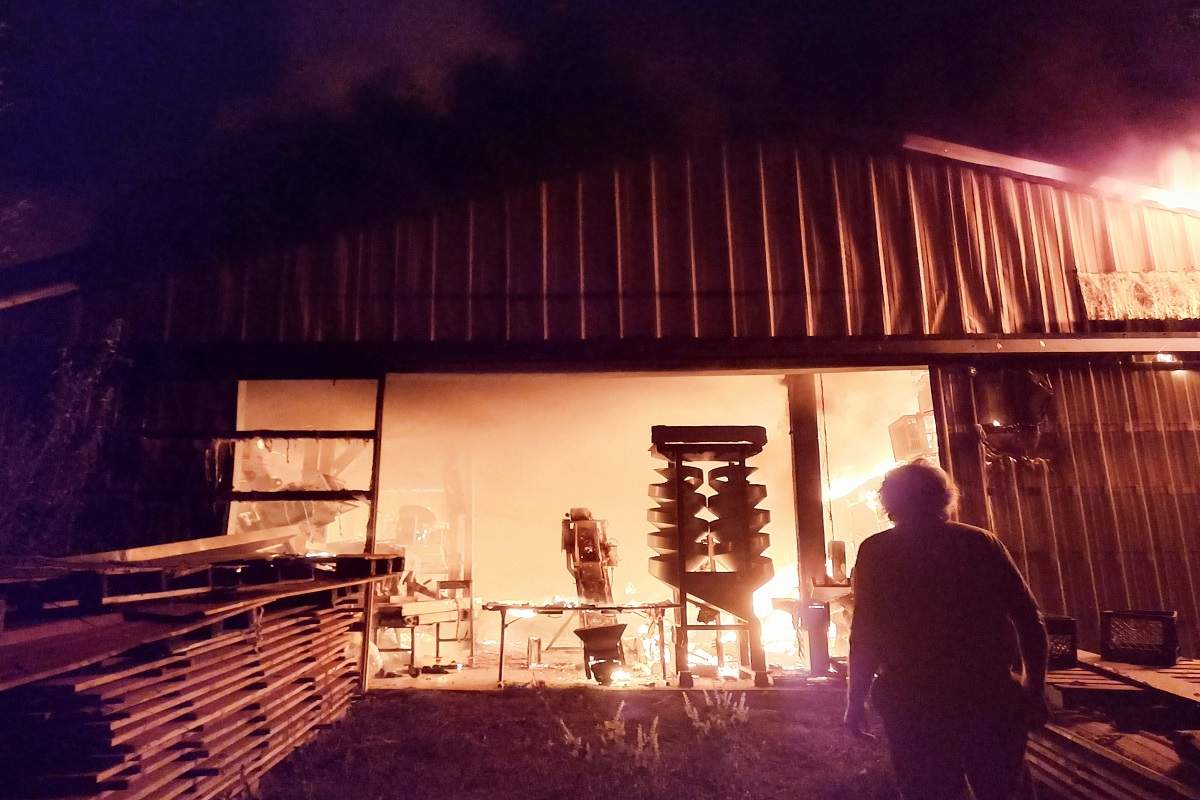
Heinz Thomet watches his barn burn at Next Step Produce.
11:52 JST, November 10, 2025
On an unseasonably warm late September morning, Heinz Thomet conducted his weekly ritual of cleaning the wood stove he uses to dry the barley, corn and other grains he harvests on his Southern Maryland farm. He dumped the ash in a metal can in the barn and went on his way.
He didn’t realize that a few hot embers remained. Or, that he’d soon learn how much farms like his still matter in a steadily changing region where many farms have become depots for agritourism or suppliers of feed for poultry companies.
Three days later, the barn where Thomet had stored the ash after transferring it to a plastic drum was engulfed in flames that swallowed up hundreds of thousands of dollars worth of equipment and almost the entire harvest from the year.
“I’m still in shock,” said Thomet, a stiff-upper-lip Swiss immigrant who didn’t even steel himself for a moment to process the damage before leaping into action to save what he could.
The incident could have spelled the end of Thomet’s 25-year farming operation, making it another casualty in a state that has lost more than half of its farmland since the mid-20th century due to development and other pressures. But neighbors and friends knew what that would mean – no more locally grown rice, sesame seeds, buckwheat or a number of other unique crops that almost nobody but Thomet grows in this part of Maryland.
Within a month of the fire, the surrounding community raised nearly $70,000 to help Thomet and his family rebuild.
Thomet said he was stunned.
“I didn’t think I was that important,” he half-joked.
But Whitney Valcarcel, a family friend and a former farmer who launched the fundraising effort, saw what was at stake: the disappearance of a singularly innovative operation that allows people in the area to taste food tended to with a level of thoughtfulness unmatched in the region.
“He’s created a way of life for us that we don’t want to go without,” said Valcarcel, who ended her organic chicken farming operation with her husband in 2017 after struggling to make enough profit to support her family.
Thomet started the farm, called Next Step, in 2000, initially growing seasonal vegetables such as spinach or carrots, that he largely sold in farmers markets.
Over the intervening years, the farm diversified its harvest – from kiwi to sunflower seeds to daikon radish – as a way to stay competitive in that marketplace.
Next Step then pivoted to restaurants. But, when the pandemic hit and brought major interruptions to the restaurant industry, Thomet and his family had to adjust again. They shifted much of their business into an online store, selling directly to customers or through an intermediary like Common Grain Alliance which sells their products at the Dupont Circle farmers market.
Over time, Thomet became known as an agricultural trailblazer in the region, his farm the stuff of “legend,” said John Keleher, who used to run the Dupont Circle farmers market.
“Their work, what they grow, is them and it is their values and it’s uncompromised,” Keleher said.
Now Next Step’s products pack rich flavor into scones, cakes and breads at boutique bakeries like Motzi Bread in Baltimore and Seylou Bakery in D.C.
But the consequence of growing so many products is needing sophisticated technology to farm them. The family imported a variety of machines from around the country and world. One uses air and screens to eliminate impurities from certain crops. Another sorts grains by weight to filter out diseased product. A particularly modern piece of equipment integrates artificial intelligence to organize crops by color, which helps identify discolored items that should be discarded. Thomet mastered each machine, a labor of love that also cost thousands of dollars in maintenance each year.
Then, came the fire.
On the evening of Oct. 1, the family was wrapping up dinner in their home when Gabrielle Lajoie, Thomet’s wife, looked out the window near the kitchen sink and saw flames pouring out of a roughly 30-foot stretch of the barn, she said. It was tearing through the grain building, feasting on piles of wood the family stores near the boiler room.
The family ran outside. Thomet watched the flames snake from one corner of the barn to the next, slowly consuming his pricey machines. The air screen cleaner, the gravity separator, the optical color sorter – machines he’d spent countless hours studying and tweaking to suit his needs – smoldered as 50 firefighters struggled to get the blaze under control.
At one point, the flames burst straight through the roof.
Those hours “felt like an eternity,” Thomet said.
The Office of the Maryland State Fire Marshal estimated the loss of the structure at $250,000 and the loss of the contents, including the machines, at $800,000. Thomet hasn’t yet had the heart to tabulate the exact total.
“It’s too depressing,” he said.
Over the past month, neighbors and friends – some of them fellow farmers – have helped the family clean the wreckage, start harvesting rice and sweet potatoes again, prepare popcorn and raise money for a new tractor.
Even still, Next Step’s future is uncertain. They just wrapped up harvesting their latest crop of beans Thomet said, but they can’t sell any of it without the cleaning equipment that burned in the fire.
For now, Thomet and his family are examining each item in the barn to see what’s salvageable and what needs to be replaced.
“So what do you want to do,” Thomet asked himself. “Put your hands up? … or do you want to say, ‘how do we reinvent ourselves?’”
The day after the fire, Valcarcel tried to help Thomet and Lajoie do just that. She reminded them they still posses the knowledge they need to tend to their soil and crops at the high level they were before.
“You just have to narrow your scope,” Valcarcel told them, the ex-farmer inside her offering words of wisdom honed from her own hardship.
On a recent day of cleaning up after the fire, the family spotted something on the ground in the barn. From beneath the ashes, surrounded by charred equipment and remnants of the barn’s structure, green shoots of wheat were sprouting again.








Most Read
Popular articles in the past 24 hours
-

Japan's Snow-Clad Beauty: Camellia Flowers Seen in Winter Bloom a...
-

Monkey Strikes Junior High School Girl from Behind in Japan's Yam...
-
Genichiro Inokuma's Mural in Ueno Station That Gave Hope in Postw...
-

Foreign and Security Policy: Political Parties Must Discuss How T...
-

Senior Japanese Citizens Return to University to Gain Knowledge, ...
-
Heavy Snow Linked to 30 Deaths across Japan since Late Jan.; JMA ...
-

Tokyo Police Arrest Head of Resignation Assistance Firm
-

Japan’s Nikkei Stock Average Jumps near 4%, Closes at Record High...
Popular articles in the past week
-

Japan Institute to Use Domestic Commercial Optical Lattice Clock ...
-

Australian Woman Dies After Mishap on Ski Lift in Nagano Prefectu...
-

Foreign Snowboarder in Serious Condition After Hanging in Midair ...
-

Chinese Embassy in Japan Reiterates Call for Chinese People to Re...
-

Narita Airport, Startup in Japan Demonstrate Machine to Compress ...
-
Toyota Motor Group Firm to Sell Clean Energy Greenhouses for Stra...
-

Sakie Yokota, Last Surviving Parent of a North Korea Abductee, Ur...
-
Beer Yeast Helps Save Labor, Water Use in Growing Rice; Govt Hope...
Popular articles in the past month
-

Univ. in Japan, Tokyo-Based Startup to Develop Satellite for Disa...
-
JAL, ANA Cancel Flights During 3-day Holiday Weekend due to Blizz...
-

China Confirmed to Be Operating Drilling Vessel Near Japan-China ...
-

China Eyes Rare Earth Foothold in Malaysia to Maintain Dominance,...
-
Japan Institute to Use Domestic Commercial Optical Lattice Clock ...
-
M6.2 Earthquake Hits Japan's Tottori, Shimane Prefectures; No Tsu...
-

Japan, Qatar Ministers Agree on Need for Stable Energy Supplies; ...
-

Japan, Italy to Boost LNG Cooperation; Aimed at Diversifying Japa...
Top Articles in News Services
-

Arctic Sees Unprecedented Heat as Climate Impacts Cascade
-

Prudential Life Expected to Face Inspection over Fraud
-

South Korea Prosecutor Seeks Death Penalty for Ex-President Yoon over Martial Law (Update)
-

Trump Names Former Federal Reserve Governor Warsh as the Next Fed Chair, Replacing Powell
-

Japan’s Nagasaki, Okinawa Make N.Y. Times’ 52 Places to Go in 2026
JN ACCESS RANKING
-
Univ. in Japan, Tokyo-Based Startup to Develop Satellite for Disaster Prevention Measures, Bears
-
JAL, ANA Cancel Flights During 3-day Holiday Weekend due to Blizzard
-
China Confirmed to Be Operating Drilling Vessel Near Japan-China Median Line
-
China Eyes Rare Earth Foothold in Malaysia to Maintain Dominance, Counter Japan, U.S.
-
Japan Institute to Use Domestic Commercial Optical Lattice Clock to Set Japan Standard Time