
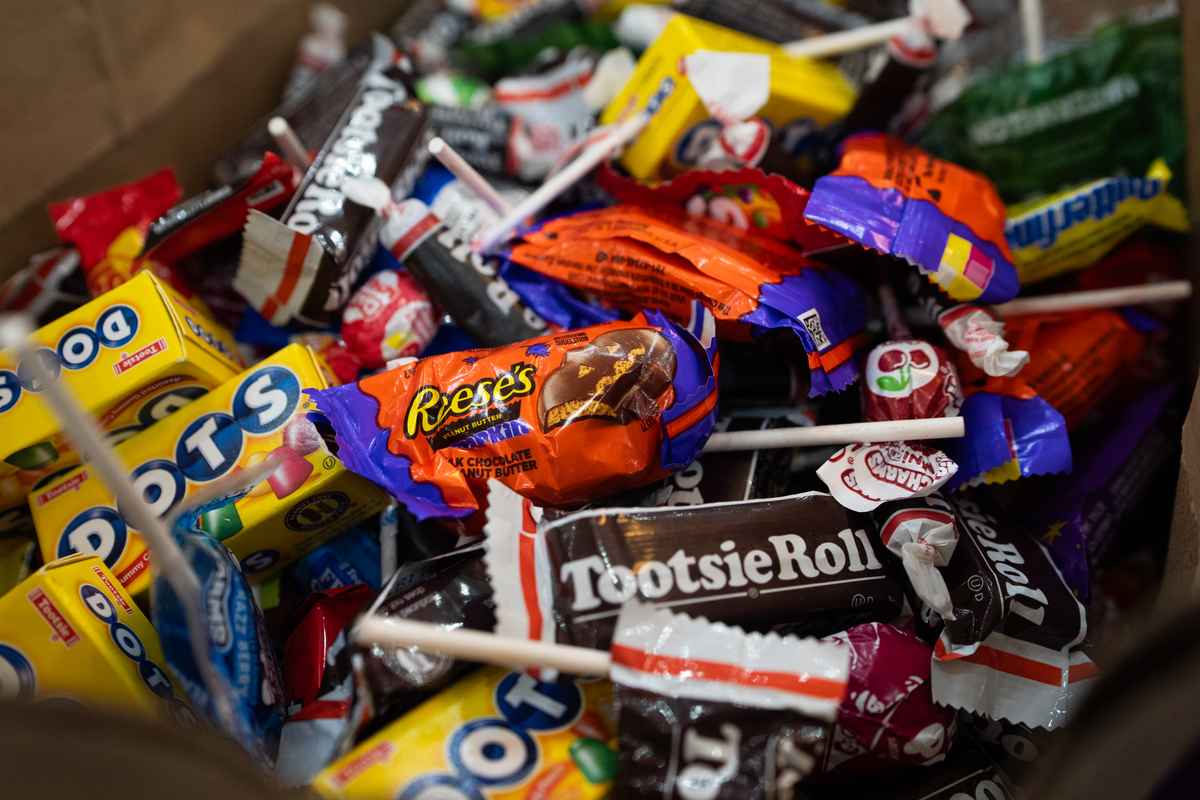
Poole said she’s expecting over 300 pounds of candy to be shipped this year.
11:36 JST, November 9, 2025
The candy was piled up on tables in colorful heaps, mounds of Reese’s peanut butter cups and KitKat bars, Snickers and Baby Ruths, Oreos and Tootsie Roll pops.
Olena Poole, 42, dumped another plastic grocery bag of treats onto the growing pile as the side door in the auditorium opened Thursday night at St. Andrew Ukrainian Orthodox Cathedral in Silver Spring, Maryland.
“Is this where we take the candy?” the woman coming through the door asked, clutching a plastic bag stuffed with leftover Halloween treats. “It’s not much but please take it.”
“Thank you so much!” Poole beamed.
For the fourth year in a row, Poole and other members of the Washington Ukrainian Humanitarian Center, the nonprofit organization tied to St. Andrew, are collecting leftover Halloween candy and shipping it to children living in Ukraine. The organization regularly sends supplies to the embattled country. In October, it mailed boxes of hand warmers, tourniquets and chest seals to medical units. In June, it delivered 68 defibrillators to Ukrainian hospitals.
Candy might seem low on the must-needs list for a country heading into its fourth year of war. But it’s something children enjoy regardless of their circumstances, Poole said.
“Most of these kids, they are not used to getting gifts,” said the Ukrainian-born Poole, the center’s volunteer coordinator. “But even a piece of candy can bring joy and help stabilize a child. We have the leftovers every year, and people don’t know what to do with it. Why not help someone smile?”
On Sunday, the organization will invite volunteers to St. Andrew to package the donated candy into individual bags, with 30 or so pieces, for each child. Then the group will ship off the treats to Ukraine.
In past years, the center has shipped around 200 pounds of candy. “We’re probably expecting over 300 pounds this year,” Poole said. “This will be the biggest year yet.”
On Thursday night, Sara Watson, 64, of Silver Spring arrived at St. Andrew with around 130 pounds of candy. Her SUV was stuffed with items collected from her church, a community mailing list and a local buy-nothing group.
“People always buy too much candy,” Watson said. “They feel like their kids have way too much anyway. And everyone in my circle is so angry about what’s happening to Ukraine but they feel helpless about what they can do. They can give money. They can call their members of Congress. But this was a tangible thing for people to do.”
The center aims to get the candy shipped by next week to reach Ukraine by the Christmas holiday season. Poole declined to give specifics on how much the nonprofit pays for shipping, only adding, “it is not cheap.”
But it is worth it, Poole said. Once the candy arrives in Ukraine, the bags are distributed around the country to schools, orphanages and children’s homes, with a special emphasis on children who are low-income, disabled or who have lost parents in the war.
One of the individuals helping the center distribute candy in Ukraine is Poole’s mother, Ganna Dudik, the principal of a school in Zhytomyr, a city west of Kyiv.
“Children suffer because of the war, their psychological heath is ruined,” Dudik explained. She said the stress of constant air raid sirens and school days passed in bomb shelters, not to mention the loss and injury of friends and family, offers little opportunity for joy.
“It’s not easy,” Dudik said. “Students are nervous. We the teachers are nervous because we understand our responsibility for their lives. They are worried about their parents, some on the front lines. They are afraid because we often see rocket and missile attacks. It is very rare to see the children smiling.”
Since Russian forces invaded Ukraine in February 2022, more than 14,300 Ukrainian civilians have been killed, according to a report by the Office of the United Nations High Commissioner for Human Rights in September. Those figures are probably an undercount, the report says. In the same time period, more than 37,500 civilians have been injured.
Dudik says the packages of candy from her daughter and other volunteers in the Washington region give the children a reason to smile. It also reminds them that they haven’t been forgotten.
Last year, one of Dudik’s students suspiciously accepted the candy. When the principal explained it was donated from the United States, the student only grew more wary, she said. “So they could eat this candy but instead they sent it to us?” the student said, according to Dudik. “Maybe the candy is no good then.”
When the student tried the candy and realized it wasn’t spoiled or bad, the size of the gift hit. Giving away good candy to strangers, the boy realized, was a real act of charity.








Most Read
Popular articles in the past 24 hours
-

Japan's Snow-Clad Beauty: Camellia Flowers Seen in Winter Bloom a...
-

Monkey Strikes Junior High School Girl from Behind in Japan's Yam...
-

Genichiro Inokuma's Mural in Ueno Station That Gave Hope in Postw...
-

Foreign and Security Policy: Political Parties Must Discuss How T...
-
Senior Japanese Citizens Return to University to Gain Knowledge, ...
-
Heavy Snow Linked to 30 Deaths across Japan since Late Jan.; JMA ...
-

Tokyo Police Arrest Head of Resignation Assistance Firm
-

Japan’s Nikkei Stock Average Jumps near 4%, Closes at Record High...
Popular articles in the past week
-

Japan Institute to Use Domestic Commercial Optical Lattice Clock ...
-
Australian Woman Dies After Mishap on Ski Lift in Nagano Prefectu...
-
Foreign Snowboarder in Serious Condition After Hanging in Midair ...
-
Chinese Embassy in Japan Reiterates Call for Chinese People to Re...
-
Narita Airport, Startup in Japan Demonstrate Machine to Compress ...
-

Toyota Motor Group Firm to Sell Clean Energy Greenhouses for Stra...
-
Sakie Yokota, Last Surviving Parent of a North Korea Abductee, Ur...
-

Beer Yeast Helps Save Labor, Water Use in Growing Rice; Govt Hope...
Popular articles in the past month
-
Univ. in Japan, Tokyo-Based Startup to Develop Satellite for Disa...
-
JAL, ANA Cancel Flights During 3-day Holiday Weekend due to Blizz...
-
China Confirmed to Be Operating Drilling Vessel Near Japan-China ...
-

China Eyes Rare Earth Foothold in Malaysia to Maintain Dominance,...
-
Japan Institute to Use Domestic Commercial Optical Lattice Clock ...
-
M6.2 Earthquake Hits Japan's Tottori, Shimane Prefectures; No Tsu...
-

Japan, Qatar Ministers Agree on Need for Stable Energy Supplies; ...
-

Japan, Italy to Boost LNG Cooperation; Aimed at Diversifying Japa...
Top Articles in News Services
-

Arctic Sees Unprecedented Heat as Climate Impacts Cascade
-

Prudential Life Expected to Face Inspection over Fraud
-

South Korea Prosecutor Seeks Death Penalty for Ex-President Yoon over Martial Law (Update)
-

Trump Names Former Federal Reserve Governor Warsh as the Next Fed Chair, Replacing Powell
-

Japan’s Nagasaki, Okinawa Make N.Y. Times’ 52 Places to Go in 2026
JN ACCESS RANKING
-
Univ. in Japan, Tokyo-Based Startup to Develop Satellite for Disaster Prevention Measures, Bears
-
JAL, ANA Cancel Flights During 3-day Holiday Weekend due to Blizzard
-
China Confirmed to Be Operating Drilling Vessel Near Japan-China Median Line
-
China Eyes Rare Earth Foothold in Malaysia to Maintain Dominance, Counter Japan, U.S.
-
Japan Institute to Use Domestic Commercial Optical Lattice Clock to Set Japan Standard Time