
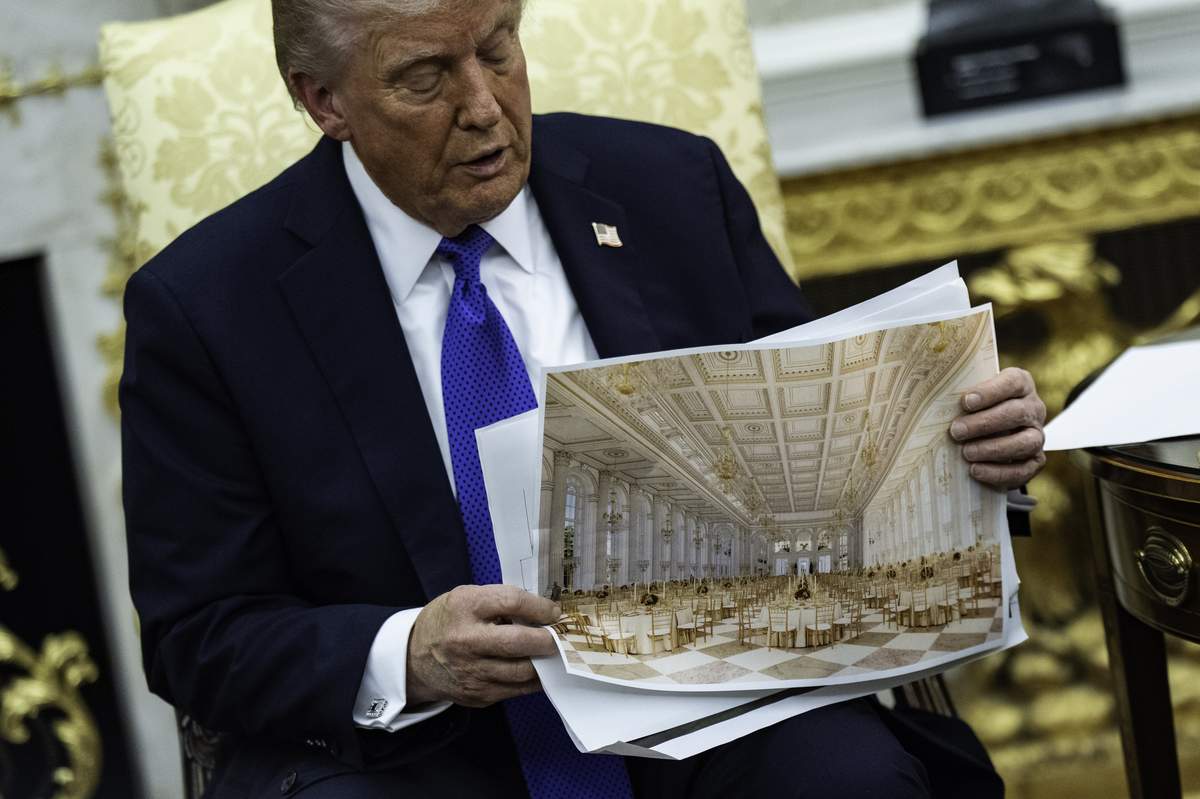
Trump shows renderings of the proposed ballroom.
13:03 JST, November 6, 2025
Agencies have hung enormous portraits of President Donald Trump outside their buildings. The Treasury Department is preparing to mint a commemorative coin that shows Trump raising a heroic fist. The president is planning a triumphal arch across from the Lincoln Memorial for America’s 250th birthday.
Trump has also added 24-karat golden adornments to the Oval Office, giving it a palatial feel. He has arranged to receive a luxurious Boeing jetliner from Qatar. He has ordered thicker paper, decorated with gold, for the letters he writes to military officers who are becoming generals.
Trump’s aggressive moves to accumulate political power – deploying National Guard troops, invoking massive tariffs – have prompted protests and lawsuits as well as plaudits. But he is also asserting his power through what might be called an imperial aesthetic: surrounding his presidency with visual cues designed to project personal command and grandeur.
“What it’s intended to convey is a kind of martial strength, the kind of presence of power that you see a lot of dictators around the world wanting to project,” said Sen. Adam Schiff (D-California). “The gold ornate style, the imposing portraiture, the military parades, the physical depiction on currency – this is what you see from state-run authoritarian regimes.”
Most recently and starkly, construction has begun on a 90,000-square-foot White House ballroom that will be almost as large as the rest of the White House complex, creating a monumental structure that, Trump’s supporters hope, will be associated with his presidency long after he has left office.
In recent days, Trump’s aspirations to an imperial aura have become even more literal. When large crowds turned out for a “No Kings” protest on Oct. 18, Trump responded with an AI-generated video of himself wearing a crown, piloting a plane with “King Trump” inscribed on the side and dumping what appeared to be feces on protesters.
The penchant for the gold and grand has not been lost on those seeking Trump’s favor. South Korean leaders on Wednesday gave the president a replica of a historic golden crown, saying it symbolized peace and unity. Apple CEO Tim Cook in August gifted the president a glass plaque with a 24-karat gold base.
White House communications director Steven Cheung said in a statement that Trump’s changes will benefit all Americans.
“This is not an imperial aesthetic, this is an American aesthetic,” Cheung said.
Tevi Troy, a presidential historian who was a senior official in the administration of George W. Bush, said Trump’s aesthetic suggests less an aspiration to royalty than a background as a real estate developer.
“He has a sense of what he thinks American building and American power should look like, and that is reflected in whatever plans he puts forward,” Troy said. “I don’t think it’s necessarily monarchical. It just reflects what he thinks it should look like, which is different from what others think it should look like.”
Other presidents have also brought their aesthetic tastes to the White House, Troy noted. Richard M. Nixon, influenced by the pageantry he saw in Europe, ordered ornate uniforms for the Secret Service, prompting widespread mockery. Bush, who cherished a cowboy image, had Western paintings hung throughout the building.
Yet Trump’s changes have been more dramatic and grandiose than those of any president in recent memory. To his critics, they are the physical counterpart of what they see as his un-American grasp for overwhelming power.
That is especially true of the planned ballroom, for which the East Wing of the White House has now been demolished. California Gov. Gavin Newsom called it a “knockoff Versailles on White House grounds.” Schiff said it brings to mind the gaudy palaces of such former dictators as Romania’s Nicolae Ceausescu and Iraq’s Saddam Hussein.
Some Democrats say the next president should demolish the ballroom, which is proceeding without input from Congress or other government bodies. On Tuesday, Trump fired all six members of the Commission of Fine Arts, an independent agency that had expected to review the ballroom and arch.
So far the project is not popular: Americans oppose tearing down the East Wing for a ballroom by a 2-to-1 margin (56 percent-28 percent), according to a Washington Post-ABC News-Ipsos poll released Thursday.
The White House is working to communicate an image of Trump as a historical figure in other ways as well.
Brandon Beach, treasurer of the United States, has confirmed that commemorative $1 coins honoring Trump are being planned for next year. That means Trump “will forever be the face of America’s 250th Birthday,” conservative commentator Steve Guest posted on X.
The president’s daughter in law, Lara Trump, has proposed that Trump’s face grace a new $25 or $45 bill – or perhaps a $47 bill, in recognition of his role as the 47th president.
Critics say honors in America have been traditionally granted many years after a figure passes from the scene to avoid erecting memorials to figures whom history may judge to be unworthy. Construction on the Washington Monument began in 1848, a half-century after George Washington left office; Abraham Lincoln first appeared on the $5 bill in 1914, almost 50 years after his assassination.
“I don’t think it fits into our traditions to build monument to himself. No president has done in that in history,” Schiff said. “It would be the equivalent of Washington building his own Washington Monument. I think if anything, our history is one of preservation of our legacy, of making the White House be the people’s house.”
In September, Schiff issued a report charging that the administration, by hanging large banners with Trump’s image outside government agencies, was illegally engaging in propaganda. To emphasize the point, Schiff’s office appended photos of the large banners hung by such dictators as Joseph Stalin and Benito Mussolini.
Trump’s supporters say the president is not naming such projects as the ballroom after himself, and that they will benefit the country for years to come. “It’s going to be a permanent renovation that will enhance the White House for all future presidents,” Rep. Steve Scalise (R-Louisiana) told reporters.
But critics say that unilaterally imposing his own over-the-top vision on the landscape is Trump’s way of proclaiming his own grandeur, not the country’s. On Friday, Trump unveiled pictures of the White House’s Lincoln Bathroom redone with white marble and gold fixtures, in sharp contrast to the bedroom itself.
“Trump has long treated all forms of architecture as tools of personal identity,” said Debbie Millman, who chairs the masters in branding program at the School of Visual Arts in New York. “Trump will call it the Trump ballroom, because it is already an extension of the Trump equity. This enduring building will be reshaped in the image of Trump’s brand.”
Trump denied reports that he was considering naming the ballroom after himself as “fake news,” suggesting the Presidential Ballroom as one name possibility.
David Harrison, who chairs the French Department at Grinnell College and is an expert in French history, said Trump’s aesthetic has always owed a good deal to the palace at Versailles, which came to symbolize the excesses of the French monarchy.
“From Donald Trump’s first forays into personal architecture, there is a clear throughline that Versailles, and particularly the Hall of Mirrors, is the model of power and authority,” Harrison said. “It seems to represent an aesthetic of personal glory, of authority, of luxury.”
Beyond the decorative, the Trump administration has regularly engineered scenes designed to portray him as a global colossus.
Cabinet meetings have become venues for officials to deliver a nonstop flow of compliments. He personally reviewed a military parade, a rarity for a U.S. president, on June 14 – a day that was both the U.S. Army’s birthday and his own, inspired by French commemorations of Bastille Day.
His aides’ public praise is strikingly florid. “Let me just say, Mr. President, that this country was going to die without you,” Stephen Miller, the deputy White House chief of staff, told the president at an Oct. 23 event. “This country was going to actually die without you. … You alone saved it.”
Troy said unilateralism is at the heart of Trump’s presidency, and reshaping the physical environment is part of that.
“I’ve had this theory that Trump does not have an ideology so much as a methodology, and that methodology is unilateralism,” Troy said. “He learned in his first term that the courts and the legislature can stand in his way. In his second term, he is emphasizing things like pardons, tariffs, executive order – and reordering the White House.”
Trump’s clearest predecessor when it comes to White House redesign may be President Chester A. Arthur, who hired Louis Comfort Tiffany, the most famed designer of his day, to give the White House a sweeping – some would say gaudy – makeover in the early 1880s.
Still, Arthur was reacting to a White House that had become shabby and run-down over the years, not remaking an already stately mansion as Trump is doing.
Historically, Harrison said, structures that are built as witnesses to a ruler’s power often fade or crumble with time, coming to represent instead the futility of excessive ambition.
“Construction can be intended to project authority, dignity, glory and a desire for immortality,” Harrison said. “But the reality is that many of things we think of as being done for that reason later come to represent the exact opposite – the vanity and the ephemerality of human wishes.”





Most Read
Popular articles in the past 24 hours
-

Japan's Snow-Clad Beauty: Camellia Flowers Seen in Winter Bloom a...
-

Monkey Strikes Junior High School Girl from Behind in Japan's Yam...
-
Genichiro Inokuma's Mural in Ueno Station That Gave Hope in Postw...
-

Foreign and Security Policy: Political Parties Must Discuss How T...
-
Senior Japanese Citizens Return to University to Gain Knowledge, ...
-

Heavy Snow Linked to 30 Deaths across Japan since Late Jan.; JMA ...
-

Tokyo Police Arrest Head of Resignation Assistance Firm
-

Japan’s Nikkei Stock Average Jumps near 4%, Closes at Record High...
Popular articles in the past week
-

Japan Institute to Use Domestic Commercial Optical Lattice Clock ...
-
Australian Woman Dies After Mishap on Ski Lift in Nagano Prefectu...
-
Foreign Snowboarder in Serious Condition After Hanging in Midair ...
-
Chinese Embassy in Japan Reiterates Call for Chinese People to Re...
-
Narita Airport, Startup in Japan Demonstrate Machine to Compress ...
-

Toyota Motor Group Firm to Sell Clean Energy Greenhouses for Stra...
-
Sakie Yokota, Last Surviving Parent of a North Korea Abductee, Ur...
-

Beer Yeast Helps Save Labor, Water Use in Growing Rice; Govt Hope...
Popular articles in the past month
-

Univ. in Japan, Tokyo-Based Startup to Develop Satellite for Disa...
-
JAL, ANA Cancel Flights During 3-day Holiday Weekend due to Blizz...
-
China Confirmed to Be Operating Drilling Vessel Near Japan-China ...
-

China Eyes Rare Earth Foothold in Malaysia to Maintain Dominance,...
-
Japan Institute to Use Domestic Commercial Optical Lattice Clock ...
-
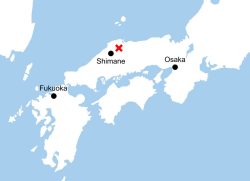
M6.2 Earthquake Hits Japan's Tottori, Shimane Prefectures; No Tsu...
-
Japan, Qatar Ministers Agree on Need for Stable Energy Supplies; ...
-
Japan, Italy to Boost LNG Cooperation; Aimed at Diversifying Japa...
Top Articles in News Services
-

Arctic Sees Unprecedented Heat as Climate Impacts Cascade
-

Prudential Life Expected to Face Inspection over Fraud
-

South Korea Prosecutor Seeks Death Penalty for Ex-President Yoon over Martial Law (Update)
-
Trump Names Former Federal Reserve Governor Warsh as the Next Fed Chair, Replacing Powell
-
Japan’s Nagasaki, Okinawa Make N.Y. Times’ 52 Places to Go in 2026
JN ACCESS RANKING
-
Univ. in Japan, Tokyo-Based Startup to Develop Satellite for Disaster Prevention Measures, Bears
-
JAL, ANA Cancel Flights During 3-day Holiday Weekend due to Blizzard
-
China Confirmed to Be Operating Drilling Vessel Near Japan-China Median Line
-
China Eyes Rare Earth Foothold in Malaysia to Maintain Dominance, Counter Japan, U.S.
-
Japan Institute to Use Domestic Commercial Optical Lattice Clock to Set Japan Standard Time