
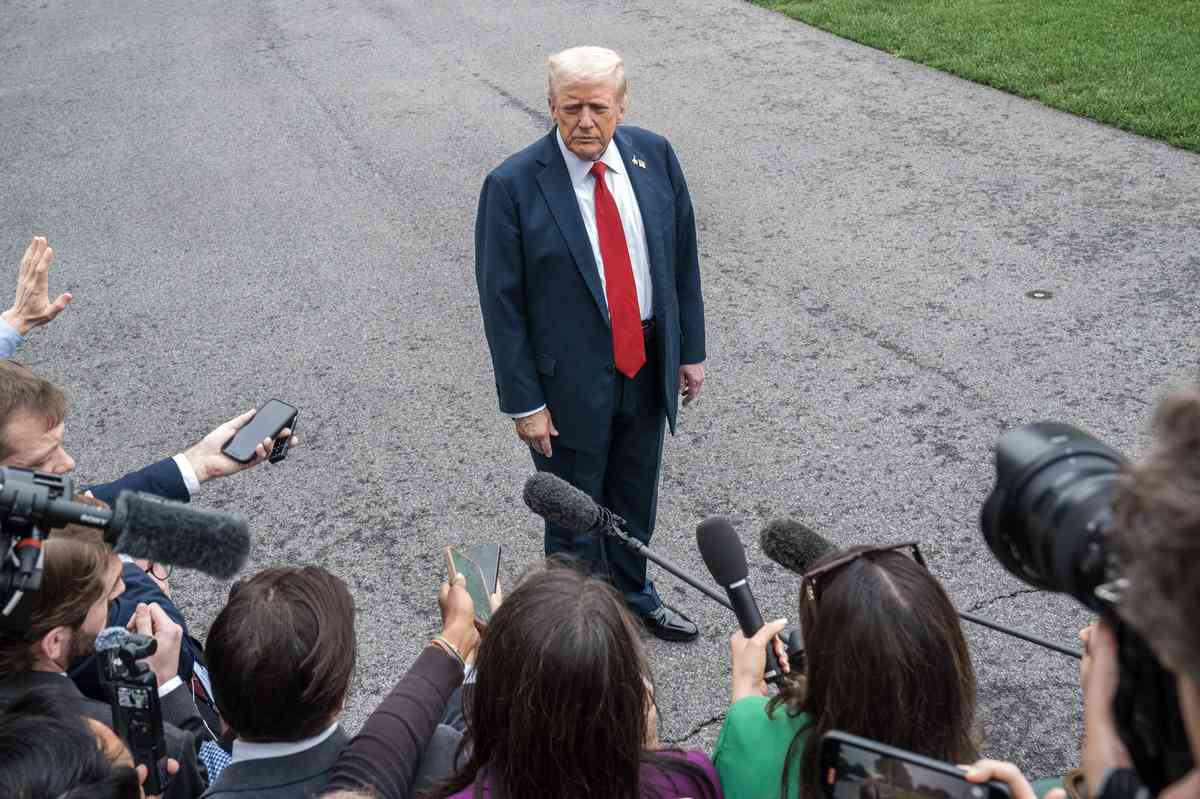
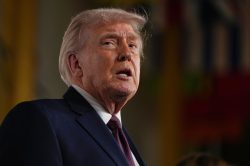
About nine months into his second term, 41 percent of Americans say they approve of the job President Donald Trump is doing and 59 percent disapprove, a recent poll shows.
12:35 JST, November 3, 2025
Americans broadly disapprove of how President Donald Trump is handling his job, and a majority say he has gone too far in exercising the powers of his office, according to a Washington Post-ABC News-Ipsos poll. But a year out from the 2026 midterm elections, there is little evidence that negative impressions of Trump’s performance have accrued to the benefit of the Democratic Party, with voters split almost evenly in their support for Democrats and Republicans.
Overall, 41 percent of Americans say they approve of the job Trump is doing, while 59 percent disapprove. That level of disapproval is the highest in a Post-ABC poll since January 2021, a week after the attack on the Capitol. Trump’s support among self-identified Republicans remains strong at 86 percent, while 95 percent of Democrats disapprove. Among independents, Trump’s approval rating is 30 percent, while his disapproval mark is 69 percent.
Across eight issues that include the economy, immigration, tariffs, managing the federal government, crime, and conflicts in the Middle East and Ukraine, most Americans say they disapprove of how he is handling each of them. The narrowest disapproval among these is on the situation with Israel and Gaza, but still a 52 percent majority say they disapprove.
Trump has governed primarily through executive orders, setting out controversial policies affecting the federal government, the nation’s electoral system, the private sector and academia, among others. These orders have drawn multiple lawsuits challenging his authority. Many of the suits are still being adjudicated, with the Supreme Court destined to be the final arbiter in setting the boundaries for executive power.
Meanwhile, the public is rendering its own judgment and mostly in opposition to the president. The poll finds that 64 percent say he is going too far in “trying to expand the power of the presidency,” and majorities say he is going too far in laying off government employees to cut the size of the federal workforce, in deploying the National Guard to patrol U.S. cities and trying to make changes in how U.S. colleges and universities operate.
Opinions are more divided on issues that include deporting undocumented immigrants, closing pathways for immigrants to enter the country legally and pushing back against diversity, equity and inclusion (DEI) programs in the government. The country is roughly split between saying Trump is handling them “about right” or “not going far enough” and saying Trump is going too far.
Democrats can find few bright spots of their own in the new survey. Americans see the president and the two political parties as out of touch with their lives. But Democrats – whose popularity has hit low points in other national polls this year – are judged most harshly. While 63 percent of Americans see Trump as out of touch and 61 percent see Republicans that way, 68 percent say the Democrats are out of touch. There has been no improvement for Democrats since a similar poll last April.
Republicans have a narrow majority in the House and Democrats hope to recapture control next year, but at this point the new poll suggests a competitive contest in 2026. When Americans were asked how they would vote if the midterms were held today, 46 percent of registered voters say they would back the Democratic candidate in their district while 44 percent would support the Republican and 9 percent would not vote.
That is a narrower margin than the 11-point advantage Democrats enjoyed at this point in Trump’s first term and the seven-point edge just before the 2018 midterm elections, when Democrats recaptured control of the House.
Elections on Tuesday for governor in Virginia and New Jersey and a high-profile mayoral race in New York will be examined for early clues about next year. But the House landscape for 2026 is being redrawn in real time amid a flurry of mid-decade redistricting efforts in both red and blue states. That presents more than the usual amount of uncertainty about an election so far away. Still, the narrowness of current intentions is more evidence of the Democrats’ challenge ahead of a midterm year that history would say favors them.
One problem for Democrats, as seen in current voting intentions for next year’s election, is that the Republican Party is capturing a much higher percentage of those who approve of the job Trump is doing than Democrats among those who disapprove. About 9 in 10 of those approvers say they would vote for the Republican in their district while about 8 in 10 of Trump’s disapprovers side with the Democrats.
While 87 percent of voters who strongly disapprove of Trump support Democrats for Congress, voters who “disapprove somewhat” are split about evenly between Democrats (36 percent) and Republicans (35 percent), with 29 percent saying they would not vote if the election were held today. By contrast, 84 percent of voters who “approve somewhat” of Trump favor Republicans for Congress.
Among voters who disapprove of Trump, support for Democrats for Congress is relatively low among independents, moderates and conservatives, and younger voters. It’s also relatively low among voters who didn’t vote in 2024 or voted for Trump.
Another way to look at this challenge for Democrats is through the lens of White Americans. The poll finds that Trump’s approval among White Americans was 49 percent positive and 51 percent negative, with 40 percent strongly disapproving. But on the question of which party they would support in next year’s midterm elections, 40 percent of White registered voters say they would vote for the Democrat while 53 percent say they support the Republican.
Trump defeated Vice President Kamala Harris a year ago in considerable part because of negative perceptions of the economy and especially the cost of living. Trump promised to swiftly bring down prices, and gasoline prices have declined. But other costs, including groceries, have not declined significantly. Today, 59 percent of Americans give Trump either a great deal or a good amount of blame for the current rate of inflation.
Approval of Trump’s handling of the economy stands at 37 percent vs. 62 percent who disapprove. Twenty-seven percent say the economy has gotten better since he was sworn in on Jan. 20 compared with 52 percent who say it has gotten worse and 20 percent who say it has stayed the same. Not quite 1 in 5 (18 percent) say they are better off financially since Trump took office for the second time, 37 percent say they are not as well off and 45 percent say their financial situation is about the same.
At the same time, two-thirds of Americans think the country has gotten pretty seriously off on the wrong track, with about a third thinking that things are going in the right direction. Optimism is up from just before last year’s election, when 24 percent said the country was on the right track.
On the president’s signature economic initiative, the implementation of tariffs on a wide variety of countries, Americans remain distinctly negative, with 33 percent saying they approve and 65 percent disapproving. There has been no change in public disapproval of the tariffs since the spring, when Trump began to impose them.
Another issue that played significantly to Trump’s advantage in 2024 was immigration, based on perceptions of a porous southern border and his promise to launch the biggest deportation effort in history. His policy to deport immigrants living in the country illegally, especially those who have criminal records, has been one of his most high-profile initiatives, even as its implementation has drawn criticism and controversy.
Overall, 43 percent of Americans say they approve of how he has handled the issue, while 56 percent disapprove. Americans are closely divided between those who support and those who oppose efforts by U.S. Immigration and Customs Enforcement (ICE) agents to detain and deport undocumented immigrants, whether they are asked about the broad national program, targeted efforts in major cities. Americans narrowly disapprove of such raids in “the area where you live.”
Other aspects of ICE’s enforcement are judged negatively. Majorities say ICE and Homeland Security personnel should not be allowed to wear masks or face coverings while on duty (57 percent) and that Trump should not be able to order the National Guard into a state over the objections of that state’s governor (58 percent), as he did in California and has attempted to do in Portland and Chicago. Those locations stand in contrast to Tennessee and Louisiana, where Republican governors have sought to deploy Guard troops to combat crime rather than take part in immigration enforcement.
On questions about immigration, as with many questions in the poll, there is a chasm between the views of Republicans and Democrats, with independents closer to the latter.
Trump has spoken out about what he claims is out-of-control crime in many cities. Roughly 6 in 10 Americans say they would describe the problem of crime in big cities as either extremely or very serious, and about half (49 percent) say that is the case more generally in the United States as a whole. They are more positive about the state of crime in their own communities, with just 18 percent calling the situation extremely or very serious, compared with 32 percent who say it is moderately serious and 49 percent who say it is not too or not-at-all serious.
Republicans are 27 percentage points more likely than Democrats to say crime in the country is at least “very serious” (63 percent vs. 36 percent) and 38 points more likely to say this about large U.S. cities (80 percent vs. 42 percent). An identical 18 percent of Democrats and Republicans say crime is extremely or very serious where they live.
Trump registered one important success internationally, which was to help bring about the return of Hamas-held Israeli hostages and what has become a tenuous agreement for a ceasefire after two years of conflict. Forty-six percent of Americans approve of the job he has done on that issue, up from 39 percent last month, before the deal was announced. Despite the role of the Trump administration in brokering the agreement, slightly more people say Trump should get “just some” or no credit for the deal than who say he should get “a good amount” or “a great deal.”
On the war in Ukraine, Americans by a significant margin (46 percent to 8 percent) say Trump has been too supportive of Russia rather than too supportive of Ukraine, while another 41 percent say he is handling this about right. Trump had claimed he could resolve the conflict quickly, but his efforts have been unsuccessful. Currently, 39 percent approve of his handling of the Russia-Ukraine situation while 60 percent disapprove.
More Americans say U.S. leadership in the world has gotten weaker (48 percent) than stronger (33 percent) under Trump, with 18 percent saying it has stayed the same.
After about nine months in office, Americans are split on how much Trump has accomplished. Forty-eight percent say he has accomplished “a great deal” or “a good” amount, with 38 percent saying those accomplishments have been good for the country and 10 percent saying they have been bad. Meanwhile, 51 percent say he has accomplished “not very much” or “nothing,” though that figure is lower than 65 percent who said this about his first term in September 2017.
Almost two months ago, conservative activist Charlie Kirk was killed while on the campus of Utah Valley University, setting off a new round in a debate about the threats of political violence and whether one party or the other is more responsible. The new poll finds that 34 percent say Republicans are more responsible, 28 percent say Democrats and 28 percent blame both equally, and 9 percent say they blame neither party.
The Washington Post-ABC News-Ipsos poll was conducted online Oct. 24 through Oct. 28 among 2,725 U.S. adults. The sample was drawn through the Ipsos KnowledgePanel, an ongoing panel of U.S. households recruited by mail using random sampling methods. Overall results have a margin of error of plus or minus 1.9 percentage points.





Most Read
Popular articles in the past 24 hours
-

Japan's Snow-Clad Beauty: Camellia Flowers Seen in Winter Bloom a...
-

Monkey Strikes Junior High School Girl from Behind in Japan's Yam...
-

Genichiro Inokuma's Mural in Ueno Station That Gave Hope in Postw...
-

Foreign and Security Policy: Political Parties Must Discuss How T...
-

Senior Japanese Citizens Return to University to Gain Knowledge, ...
-

Heavy Snow Linked to 30 Deaths across Japan since Late Jan.; JMA ...
-

Tokyo Police Arrest Head of Resignation Assistance Firm
-

Japan’s Nikkei Stock Average Jumps near 4%, Closes at Record High...
Popular articles in the past week
-

Japan Institute to Use Domestic Commercial Optical Lattice Clock ...
-

Australian Woman Dies After Mishap on Ski Lift in Nagano Prefectu...
-

Foreign Snowboarder in Serious Condition After Hanging in Midair ...
-

Chinese Embassy in Japan Reiterates Call for Chinese People to Re...
-

Narita Airport, Startup in Japan Demonstrate Machine to Compress ...
-

Toyota Motor Group Firm to Sell Clean Energy Greenhouses for Stra...
-

Sakie Yokota, Last Surviving Parent of a North Korea Abductee, Ur...
-

Beer Yeast Helps Save Labor, Water Use in Growing Rice; Govt Hope...
Popular articles in the past month
-

Univ. in Japan, Tokyo-Based Startup to Develop Satellite for Disa...
-

JAL, ANA Cancel Flights During 3-day Holiday Weekend due to Blizz...
-

China Confirmed to Be Operating Drilling Vessel Near Japan-China ...
-

China Eyes Rare Earth Foothold in Malaysia to Maintain Dominance,...
-
Japan Institute to Use Domestic Commercial Optical Lattice Clock ...
-

M6.2 Earthquake Hits Japan's Tottori, Shimane Prefectures; No Tsu...
-

Japan, Qatar Ministers Agree on Need for Stable Energy Supplies; ...
-

Japan, Italy to Boost LNG Cooperation; Aimed at Diversifying Japa...
Top Articles in News Services
-

Arctic Sees Unprecedented Heat as Climate Impacts Cascade
-

Prudential Life Expected to Face Inspection over Fraud
-

South Korea Prosecutor Seeks Death Penalty for Ex-President Yoon over Martial Law (Update)
-
Trump Names Former Federal Reserve Governor Warsh as the Next Fed Chair, Replacing Powell
-

Japan’s Nagasaki, Okinawa Make N.Y. Times’ 52 Places to Go in 2026
JN ACCESS RANKING
-
Univ. in Japan, Tokyo-Based Startup to Develop Satellite for Disaster Prevention Measures, Bears
-
JAL, ANA Cancel Flights During 3-day Holiday Weekend due to Blizzard
-
China Confirmed to Be Operating Drilling Vessel Near Japan-China Median Line
-
China Eyes Rare Earth Foothold in Malaysia to Maintain Dominance, Counter Japan, U.S.
-
Japan Institute to Use Domestic Commercial Optical Lattice Clock to Set Japan Standard Time