
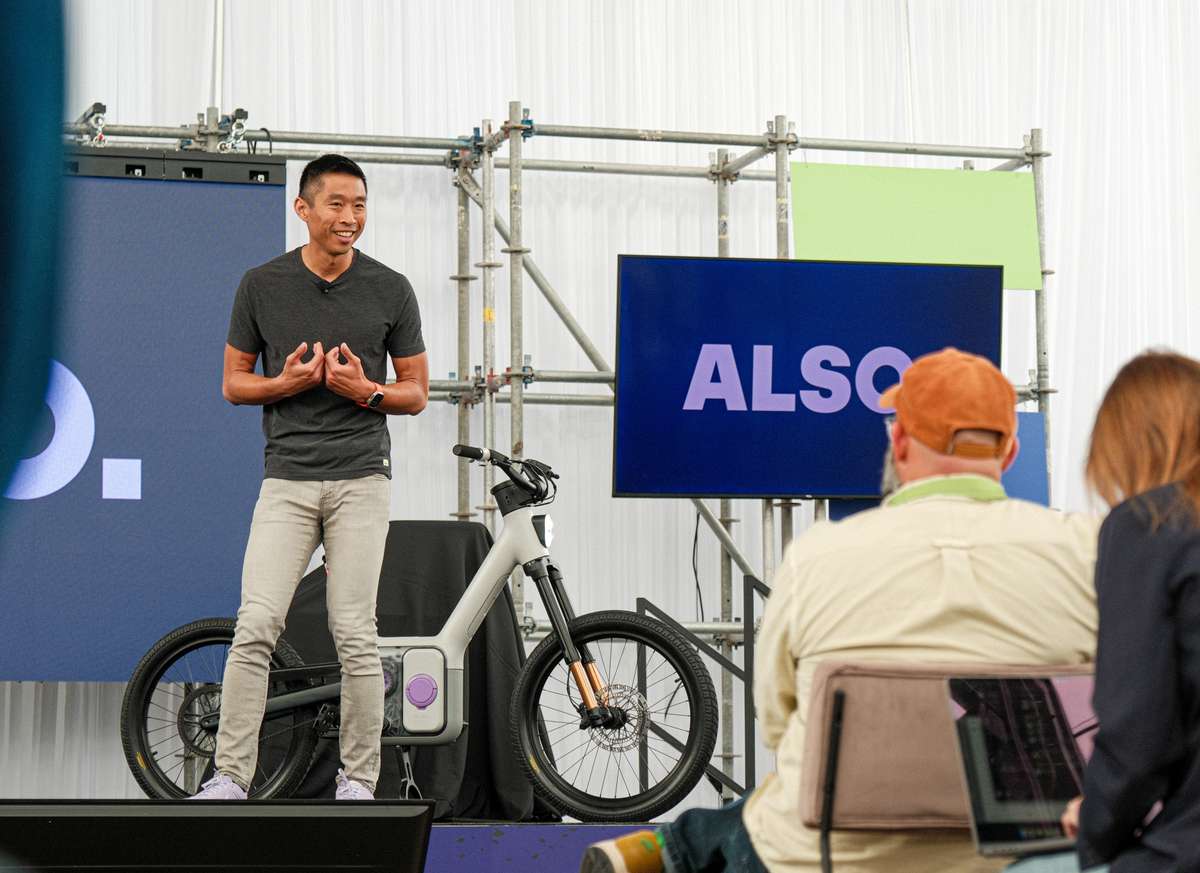
Also President Chris Yu showing off the TM-B at a launch event in Oakland, California.
12:34 JST, October 31, 2025
PALO ALTO, Calif. – It looks like a bike. It rides like a bike, mostly.
But a new electric two-wheeler from a Rivian spin-off packs more than a few features you would expect from a full-size electric car instead.
The TM-B e-bike, built by a team that spun out of the electric truck maker, recharges its battery when you brake. A five-inch touch screen it calls the “Portal” offers music controls and navigational cues. When the $4,000-plus e-bike starts shipping next year, your phone will act as a key, unlocking the bike and priming it for a ride when you – or another designated rider – walks up to it.
It’s pretty flexible, too: You can swap out the standard bike seat for a Vespa-style bench that seats two, or a utility frame that can accommodate a few bags of groceries. And most notably, its “virtual” drivetrain – which means pumping those pedals doesn’t directly turn the bike’s wheels – makes the TM-B both fun to ride and surprisingly difficult to steal. I took one for a ride around the start-up’s Palo Alto headquarters and found it nimble, fast off the line and easier to handle than its 80-pound frame suggests.
Sales of electric bikes surged in the wake of the pandemic and have become fixtures of city streets and suburbs across the United States. But why give them the technological flourishes of a well-specced car?
The idea isn’t just to give existing e-bike riders an upgrade path, Chris Yu, president of the start-up, called Also, said in an interview with The Washington Post. It’s also to catch the eye of Americans who find using their cars for short jaunts kind of obnoxious – and there are more of these people than you might think.
Residents in well-to-do enclaves in sunny states have embraced golf carts, not cars, as their go-tos for running errands and ducking out to dinner. And more than 300 U.S. cities have shared bike or scooter systems in place, which might take on a larger role as some larger cities contemplate congestion charges to tamp down traffic.
There’s a hunger for a “lower-cost, more enjoyable, less hassle-filled way to do short trips” that reduce the stress of sitting in traffic and finding parking, Yu said. He expects that, within 10 to 20 years, nearly all of the smaller vehicles better suited to those situations will be fully electric.
“There’s going to be a couple of dozen companies like Also that will need to exist to service this transition to an electric future,” he said.
That transition is likely to unfold much faster overseas, where tiny cars, bicycles and three-wheelers such as tuk-tuks are already woven deep into the fabric of everyday life. The U.S. is a trickier matter. Large swaths of the country are too spread out for a new breed of tiny electric vehicles to make sense. Some cities with citizenry that might benefit most from a flexible kind of electric bike are contemplating slower speed limits and other regulatory tools to squash rising e-bike accident rates.
That means Also’s job isn’t just to convince people that the TM-B is a capable stand-in for cars and rival e-bikes – it also has to be a good community citizen.
To do that, Yu said the TM-B was built to strictly adhere to existing U.S. e-bike regulations, unlike some imported models that zip around at much faster speeds than state and federal laws permit. The company also baked software features into its e-bike that allow parents to set speed limits for their younger riders.
Beyond all that, it also has to be engaging and enjoyable to ride – and that’s where cycling purists might start to take issue. Because there’s no direct, physical connection between pedals and wheels, the feedback I felt rising up from my legs and feet – even when I dialed the electric assist down to its minimum – felt noticeably un-bike-like.
If someone else swoops in and tries to ride off on it, they’ll soon find that pounding those pedals does nothing at all. (Just in case, owners can also remotely lock the bike and locate their missing ride via GPS.)
But owners will find the same to be true if the bike’s battery – rated for up to 100 miles of range – ever goes dry. Unlike most electric bikes, where electric motors assist the traditional setup of pedals, gears, chains and wheels, this one can’t move at all once the battery is dead. It might not help that the company says riders can pop out their batteries and use them as power banks to charge their other devices. (That said, the company says the battery can recharge an iPhone 17 more than 50 times before it gives out completely.)
It’ll be a while yet before we can tell if Also is really onto something here. As it turns out, though, you might not need to buy one of these things to benefit from them.
Similar to its deal to use specialized electric Rivian vans for hauling deliveries, Amazon also inked a multiyear deal with Also to put thousands of four-wheeled versions of its bikes on streets in the U.S. and Europe to haul packages. (Amazon founder Jeff Bezos owns The Washington Post.)
They can haul hundreds of pounds of packages, far less than a traditional delivery van, but they help “reduce traffic and noise,” said Emily Barber, Amazon’s director of global fleet and products, in a statement.
Even now, with new bikes to sell, a commercial partner to keep happy and an electric transition to spearhead, Yu can’t help but think about what should come next. One possibility is a consumer-friendly version of those cargo-hauling four-wheelers, minus the big enclosure for packages. Instead, it might ferry something far more precious: When the start-up showed off a prototype at a launch event in Oakland, California, its open-air rear cargo hold was full of kids.






Most Read
Popular articles in the past 24 hours
-

Voters Using AI to Choose Candidates in Japan's Upcoming General ...
-

Japan's Snow-Clad Beauty: Camellia Flowers Seen in Winter Bloom a...
-

Monkey Strikes Junior High School Girl from Behind in Japan's Yam...
-
Genichiro Inokuma's Mural in Ueno Station That Gave Hope in Postw...
-

Senior Japanese Citizens Return to University to Gain Knowledge, ...
-

Foreign and Security Policy: Political Parties Must Discuss How T...
-
Heavy Snow Linked to 30 Deaths across Japan since Late Jan.; JMA ...
-

Tokyo Police Arrest Head of Resignation Assistance Firm
Popular articles in the past week
-

Japan Institute to Use Domestic Commercial Optical Lattice Clock ...
-
Australian Woman Dies After Mishap on Ski Lift in Nagano Prefectu...
-
Foreign Snowboarder in Serious Condition After Hanging in Midair ...
-
Chinese Embassy in Japan Reiterates Call for Chinese People to Re...
-
Narita Airport, Startup in Japan Demonstrate Machine to Compress ...
-

Toyota Motor Group Firm to Sell Clean Energy Greenhouses for Stra...
-

Sakie Yokota, Last Surviving Parent of a North Korea Abductee, Ur...
-
Beer Yeast Helps Save Labor, Water Use in Growing Rice; Govt Hope...
Popular articles in the past month
-
Univ. in Japan, Tokyo-Based Startup to Develop Satellite for Disa...
-
JAL, ANA Cancel Flights During 3-day Holiday Weekend due to Blizz...
-
China Confirmed to Be Operating Drilling Vessel Near Japan-China ...
-
China Eyes Rare Earth Foothold in Malaysia to Maintain Dominance,...
-
M6.2 Earthquake Hits Japan's Tottori, Shimane Prefectures; No Tsu...
-
Japan Institute to Use Domestic Commercial Optical Lattice Clock ...
-
Japan, Qatar Ministers Agree on Need for Stable Energy Supplies; ...
-

Japan, Italy to Boost LNG Cooperation; Aimed at Diversifying Japa...
Top Articles in News Services
-
Arctic Sees Unprecedented Heat as Climate Impacts Cascade
-

Prudential Life Expected to Face Inspection over Fraud
-

South Korea Prosecutor Seeks Death Penalty for Ex-President Yoon over Martial Law (Update)
-

Trump Names Former Federal Reserve Governor Warsh as the Next Fed Chair, Replacing Powell
-
Japan’s Nagasaki, Okinawa Make N.Y. Times’ 52 Places to Go in 2026
JN ACCESS RANKING
-
Univ. in Japan, Tokyo-Based Startup to Develop Satellite for Disaster Prevention Measures, Bears
-
JAL, ANA Cancel Flights During 3-day Holiday Weekend due to Blizzard
-
China Confirmed to Be Operating Drilling Vessel Near Japan-China Median Line
-
China Eyes Rare Earth Foothold in Malaysia to Maintain Dominance, Counter Japan, U.S.
-
Japan Institute to Use Domestic Commercial Optical Lattice Clock to Set Japan Standard Time