
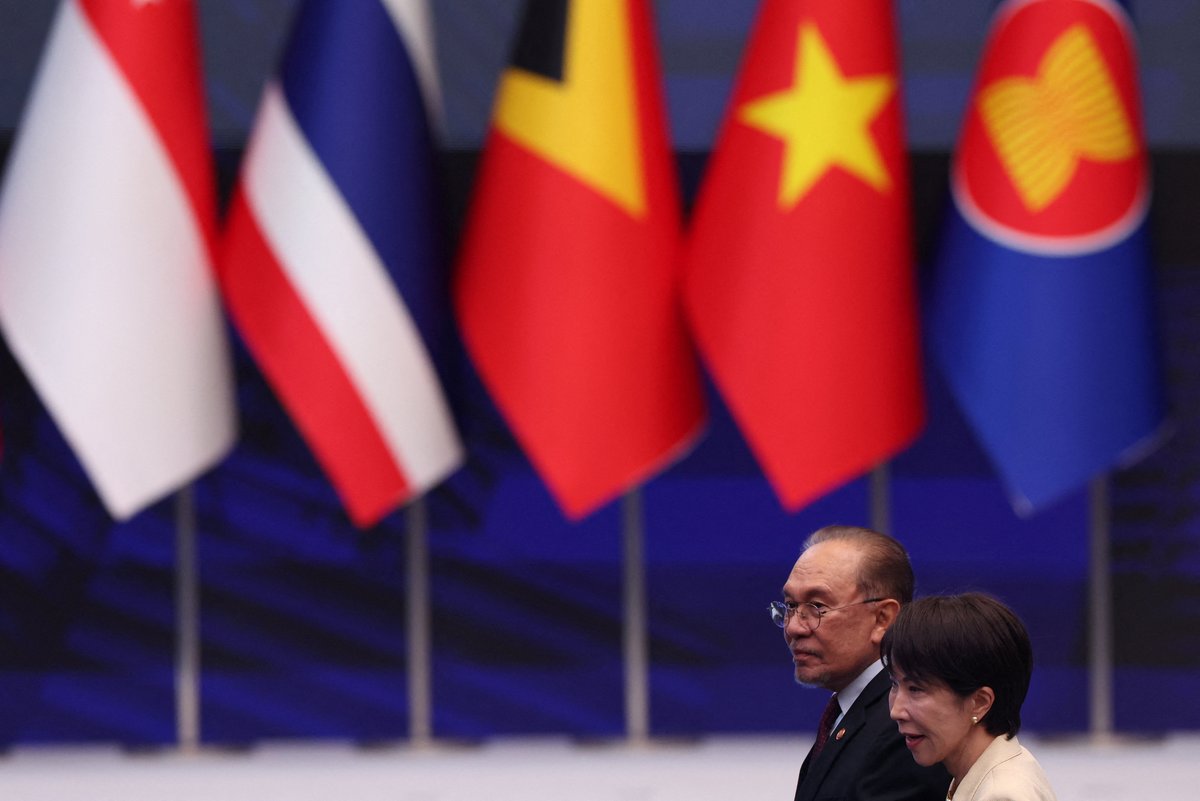
Prime Minister Sanae Takaichi and Malaysia’s Prime Minister Anwar Ibrahim walk at the venue for the 28th ASEAN-Japan Summit as part of the 47th ASEAN Summit in Kuala Lumpur on Sunday.
14:25 JST, October 27, 2025
BEIJING/SEOUL — China and South Korea appear wary of Prime Minister Sanae Takaichi’s conservative political stance. The two countries seem intent on gauging how her stance will be reflected in Japan’s foreign policy.
Since taking office in March 2013, Chinese President Xi Jinping has sent congratulatory messages to foreign leaders upon their inauguration. He has sent such messages to three Japanese prime ministers — Yoshihide Suga, Fumio Kishida and Shigeru Ishiba — on their inauguration days and announced that he had done so.
Takaichi took office last Tuesday, but as of Sunday evening, the Xi administration has not announced whether it had sent a congratulatory message to her. So far, it has only been confirmed that Chinese Premier Li Qiang sent a congratulatory message to Takaichi, according to sources familiar with Japan-China relations.
The Global Times, an affiliate of the Chinese Communist Party’s official newspaper, has described Takaichi as “a leading figure of Japan’s right-wing conservatives.”
Before taking office, Takaichi would visit Yasukuni Shrine on occasions such as the anniversary of the end of World War II and has stressed her stance on protecting Japan’s sovereignty in territorial issues, thereby winning support from conservative voters.
A diplomatic source in Beijing analyzed China’s recent moves as “a possible indication that Beijing is trying to gauge moves by the Takaichi administration going forward.”
South Korean President Lee Jae Myung’s administration sent National Security Adviser Wi Sunglac to Japan on Oct. 21, the day Takaichi’s Cabinet was formed. The following day, Wi held talks with Keiichi Ichikawa, secretary general of the National Security Secretariat, and both agreed on maintaining and developing good bilateral relations.
Wi also met with Liberal Democratic Party Vice President Taro Aso on the same day, according to a South Korean presidential office source. This is a sign that the Lee administration, which is pursuing pragmatic diplomacy that prioritizes national interests, has continuously demonstrated its stance of placing importance on Japan.
However, South Korea’s Yonhap News Agency published an article on Oct. 21 saying Takaichi has made hardline statements on topics such as historical views and territorial issues. It also said that if she visits Yasukuni Shrine, Japan-South Korea relations would suddenly take a sharp turn toward a difficult state.
A South Korean presidential office official anticipated active interactions between the two countries, but also stressed hope that “Japan will face history squarely and act in a manner reflecting genuine remorse.”






Most Read
Popular articles in the past 24 hours
-

Voters Using AI to Choose Candidates in Japan's Upcoming General ...
-

Genichiro Inokuma's Mural in Ueno Station That Gave Hope in Postw...
-
Monkey Strikes Junior High School Girl from Behind in Japan's Yam...
-

Japan's Snow-Clad Beauty: Camellia Flowers Seen in Winter Bloom a...
-
Senior Japanese Citizens Return to University to Gain Knowledge, ...
-
Tokyo Police Arrest Head of Resignation Assistance Firm
-
Heavy Snow Linked to 30 Deaths across Japan since Late Jan.; JMA ...
-

Japan’s Nikkei Stock Average Jumps near 4%, Closes at Record High...
Popular articles in the past week
-

Japan Institute to Use Domestic Commercial Optical Lattice Clock ...
-
Australian Woman Dies After Mishap on Ski Lift in Nagano Prefectu...
-
Foreign Snowboarder in Serious Condition After Hanging in Midair ...
-
Chinese Embassy in Japan Reiterates Call for Chinese People to Re...
-
Narita Airport, Startup in Japan Demonstrate Machine to Compress ...
-

Toyota Motor Group Firm to Sell Clean Energy Greenhouses for Stra...
-
Sakie Yokota, Last Surviving Parent of a North Korea Abductee, Ur...
-
Beer Yeast Helps Save Labor, Water Use in Growing Rice; Govt Hope...
Popular articles in the past month
-
Univ. in Japan, Tokyo-Based Startup to Develop Satellite for Disa...
-
JAL, ANA Cancel Flights During 3-day Holiday Weekend due to Blizz...
-
China Confirmed to Be Operating Drilling Vessel Near Japan-China ...
-

China Eyes Rare Earth Foothold in Malaysia to Maintain Dominance,...
-
M6.2 Earthquake Hits Japan's Tottori, Shimane Prefectures; No Tsu...
-
Japan, Qatar Ministers Agree on Need for Stable Energy Supplies; ...
-
Japan Institute to Use Domestic Commercial Optical Lattice Clock ...
-

Japan, Italy to Boost LNG Cooperation; Aimed at Diversifying Japa...
Top Articles in World
-
China Confirmed to Be Operating Drilling Vessel Near Japan-China Median Line
-
China Eyes Rare Earth Foothold in Malaysia to Maintain Dominance, Counter Japan, U.S.
-
Japan, Qatar Ministers Agree on Need for Stable Energy Supplies; Motegi, Qatari Prime Minister Al-Thani Affirm Commitment to Cooperation
-
North Korea Possibly Launches Ballistic Missile
-

10 Universities in Japan, South Korea, Mongolia to Establish Academic Community to Promote ICC Activities, Rule of Law
JN ACCESS RANKING
-
Univ. in Japan, Tokyo-Based Startup to Develop Satellite for Disaster Prevention Measures, Bears
-
JAL, ANA Cancel Flights During 3-day Holiday Weekend due to Blizzard
-
China Confirmed to Be Operating Drilling Vessel Near Japan-China Median Line
-
China Eyes Rare Earth Foothold in Malaysia to Maintain Dominance, Counter Japan, U.S.
-
Japan, Qatar Ministers Agree on Need for Stable Energy Supplies; Motegi, Qatari Prime Minister Al-Thani Affirm Commitment to Cooperation