
Compatible Motives Bring LDP, JIP Together But Swift Agreement on Coalition May Bring Instability
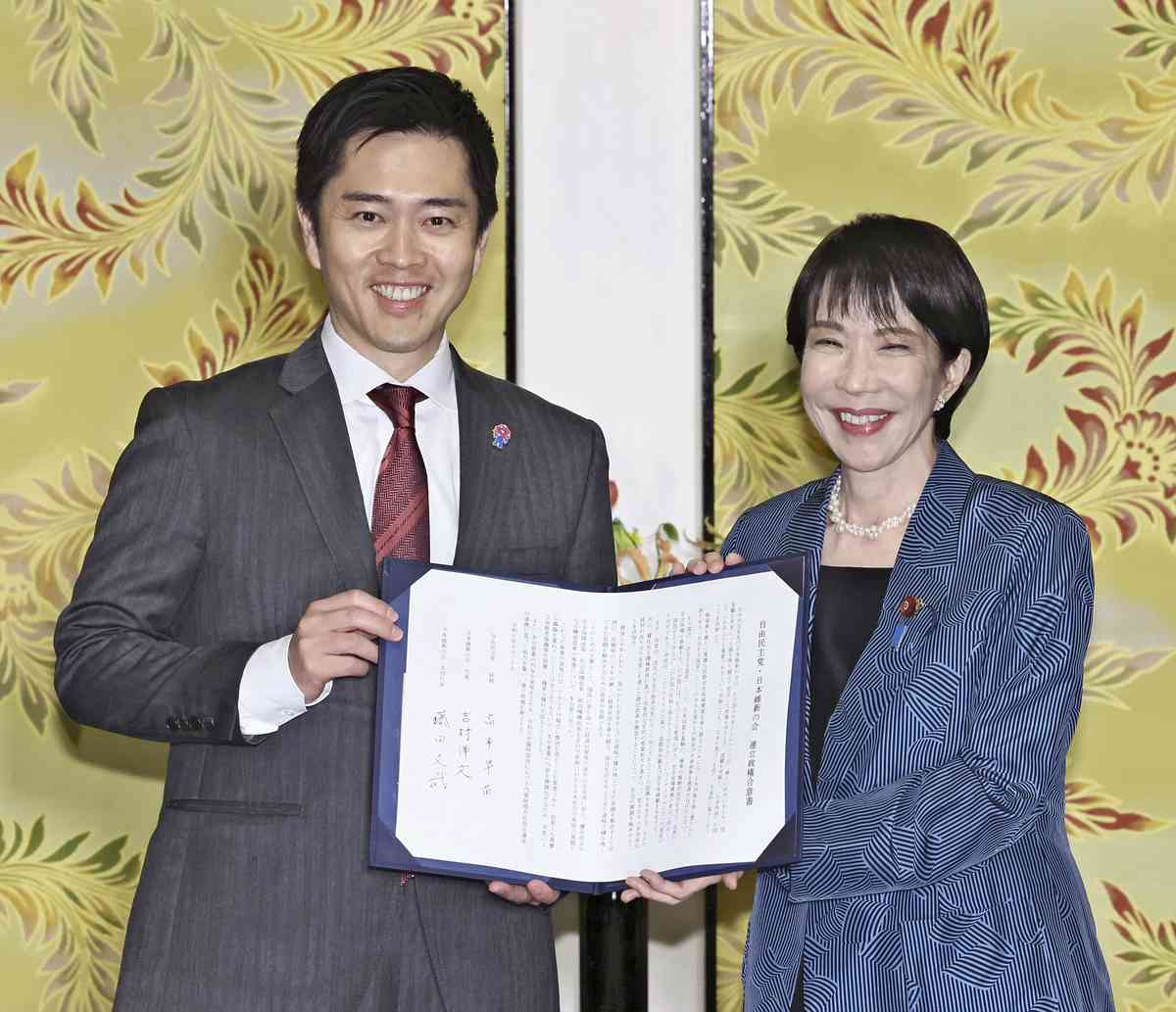
Liberal Democratic Party President Sanae Takaichi, right, and Japan Innovation Party leader Hirofumi Yoshimura hold the document agreeing on a coalition government at the Diet Building in Tokyo on Monday.
17:23 JST, October 21, 2025
The ruling Liberal Democratic Party and the Japan Innovation Party decided very quickly to form a coalition government, agreeing to join forces just a little over 10 days after full-fledged talks started between their leaders.
The two parties had compatible goals — LDP President Sanae Takaichi sought to secure the prime minister’s seat, while JIP leader Hirofumi Yoshimura aimed to assert his party’s presence by implementing its policies.
However, this speedy agreement also brings inherent instability as the coalition sets sail.
“This coalition government [with the JIP] is essential for advancing politics with strength,” Takaichi said with a smile at a joint press conference on Monday after signing a document on the coalition agreement.
Yoshimura echoed her sentiment, saying, “We want to work hand in hand to move politics forward.”
Although they emphasized their close relations, the two leaders did not even know each other’s mobile phone numbers until just before their coalition talks began.
The agreement was reached because Takaichi’s rare connection with the JIP paid off at a crucial moment. On Oct. 9, Takaichi received an email on her mobile phone from Takashi Endo, the JIP’s Diet affairs committee chairperson, which said, “It will be tough, but please do your best.”
At this time, speculation was rife that Komeito was leaning toward leaving the coalition government. Takaichi called Endo and urged the JIP to cooperate with the LDP, saying, “Let’s work together on what we can do.”
Bearing in mind her meeting with Democratic Party for the People leader Yuichiro Tamaki on Oct. 5, Takaichi also stated, “I have no personal relationship with the DPFP as reported in the media,” hinting at her expectation for close cooperation with the JIP.
Although Takaichi has had limited interactions with the JIP, she is acquainted with Endo, who has extensive connections across ruling and opposition parties. They dined together this summer.
Komeito informed Takaichi of its departure from the coalition government on Oct. 10. Takaichi then called Endo and took a step toward cooperation with the JIP, saying, “Let’s have policy talks together.” Endo responded, “If our policies can be realized.” Both parties began working for cooperation behind the scenes.
Led by former Defense Minister Minoru Kihara, who is set to be appointed chief cabinet secretary, and JIP co-leader Fumitake Fujita, arrangements to hold policy talks between the LDP and the JIP were made in the office building for House of Representatives members in Tokyo’s Akasaka district during the three-day holiday starting on Oct. 11.
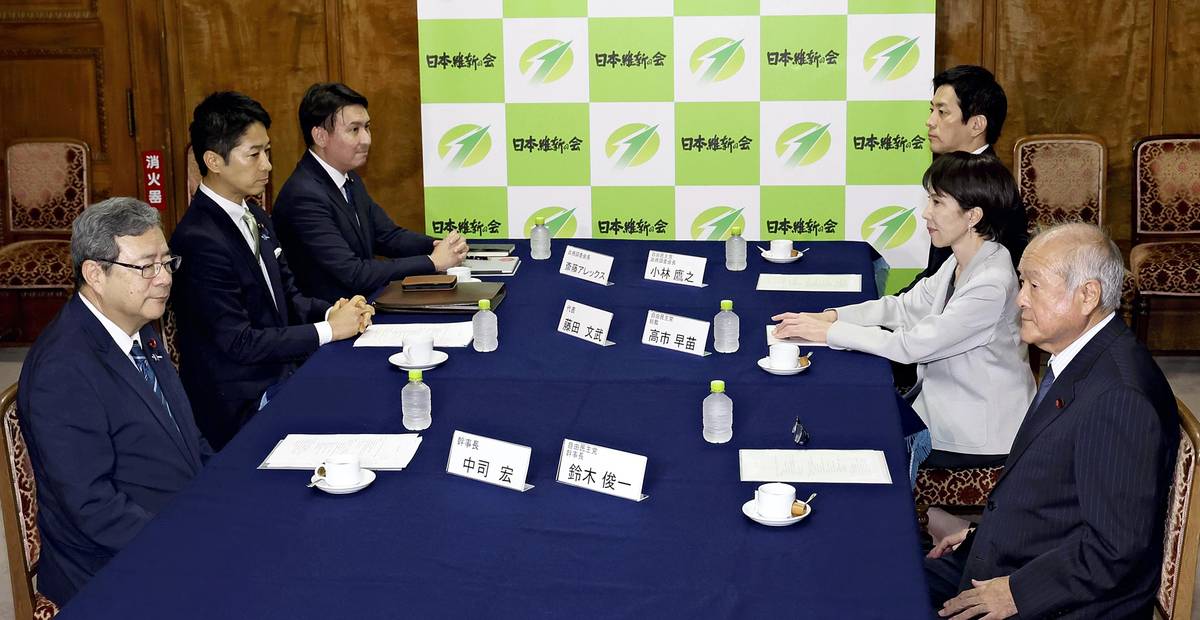
Japan Innovation Party co-leader Fumitake Fujita, second from left, and Liberal Democratic Party President Sanae Takaichi, second from right, hold a meeting in the Diet Building on Oct. 16.
Takaichi obtained Yoshimura’s mobile number from Endo and called Yoshimura on the evening of Oct. 13 to propose a party leader meeting.
Yoshimura answered that Oct. 15 would be possible. He later told his aides that he had felt Takaichi’s desire to improve the country.
Subsequently, the party leader meetings and policy discussions proceeded smoothly.
Reasons of quick conclusion
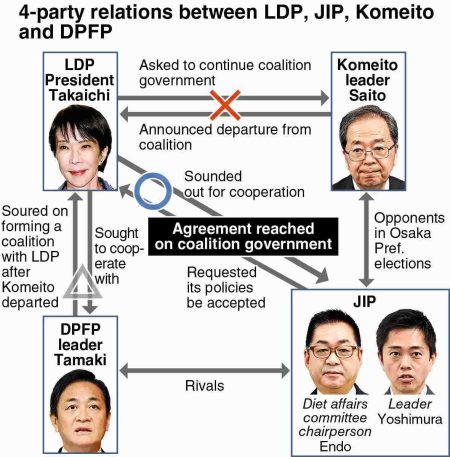
The LDP and the JIP began talks quickly because both sides were in sink-or-swim situations.
With Komeito leaving its coalition with the LDP, Takaichi was facing a situation in which she might not become prime minister if opposition parties fielded a joint candidate. The JIP, which was the second largest opposition party, was also in a difficult position, as its political momentum had weakened and some members left the party.
The JIP had planned to form a coalition with then Agriculture, Forestry and Fisheries Minister Shinjiro Koizumi, who it thought would win the election. When Koizumi ultimately lost, the party needed to find another partner to strengthen its political presence.
After Takaichi became LDP president, the DPFP — a JIP rival regarding policies — suddenly became a potential coalition ally for the LDP.
“We desperately want to weaken the DPFP’s momentum,” a senior JIP member said.
DPFP leader Tamaki became less eager to continue talks after Komeito decided to leave the coalition.
While Tamaki was considering the possibility of becoming the prime ministerial candidate for the opposition parties, the JIP and the LDP quickly began talks.
Tamaki criticized both the JIP and the LDP for their actions, but Yoshimura rejected such censure, saying, “The [DPFP] would be better off pouring its energy into figuring out how to realize its own policies.”
The JIP was formed after politicians including former leader Ichiro Matsui left an LDP-led parliamentary force in the Osaka prefectural assembly in 2009. Its policies are similar to those of the LDP regarding constitutional revision, diplomacy and national security.
It proved effective that the JIP had compiled a list of policy measures under the assumption that Koizumi would become LDP president.
However, the speed of the decision to join forces even surprised some within the LDP. “It was surprising that [the coalition talks] were concluded in such a short period of time,” a senior LDP member said.
With the LDP-Komeito coalition, talks behind the scenes began around summer 1998 and the LDP and the now-defunct Liberal Party formed a coalition in January 1999.
Komeito joined in October 1999 to make it a three-party coalition.
Bitter experience
Because they focused on forming a coalition so quickly, the LDP and the JIP have not had time to build up trust in each other.
Former JIP leader Nobuyuki Baba had insisted that the JIP should be a non-cabinet ally. “A situation in which [the JIP] can join the cabinet and begin moving forward has not yet arrived,” Baba told reporters.
In 2024, when Baba was the leader of the JIP, he and then Prime Minister Fumio Kishida signed a written agreement on reforms of Diet lawmakers’ allowances for travel, accommodations and other such expenses. However, the JIP felt the LDP did not keep their promise about when the reforms would be implemented.
Some JIP members were hesitant, worried about the same thing happening again.
“If the policy agreement is not fulfilled, we should simply leave [the coalition],” one JIP member said.
The LDP and Komeito made policy adjustments for years and worked to find compromises in areas where the two parties differed. Policy coordination between the LDP and the JIP will likely go through a process of trial and error.
Some within the LDP are cautious.
“The JIP will continue to make huge demands, aiming to increase its presence,” said one LDP member.
The new coalition’s administration began Tuesday with both parties unable to completely forget about their concerns.


Related Tags

Most Read
Popular articles in the past 24 hours
-

Voters Using AI to Choose Candidates in Japan's Upcoming General ...
-

Japan's Snow-Clad Beauty: Camellia Flowers Seen in Winter Bloom a...
-
Monkey Strikes Junior High School Girl from Behind in Japan's Yam...
-
Genichiro Inokuma's Mural in Ueno Station That Gave Hope in Postw...
-
Senior Japanese Citizens Return to University to Gain Knowledge, ...
-

Foreign and Security Policy: Political Parties Must Discuss How T...
-

Heavy Snow Linked to 30 Deaths across Japan since Late Jan.; JMA ...
-
Tokyo Police Arrest Head of Resignation Assistance Firm
Popular articles in the past week
-

Japan Institute to Use Domestic Commercial Optical Lattice Clock ...
-
Australian Woman Dies After Mishap on Ski Lift in Nagano Prefectu...
-
Foreign Snowboarder in Serious Condition After Hanging in Midair ...
-
Chinese Embassy in Japan Reiterates Call for Chinese People to Re...
-
Narita Airport, Startup in Japan Demonstrate Machine to Compress ...
-

Toyota Motor Group Firm to Sell Clean Energy Greenhouses for Stra...
-
Sakie Yokota, Last Surviving Parent of a North Korea Abductee, Ur...
-

Beer Yeast Helps Save Labor, Water Use in Growing Rice; Govt Hope...
Popular articles in the past month
-
Univ. in Japan, Tokyo-Based Startup to Develop Satellite for Disa...
-

JAL, ANA Cancel Flights During 3-day Holiday Weekend due to Blizz...
-
China Confirmed to Be Operating Drilling Vessel Near Japan-China ...
-
China Eyes Rare Earth Foothold in Malaysia to Maintain Dominance,...
-
M6.2 Earthquake Hits Japan's Tottori, Shimane Prefectures; No Tsu...
-
Japan Institute to Use Domestic Commercial Optical Lattice Clock ...
-
Japan, Qatar Ministers Agree on Need for Stable Energy Supplies; ...
-
Japan, Italy to Boost LNG Cooperation; Aimed at Diversifying Japa...
Top Articles in Politics
-
Japan Seeks to Enhance Defense Capabilities in Pacific as 3 National Security Documents to Be Revised
-
Japan Tourism Agency Calls for Strengthening Measures Against Overtourism
-
Japan’s Prime Minister: 2-Year Tax Cut on Food Possible Without Issuing Bonds
-
Japan-South Korea Leaders Meeting Focuses on Rare Earth Supply Chains, Cooperation Toward Regional Stability
-

Japanese Government Plans New License System Specific to VTOL Drones; Hopes to Encourage Proliferation through Relaxed Operating Requirements
JN ACCESS RANKING
-
Univ. in Japan, Tokyo-Based Startup to Develop Satellite for Disaster Prevention Measures, Bears
-
JAL, ANA Cancel Flights During 3-day Holiday Weekend due to Blizzard
-
China Confirmed to Be Operating Drilling Vessel Near Japan-China Median Line
-
China Eyes Rare Earth Foothold in Malaysia to Maintain Dominance, Counter Japan, U.S.
-
Japan Institute to Use Domestic Commercial Optical Lattice Clock to Set Japan Standard Time