
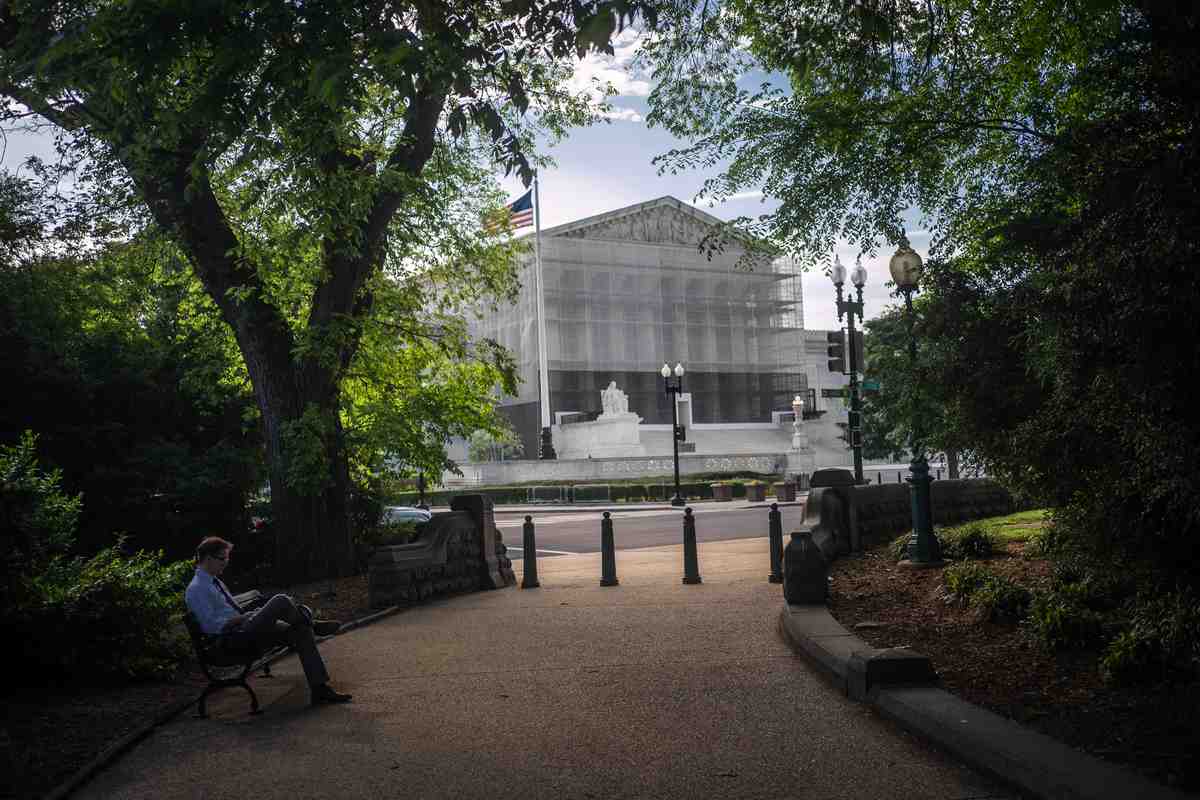
The Supreme Court heard arguments Wednesday about whether race played too large a role in the decision to create a second majority-Black congressional district in Louisiana.
13:28 JST, October 16, 2025
The Supreme Court seemed open Wednesday to further limiting the use of race in drawing legislative maps, a move that could undermine the last major pillar of the Voting Rights Act, which has bolstered the power of minority voters and candidates for more than half a century and is widely considered one of the most significant laws of the civil rights era.
The court’s conservative majority appeared sympathetic to arguments by attorneys for Louisiana and the Trump administration, who said race played too large a role in the decision to create a second Black-majority congressional district in the state, in violation of the Constitution’s provision that all people must be treated equally. Black voters had sued, claiming their voting power had been diluted by a previous map.
Several conservative justices appeared to be searching for ways to cap how and when states consider race as they redistrict. Such a ruling would most likely lead to a decline in the number of minorities holding public office. It would also touch off a scramble to redraw electoral maps across the country, putting Black elected officials in particular danger.
At issue is Section 2 of the Voting Rights Act, which requires states to craft legislative districts under certain circumstances to ensure Black and other minority voters have an opportunity to elect candidates of their choice. It was fashioned in 1965 to root out discriminatory practices in voting and elections that had long diminished the voting power of Black Americans and was strengthened by Congress in 1982.
But conservative justices signaled it might be time to curtail the law.
“This court’s cases in a variety of contexts have said that race-based remedies are permissible for a period of time, sometimes for a long period of time, decades in some cases, but that they should not be indefinite and should have an end point,” Justice Brett M. Kavanaugh said during 2½ hours of sometimes contentious arguments.
Chief Justice John G. Roberts Jr. chimed in at another point to ask, “What’s the proper size?” in talking about the role race should play in drawing voting maps.
Those two justices provided the key votes for a decision two years ago that said Alabama had drawn electoral maps that diluted the power of Black voters. Their comments this time indicated openness to changing how the law works to control redistricting decisions but left unclear how far they might go in trimming Section 2.
Louisiana Solicitor General Benjamin Aguiñaga told the justices that any “race-based redistricting is fundamentally contradictory to our Constitution” and said the creation of “majority-minority” districts relied on outmoded ideas about voting in communities of color. He said that Louisiana had changed in recent decades, so the need for the protections of Section 2 had diminished.
“It requires striking enough members of the majority race to sufficiently diminish their voting strength, and it requires drawing in enough members of a minority race to sufficiently augment their voting strength,” Aguiñaga said. “Embedded within these express targets are racial stereotypes that this court has long criticized.”
Hashim Mooppan, principal deputy solicitor general for the Trump administration, did not go as far as Aguiñaga. He said states should be allowed to factor race into redistricting decisions, but only if racial considerations take a back seat to race-neutral factors in creating maps, like protecting incumbents. Too often the law is bolstering Democrats rather than leveling the playing field for racial minorities, he said.
“The problem is not the mere consideration of race in districting,” Mooppan said. “The problem is when race subordinates traditional neutral principles and is the factor that cannot be compromised.”
The court’s three liberals sharply questioned lawyers for Louisiana and the Trump administration and were deeply skeptical of changes to the law. Justice Sonia Sotomayor tartly responded to Mooppan that their position amounted to “bottom line … just get rid of Section 2.” She said its practical impact would be to gut the Voting Rights Act.
Justice Elena Kagan asked an attorney for Black voters in Louisiana what impact a demise of Section 2 would have.
“The results would be pretty catastrophic,” Janai Nelson bluntly responded.
“We only have the diversity we see across the South because of litigation” under the voting rights law, Nelson said, adding that it had been “crucial to diversifying leadership” in Louisiana and other states. Even now, she said, no Black person has been elected to statewide office in Louisiana.
Roughly a dozen majority-minority districts exist across the South and account for roughly 1 in 4 of the Black representatives in Congress. Democrats fear that if the Voting Rights Act is weakened, Republican-controlled legislatures would wipe out those districts.
The case arrives at a moment when President Donald Trump has pushed Republican states to redraw their congressional maps to try to shore up conservatives’ slim House majority. Democrats in California and other states are considering redistricting to counter that plan. It’s unclear, however, if a decision in the current case would come in time to affect next year’s midterm congressional elections. The justices are likely to issue a decision in the case by June or July.
Wednesday’s session was an uncommon reargument of the case, which the justices first heard last term.
In August, the justices told the parties that they should address the question of whether Section 2 violated the 14th and 15th amendments, which were passed after the Civil War to guarantee Black people citizenship, equal treatment and the right to vote.
States typically have to thread a needle when creating voting maps. The Voting Rights Act allows states to consider race when drawing districts to redress past racial discrimination and requires that minority voters have a realistic opportunity to elect representatives of their choice. Maps drawn explicitly along racial lines, however, violate the 14th Amendment’s equal protection clause and the 15th Amendment’s ban on racial discrimination in voting practices, the Supreme Court has said in previous decisions.
The Louisiana case has followed an especially circuitous path, which illustrates how complicated complying with those commands can be.
In 2022, Black voters and civil rights groups sued Louisiana under Section 2, saying the state had diluted their voting power by creating a new congressional map that had only one Black-majority district out of six. African Americans make up a third of the state’s population.
A federal judge ruled for the plaintiffs and ordered the state to craft a new map with a second Black-majority district. After additional legal wrangling, the Louisiana legislature drew such a map in 2024.
The new map that lawmakers approved, drawn in part to protect the seats of powerful Republican incumbents, including House Speaker Mike Johnson and House Majority Leader Steve Scalise, created a Black-majority district that snaked across the state from Baton Rouge to Shreveport.
A self-described “non-Black voter” group then sued to block the new map. They argued it was an unconstitutional racial gerrymander that violated the equal protection clause. A district court panel ruled for the non-Black plaintiffs and put a hold on the redrawn map.
The Supreme Court eventually allowed the map with two Black-majority districts to go into effect for the 2024 congressional election. Voters selected Cleo Fields, a Black Democrat, for the new seat.
The non-Black voters brought their case back to the Supreme Court, which initially heard it last term. In June, however, the justices decided to put off ruling and said they would hear additional arguments.
Over the last several decades, the courts have interpreted the 14th and 15th amendments in ways that traditionally give the states some space to comply with the Voting Rights Act. But that appears to be in danger.
The Supreme Court previously dealt a major blow to the Voting Rights Act in 2013. In a decision that year, a sharply divided court invalidated Section 5 of the act, which required certain states with a history of racial discrimination in voting to get “pre-clearance” from the federal government before changing election rules. Most of those states are in the South.
“Our country has changed, and while any racial discrimination in voting is too much, Congress must ensure that the legislation it passes to remedy that problem speaks to current conditions,” Roberts wrote for the majority in that case.
The demise of Section 5 led to a wave of laws requiring voters to show IDs and to curbs on mail-in voting. Critics say such rules have made it more difficult to vote, particularly for communities of color.
The court has also recently curtailed the use of race to address discrimination in a series of rulings. Most notably, the court struck down affirmative action in college admissions in a major decision in 2023. Roberts also penned that decision, writing that “the student must be treated based on his or her experiences as an individual – not on the basis of race.”




Most Read
Popular articles in the past 24 hours
-

Japan's Snow-Clad Beauty: Camellia Flowers Seen in Winter Bloom a...
-

Monkey Strikes Junior High School Girl from Behind in Japan's Yam...
-
Genichiro Inokuma's Mural in Ueno Station That Gave Hope in Postw...
-

Foreign and Security Policy: Political Parties Must Discuss How T...
-
Senior Japanese Citizens Return to University to Gain Knowledge, ...
-
Heavy Snow Linked to 30 Deaths across Japan since Late Jan.; JMA ...
-

Tokyo Police Arrest Head of Resignation Assistance Firm
-

Japan’s Nikkei Stock Average Jumps near 4%, Closes at Record High...
Popular articles in the past week
-

Japan Institute to Use Domestic Commercial Optical Lattice Clock ...
-
Australian Woman Dies After Mishap on Ski Lift in Nagano Prefectu...
-
Foreign Snowboarder in Serious Condition After Hanging in Midair ...
-

Chinese Embassy in Japan Reiterates Call for Chinese People to Re...
-
Narita Airport, Startup in Japan Demonstrate Machine to Compress ...
-

Toyota Motor Group Firm to Sell Clean Energy Greenhouses for Stra...
-
Sakie Yokota, Last Surviving Parent of a North Korea Abductee, Ur...
-

Beer Yeast Helps Save Labor, Water Use in Growing Rice; Govt Hope...
Popular articles in the past month
-

Univ. in Japan, Tokyo-Based Startup to Develop Satellite for Disa...
-
JAL, ANA Cancel Flights During 3-day Holiday Weekend due to Blizz...
-
China Confirmed to Be Operating Drilling Vessel Near Japan-China ...
-

China Eyes Rare Earth Foothold in Malaysia to Maintain Dominance,...
-
Japan Institute to Use Domestic Commercial Optical Lattice Clock ...
-
M6.2 Earthquake Hits Japan's Tottori, Shimane Prefectures; No Tsu...
-

Japan, Qatar Ministers Agree on Need for Stable Energy Supplies; ...
-
Japan, Italy to Boost LNG Cooperation; Aimed at Diversifying Japa...
Top Articles in News Services
-
Arctic Sees Unprecedented Heat as Climate Impacts Cascade
-
Prudential Life Expected to Face Inspection over Fraud
-

South Korea Prosecutor Seeks Death Penalty for Ex-President Yoon over Martial Law (Update)
-
Trump Names Former Federal Reserve Governor Warsh as the Next Fed Chair, Replacing Powell
-

Japan’s Nagasaki, Okinawa Make N.Y. Times’ 52 Places to Go in 2026
JN ACCESS RANKING
-
Univ. in Japan, Tokyo-Based Startup to Develop Satellite for Disaster Prevention Measures, Bears
-
JAL, ANA Cancel Flights During 3-day Holiday Weekend due to Blizzard
-
China Confirmed to Be Operating Drilling Vessel Near Japan-China Median Line
-
China Eyes Rare Earth Foothold in Malaysia to Maintain Dominance, Counter Japan, U.S.
-
Japan Institute to Use Domestic Commercial Optical Lattice Clock to Set Japan Standard Time