
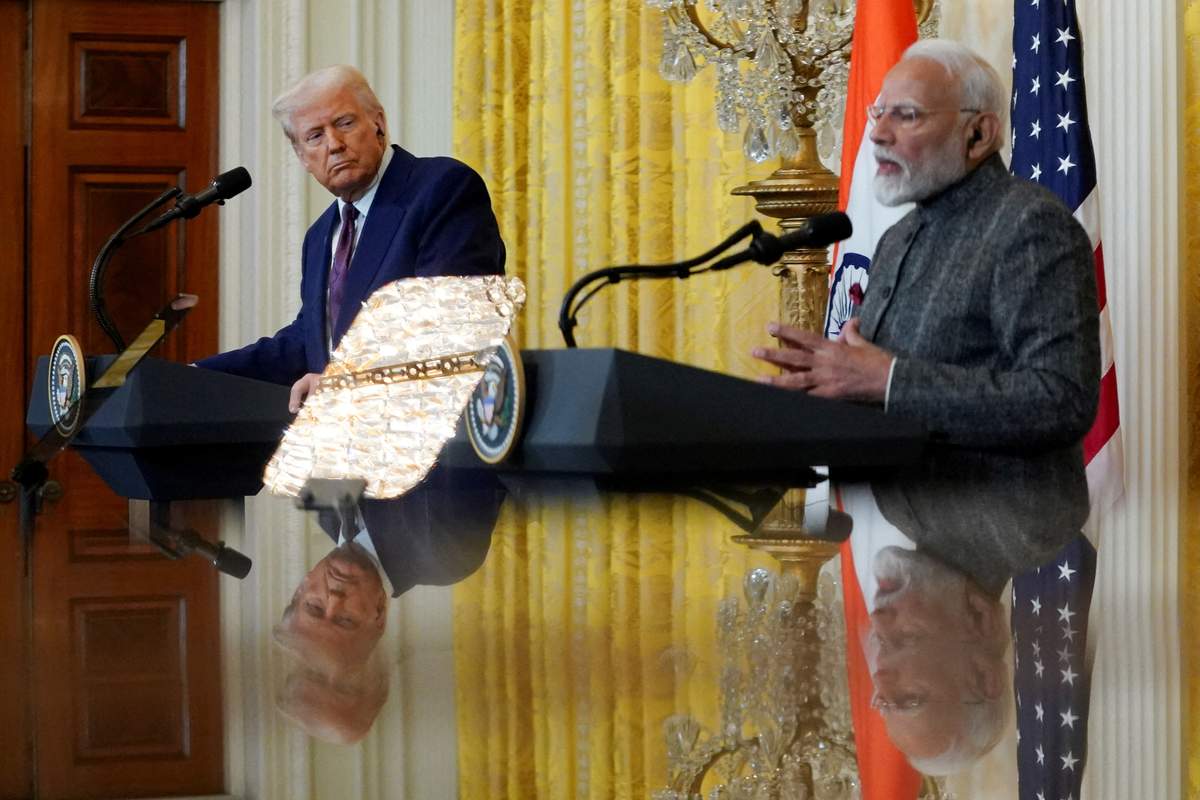
U.S. President Donald Trump and Indian Prime Minister Narendra Modi are pictured in a mirror as they attend a joint press conference at the White House in Washington, D.C., U.S., February 13, 2025.
10:24 JST, October 16, 2025
WASHINGTON, Oct 15 (Reuters) – U.S. President Donald Trump said on Wednesday that Indian Prime Minister Narendra Modi has pledged to stop buying oil from Russia, and Trump said he would next try to get China to do the same as Washington intensifies efforts to cut off Moscow’s energy revenues.
India and China are the two top buyers of Russian seaborne crude exports, taking advantage of the discounted prices Russia has been forced to accept after European buyers shunned purchases and the U.S. and the European Union imposed sanctions on Moscow for its invasion of Ukraine in February 2022.
Trump has recently targeted India for its Russian oil purchases, imposing tariffs on Indian exports to the U.S. to discourage the country’s crude buying as he seeks to choke off Russia’s oil revenues and pressure Moscow to negotiate a peace deal in Ukraine.
“So I was not happy that India was buying oil, and he assured me today that they will not be buying oil from Russia,” Trump told reporters during a White House event.
“That’s a big step. Now we’re going to get China to do the same thing.”
The Indian embassy in Washington did not immediately respond to emailed questions about whether Modi had made such a commitment to Trump.
Russia is India’s top oil supplier. Moscow exported 1.62 million barrels per day to India in September, roughly one third of the country’s oil imports. For months, Modi resisted U.S. pressure, with Indian officials defending the purchases as vital to national energy security.
While imports from other producers would likely cost India more, lower oil prices would temper the impact. Benchmark Brent crude futures LCOc1 hit a five-month low on Wednesday on concerns about a growing surplus in the market.
A move by India to stop imports would signal a major shift by one of Moscow’s top energy customers and could reshape the calculus for other nations still importing Russian crude. Trump wants to leverage bilateral relationships to enforce economic isolation on Russia, rather than relying solely on multilateral sanctions.
The announcement comes just days after Trump’s new pick for Indian ambassador, Sergio Gor, met with Modi. The two discussed defense, trade and technology issues. The appointment of Gor, a close confidant to Trump, was widely seen as a positive move for the U.S.-India bilateral relationship.
During his comments to reporters, Trump added that India could not “immediately” halt shipments, calling it “a little bit of a process, but that process will be over soon.”
Despite his push on India, Trump has largely avoided placing similar pressure on China. The U.S. trade war with Beijing has complicated diplomatic efforts, with Trump reluctant to risk further escalation by demanding a halt to Chinese energy imports from Russia.
Trump imposed a 25 percent tariff on India this summer after the two countries failed to reach an initial trade agreement. He followed up with an additional 25 percent because of the country’s purchases of Russian oil. India chafed at the move because no other top purchasers of Russian oil, like China or Turkey, were hit with similar tariffs.


Related Tags



Most Read
Popular articles in the past 24 hours
-

Voters Using AI to Choose Candidates in Japan's Upcoming General ...
-

Japan's Snow-Clad Beauty: Camellia Flowers Seen in Winter Bloom a...
-
Monkey Strikes Junior High School Girl from Behind in Japan's Yam...
-

Genichiro Inokuma's Mural in Ueno Station That Gave Hope in Postw...
-
Senior Japanese Citizens Return to University to Gain Knowledge, ...
-

Foreign and Security Policy: Political Parties Must Discuss How T...
-
Heavy Snow Linked to 30 Deaths across Japan since Late Jan.; JMA ...
-
Tokyo Police Arrest Head of Resignation Assistance Firm
Popular articles in the past week
-

Japan Institute to Use Domestic Commercial Optical Lattice Clock ...
-
Australian Woman Dies After Mishap on Ski Lift in Nagano Prefectu...
-
Foreign Snowboarder in Serious Condition After Hanging in Midair ...
-
Chinese Embassy in Japan Reiterates Call for Chinese People to Re...
-
Narita Airport, Startup in Japan Demonstrate Machine to Compress ...
-

Toyota Motor Group Firm to Sell Clean Energy Greenhouses for Stra...
-
Sakie Yokota, Last Surviving Parent of a North Korea Abductee, Ur...
-
Beer Yeast Helps Save Labor, Water Use in Growing Rice; Govt Hope...
Popular articles in the past month
-
Univ. in Japan, Tokyo-Based Startup to Develop Satellite for Disa...
-
JAL, ANA Cancel Flights During 3-day Holiday Weekend due to Blizz...
-
China Confirmed to Be Operating Drilling Vessel Near Japan-China ...
-
China Eyes Rare Earth Foothold in Malaysia to Maintain Dominance,...
-
M6.2 Earthquake Hits Japan's Tottori, Shimane Prefectures; No Tsu...
-
Japan Institute to Use Domestic Commercial Optical Lattice Clock ...
-
Japan, Qatar Ministers Agree on Need for Stable Energy Supplies; ...
-
Japan, Italy to Boost LNG Cooperation; Aimed at Diversifying Japa...
Top Articles in News Services
-

Arctic Sees Unprecedented Heat as Climate Impacts Cascade
-

Prudential Life Expected to Face Inspection over Fraud
-

South Korea Prosecutor Seeks Death Penalty for Ex-President Yoon over Martial Law (Update)
-
Trump Names Former Federal Reserve Governor Warsh as the Next Fed Chair, Replacing Powell
-

Japan’s Nagasaki, Okinawa Make N.Y. Times’ 52 Places to Go in 2026
JN ACCESS RANKING
-
Univ. in Japan, Tokyo-Based Startup to Develop Satellite for Disaster Prevention Measures, Bears
-
JAL, ANA Cancel Flights During 3-day Holiday Weekend due to Blizzard
-
China Confirmed to Be Operating Drilling Vessel Near Japan-China Median Line
-
China Eyes Rare Earth Foothold in Malaysia to Maintain Dominance, Counter Japan, U.S.
-
Japan Institute to Use Domestic Commercial Optical Lattice Clock to Set Japan Standard Time