
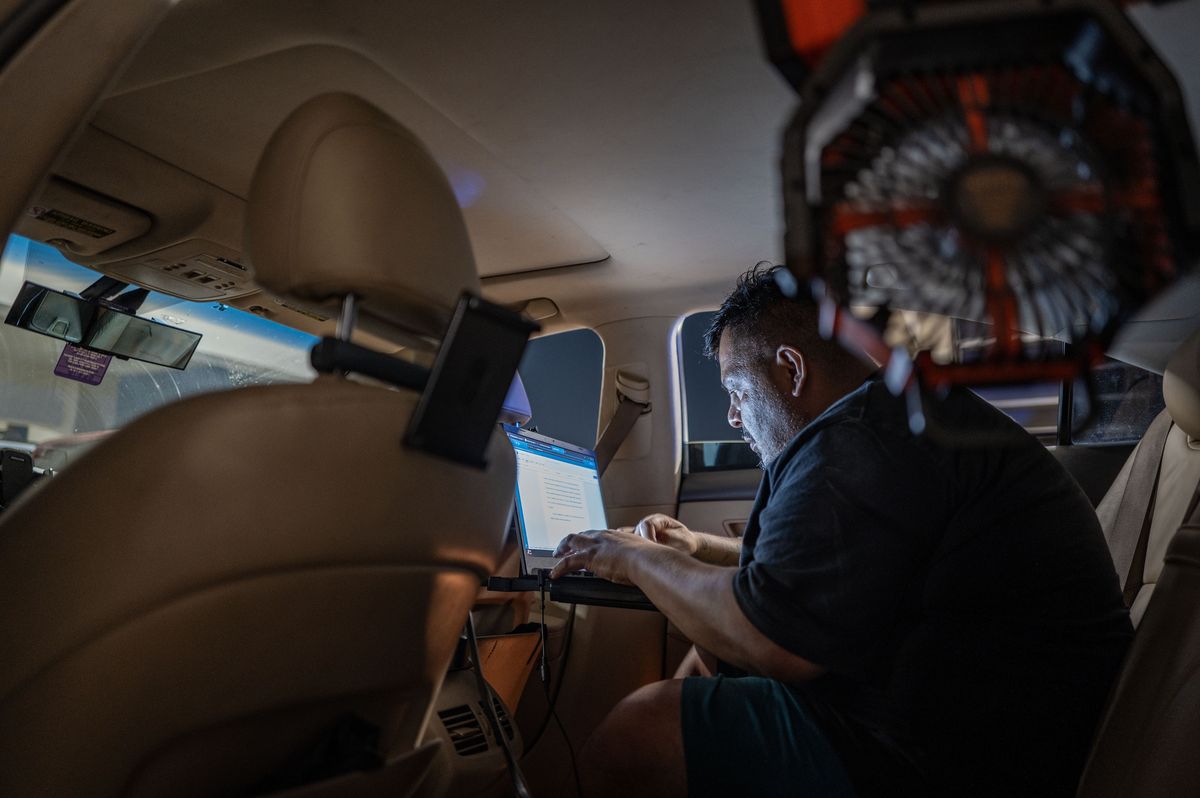
Long Beach City College student Edgar Rosales Jr. works on homework in the back seat of his car.
14:57 JST, October 13, 2025
LONG BEACH, Calif. – To most at Long Beach City College, there’s nothing special about Parking Lot N – just another drab slab of asphalt near the center of campus.
But to Edgar Rosales Jr., the lot has been a lifeline. Each evening, around 8 p.m., it transforms into a refuge for students with nowhere else to go. For roughly a year, Rosales has joined handfuls of his classmates here, parking his gold ’07 Lexus sedan in one of 15 spaces allotted to the school’s homeless undergrads.
Night after night, Rosales, 39, has blacked out his windows and tipped back his passenger seat, trying to catch a few hours of sleep with his heels pressed against the floorboard, knees aching and battery-powered fan whirring in the stifling Southern California heat.
As the United States contends with an escalating homelessness epidemic, more people than ever are living in their cars – including college students like Rosales – many juggling jobs, family and their studies. Local governments and nonprofits have increasingly embraced “safe parking programs,” secure lots that allow people to sleep in their vehicles overnight, but they remain rare on campuses.
“The number one word in my head is: survive, survive, survive,” said Rosales, a former long-haul truck driver.
Long Beach City College, a community college, is led by a president who was once homeless himself. It has no dorms, but is one of the only schools in the country to offer its unhoused students a safe parking option. In California, capital of the housing crisis, it’s badly needed. One in 5 community college students in the state has been homeless in the past year, a recent study found.
Parking lots are nobody’s idea of a permanent housing solution. But, proponents say, they can be an effective stopgap, and they’re a lot better than the alternative: students left to fend for themselves, searching for spots to sleep on potentially dangerous city streets. That’s where Rosales was before he found LBCC’s safe parking program: driving through Long Beach’s roughest neighborhoods, a different dark corner every night. Without the school lot, he said, he would have dropped out.
“It’s been my home,” Rosales said. “It’s consistently given me somewhere to be every night. They never kicked me out.”
Still, this is not how he pictured college.
His school days begin when the sun shines through the cracks in his car windows. Jolted awake, Rosales unsticks himself from his torn leather seat and stashes his pillows in the trunk. Then he rushes to the college’s football stadium, where he’s allowed to take a quick shower in one of the locker rooms before walking into his first class looking – he hopes – like all the other students.
‘Rock bottom gets deeper’
Rosales, a Los Angeles native, was raised around trucks. His father and grandfather both drove big rigs, and when he turned 18, he dropped out of high school to do the same. He drove semis for two decades, transporting all sorts of cargo. He lived for the long-haul journeys, plotting out his routes, passing through his favorite pitstops, a new state every day.
He saw the Lake of the Ozarks in Missouri and tornado chasers in Kansas. Back then, he didn’t mind being cooped up in his cab. He had a choice – and a house to go back to at the end of the trip.
In June 2023, he was laid off for the first time. He found another driving job, but trucking no longer felt like a viable career, and he had two children to consider. So he decided to go back to school. He would become a nurse and move into a growing field with a decent starting salary.
Long Beach City College was close to home and had a lively campus, with more than 35,000 students. He enrolled.
But things got complicated fast. Rosales had been living with an ex until last fall. Shortly after he started at LBCC, she asked him to move out, he said.
In one of the country’s tightest rental markets, and without much savings, he had few options. Rosales crashed with one of his younger brothers for a while, but he didn’t want to be a burden, and he was too proud to say anything to his other family members.
“I’ve got to figure this out. I’m old,” he said. “How am I going to be asking my aunts and uncles and brothers for help?”
He was exhausted – working by night, attending class by day – and his grades were starting to suffer.
“When you’re hungry, when you’re cold, when you’re tired because you haven’t had a good night’s sleep, it’s going to be nearly impossible to focus on your studies,” said Alex Visotzky, a senior California policy fellow at the nonprofit National Alliance to End Homelessness.
When Rosales explained his situation to a guidance counselor, she told him about the school’s Basic Needs program, with its food pantry, shower program and safe parking lot.
It was a long way from a home, but at least it was a sure thing. He signed up. Then things got worse. He was laid off again and needed the program more than ever.
“Rock bottom gets deeper,” he said. “And you don’t know about it until you’ve faced it.”
No perfect solutions
Mike Muñoz, the superintendent-president of Long Beach City College, knows about rock bottom, too.
He was 17 when his family lost their home. Estranged from his father, he wound up on his own. He often went hungry. He couch-surfed and slept in his car. Then he became a single parent – all while trying to go to school.
“It felt insurmountable, and I was going to drop out,” he said, more than two decades later.
But school apartments for families at UC Irvine gave him and his daughter stability. He finished his degree and rose quickly through academic ranks as a counselor and administrator. In 2021, he took over the top job at LBCC, aiming to do more for students who face the same challenges he once did. He began pushing for a safe parking program.
Muñoz knew the requirements could not be too onerous. Homeless students wouldn’t be able to afford to keep their registrations or insurance up-to-date. The school would have to help with that.
“I knew that from life experience,” he said. “Because I was one of those people that was riding dirty.”
The program runs year-round and is open to students enrolled in at least one class. Staff act as case managers, connecting students to other services and helping them secure long-term housing.
It has become more popular every semester. During the first year Rosales slept in the lot, about 60 other students used it at least once. This term, the program has averaged 10 students a night, the most ever.
The LBCC program – which costs roughly $265,000 a year and is covered by the school’s philanthropic foundation and its general fund – remains one of the only official safe parking sites at a college or university.
California lawmakers have tried several times to pass bills requiring community colleges and the California State University system to develop safe parking pilot programs. Schools have overwhelmingly fought the bills, citing concerns over cost and legal liability. They also argue the lots would draw resources away from permanent housing.
But LBCC has managed to fund both safe parking and a recently announced affordable student dorm complex, set to open in about three years.
The most recent safe parking bill, sponsored by Democratic State Assembly member Corey A. Jackson, died last month. State Republicans joined the schools in opposition, blaming Democrats for a housing crisis that has worsened on their watch and alleging safe parking lots would do nothing to help.
“We’re again taking a Band-Aid approach to dealing with this problem,” Assembly member Carl DeMaio (R), who occasionally lived in his car as a high school and college student, said during a floor debate on the bill.
But with long-term answers to the state’s desperate housing shortage still far off, Jackson said schools have a duty to help their most vulnerable students now.
“My goal is to solve issues, not to have the perfect solution – because those don’t exist in California anymore,” said Jackson, a former social worker. “It is morally wrong to force people to wait for the perfect solution and allow them to suffer while they wait.”
‘The world is open to him’
When the days end and the other students head home, Rosales turns to his own private map of campus, an internal guide to the buildings that stay open late.
He knows where to find the coldest blasts of AC, the offices with plentiful giveaway snacks and the bathrooms that remain unlocked at all hours.
But most importantly, he knows where the electrical outlets are.
Battery power is a precious resource, and Rosales carries an extension cord in his Lexus so he can plug in while he’s parked. His favorite place is a campus garage, where he can catch a cool evening breeze and wait for the safe lot to open. As he charges his computer, phone and fan, he unfolds an improvised desk that hangs from the back of his passenger side headrest. He sits in the back seat, opens his laptop and tries to concentrate on homework, hoping passersby don’t notice.
Living in your car can be an isolating experience. But as he spent more time in the safe parking program, Rosales began to discover that the school had a bounty of programs to help students like him – free books, free clothes, free haircuts, free therapy.
He switched his focus from nursing to public health. He wants to be an advocate for people on the margins. He became an ambassador for the safe parking program, organizing breakfast potlucks for the other participants. And he started a club – called Voz, which means “voice” in Spanish – to help low-income and homeless students find on-campus resources.
“Through his own challenges, he’s seeing past himself and wants to help others,” said Justin Mendez, the director of Basic Needs at LBCC, who met Rosales shortly after he enrolled. “I don’t think he sees his full potential yet. And the world is open to him. We’re blessed to have him as a student.”
But Rosales is still struggling to get by. His unemployment insurance expired over the summer. His food stamps never seem to last long enough. He’s paying for school with Pell grants and a little help from his family.
He misses his kids, ages 10 and 16, who are living with their mothers. He didn’t want them to know he was homeless, but they’ve pieced it together. He dreams that someday soon he’ll have a place of his own, where they can come visit and stay with him.
Until then, he measures his gas obsessively. He’s learning to fix his brakes and motor mounts himself so he can save money on repairs. Driving used to be his escape, but these days it feels more like a trap.
“Instead of a passion, it became a curse,” he said. “I’m doing everything in my car, 24/7. This is getting smaller and smaller, and then I can’t breathe.”
As the fall semester began, Rosales was steeling himself for another school year in his car. Then, Mendez delivered a bit of news that changed everything: Rosales had been accepted into a bridge housing program, paid for by the school and operated by a local nonprofit.
He could move into a shared room in a shared house in early September. He didn’t believe it. The staff at the nonprofit, Jovenes, would teach him about saving, help him put away what he made from a new internship and eventually move into a place of his own. It was more than he even dared to imagine when he signed up for the safe parking program.
The last few days in his car were a blur. He kept expecting to wake up and learn it was all a dream or a joke. Then, on a Wednesday, between classes, he drove out to the duplex, about 20 minutes from campus. Juan Castelan, a Jovenes program coordinator, met him there, explained the rules and handed Rosales a pair of house keys.
That evening, after anatomy lab, he got in his car and drove north, away from the safe lot, toward his new house. When he arrived, he walked upstairs and eased open the door to his room. He was drained, but he was home. Outside, parked on the street, his gold Lexus sat empty.






Most Read
Popular articles in the past 24 hours
-

Voters Using AI to Choose Candidates in Japan's Upcoming General ...
-

Japan's Snow-Clad Beauty: Camellia Flowers Seen in Winter Bloom a...
-

Monkey Strikes Junior High School Girl from Behind in Japan's Yam...
-
Genichiro Inokuma's Mural in Ueno Station That Gave Hope in Postw...
-

Senior Japanese Citizens Return to University to Gain Knowledge, ...
-
Heavy Snow Linked to 30 Deaths across Japan since Late Jan.; JMA ...
-

Foreign and Security Policy: Political Parties Must Discuss How T...
-
Tokyo Police Arrest Head of Resignation Assistance Firm
Popular articles in the past week
-

Japan Institute to Use Domestic Commercial Optical Lattice Clock ...
-
Australian Woman Dies After Mishap on Ski Lift in Nagano Prefectu...
-
Foreign Snowboarder in Serious Condition After Hanging in Midair ...
-

Chinese Embassy in Japan Reiterates Call for Chinese People to Re...
-
Narita Airport, Startup in Japan Demonstrate Machine to Compress ...
-

Toyota Motor Group Firm to Sell Clean Energy Greenhouses for Stra...
-
Sakie Yokota, Last Surviving Parent of a North Korea Abductee, Ur...
-

Beer Yeast Helps Save Labor, Water Use in Growing Rice; Govt Hope...
Popular articles in the past month
-

Univ. in Japan, Tokyo-Based Startup to Develop Satellite for Disa...
-
JAL, ANA Cancel Flights During 3-day Holiday Weekend due to Blizz...
-

China Confirmed to Be Operating Drilling Vessel Near Japan-China ...
-

China Eyes Rare Earth Foothold in Malaysia to Maintain Dominance,...
-
M6.2 Earthquake Hits Japan's Tottori, Shimane Prefectures; No Tsu...
-
Japan Institute to Use Domestic Commercial Optical Lattice Clock ...
-

Japan, Qatar Ministers Agree on Need for Stable Energy Supplies; ...
-

Japan, Italy to Boost LNG Cooperation; Aimed at Diversifying Japa...
Top Articles in News Services
-

Arctic Sees Unprecedented Heat as Climate Impacts Cascade
-

Prudential Life Expected to Face Inspection over Fraud
-

South Korea Prosecutor Seeks Death Penalty for Ex-President Yoon over Martial Law (Update)
-

Trump Names Former Federal Reserve Governor Warsh as the Next Fed Chair, Replacing Powell
-

Japan’s Nagasaki, Okinawa Make N.Y. Times’ 52 Places to Go in 2026
JN ACCESS RANKING
-
Univ. in Japan, Tokyo-Based Startup to Develop Satellite for Disaster Prevention Measures, Bears
-
JAL, ANA Cancel Flights During 3-day Holiday Weekend due to Blizzard
-
China Confirmed to Be Operating Drilling Vessel Near Japan-China Median Line
-
China Eyes Rare Earth Foothold in Malaysia to Maintain Dominance, Counter Japan, U.S.
-
Japan Institute to Use Domestic Commercial Optical Lattice Clock to Set Japan Standard Time