
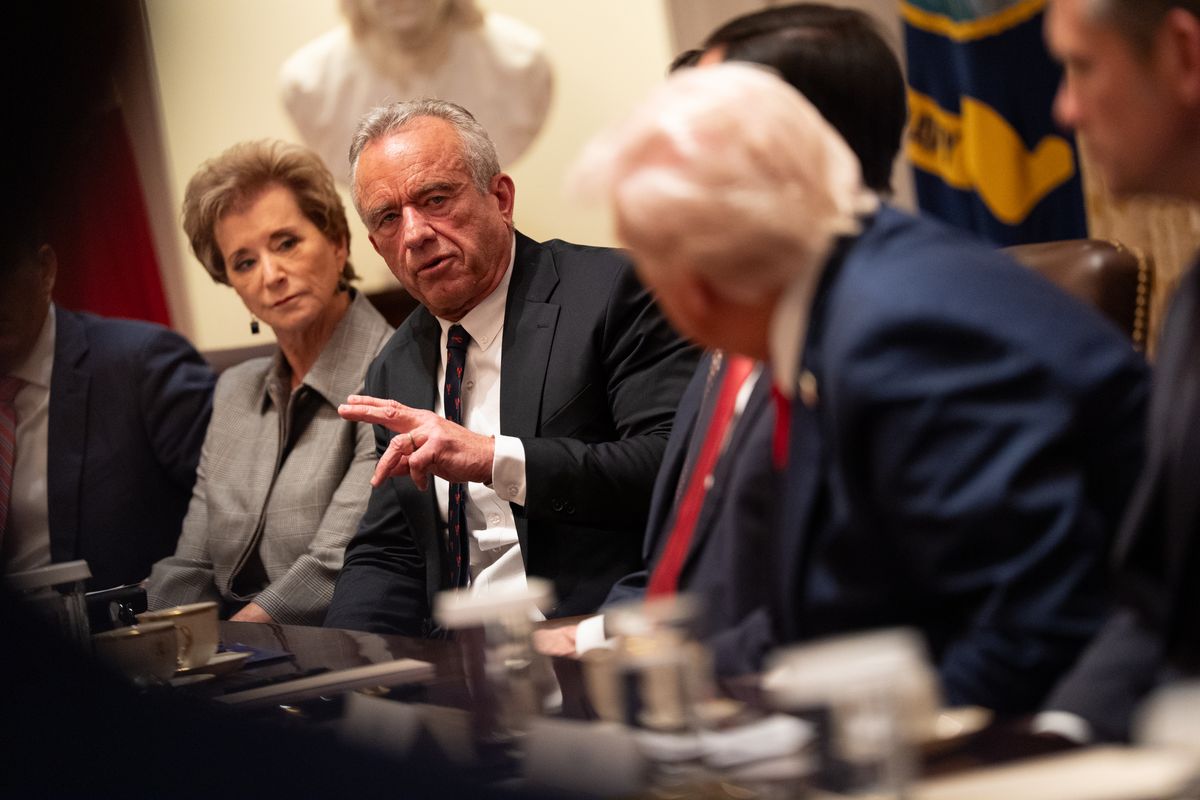
Robert F. Kennedy Jr. during a Cabinet meeting Thursday.
15:23 JST, October 11, 2025
At a Cabinet meeting earlier this week, President Donald Trump repeated a now familiar warning: Pregnant people should avoid Tylenol and refrain from giving it to infants. But it was Robert F. Kennedy Jr.’s response that ignited a wave of speculation online.
“There’s two studies that show children who are circumcised early have double the rate of autism. And it’s highly likely because they’re given Tylenol,” Kennedy said.
Kennedy inserted a note of uncertainty into his comments, stating that “none of this is positive, but all of it is stuff that we should be paying attention to.” Some parents voiced concern on social media, prompting doctors and scientists to jump in try to curb the spread of unfounded fears.
Here’s what the science says.
Where does this idea of a link come from?
There were two studies about this idea that received a fair amount of attention (and criticism) after they were published roughly a decade ago.
The first, which came out in 2013 in Environmental Health, claimed a strong correlation between autism prevalence in males in eight countries and circumcision rates. The authors said the purpose of their study was to look at newborn exposure to paracetamol (another name for acetaminophen, the active ingredient in Tylenol) which they said was widely prescribed since the mid-1990s for male circumcision.
One of the paper’s authors, Ann Bauer, also co-authored a 2025 analysis that linked Tylenol use during pregnancy to an increased risk of autism in children – a paper that officials from the Trump administration cited when issuing a related warning last month. Bauer did not immediately respond to a request for comment.
Helen Tager-Flusberg, a professor emerita at Boston University, called the 2013 study “quite abysmal.”
She questioned the study’s methodology, saying it did not look at key variables related to autism diagnosis such as the average age of parents having children or increased awareness of autism leading to more diagnoses. She said the study did not have enough data to establish a correlation between autism, much less a causal relationship. And she questioned the basic premise of the research in the first place.
“Infants are given Tylenol for many many reasons. Why you would pick circumcision? It does not make a lot of sense,” said Tager-Flusberg, founder of the Coalition of Autism Scientists, which advocates for high-quality autism research.
A second peer-reviewed study based on Danish national health system data was published in 2015 in the Journal of the Royal Society of Medicine, a British publication. It claimed that circumcised boys had a 46 to 62 percentage increase in risk of autism spectrum disorder in the first 10 years of life likely than non-circumcised boys. Their explanation for the possible link focused more on pain.
“While no firm conclusions should be drawn at this point, several lines of evidence are compatible with a possible causal role of circumcision trauma in some cases,” the authors wrote. That study called the previous paper’s assumption that boys undergoing circumcision always get paracetamol as a pain medication “questionable” but said they had no data to address the hypothesis.
Shortly after it was published the Danish study drew a sharply worded rebuttal from other scientists calling it “flawed.”
“Since the Danish study was about pain why didn’t [the authors] examine other painful conditions?” the authors of the rebuttal in the Journal of the Royal Society of Medicine wrote. The rebuttal paper mentioned urinary tract infections as an example, and also criticized the Danish study for not considering whether general anesthesia, rather than pain, could have contributed.
In a post on X on Friday, Kennedy mentioned a preprint – a study that is posted in advance of peer review – that he said “directly validates my point that the observed autism correlation in circumcised boys is best explained by acetaminophen exposure, not by circumcision itself.”
What’s the takeaway for parents?
Komal Kumar, an obstetrician-gynecologist in Washington State and fellow with Physicians for Reproductive Health who performs circumcisions, said the idea that Tylenol could be a contributing factor to the development of autism “is not based in valid medical evidence.” She said that assertions that the procedure is trauma-inducing are not accurate, and patients have a wide-range of experiences in pain level.
“I would caution American people against assuming that correlation equals causation,” Kumar said. As a common example, Kumar elaborated in an email response to questions, many Americans drink coffee and the rate of cancer among the American people is rising but that does not mean coffee causes cancer. She encourages parents to talk to their doctors if they have questions.
Several children’s hospitals in their informational pages about care for an infant after circumcisions say parents may give their children acetaminophen for pain, but advise consulting with a doctor.
Acetaminophen is generally not recommended for children under 12 months, except to treat fever and only under a doctor’s guidance. Most circumcisions occur before this age. The American Academy of Pediatrics suggests families read the JAMA Pediatrics “What Parents Should Understand About Infant Male Circumcision” page for more context.






Most Read
Popular articles in the past 24 hours
-

Voters Using AI to Choose Candidates in Japan's Upcoming General ...
-

Japan's Snow-Clad Beauty: Camellia Flowers Seen in Winter Bloom a...
-

Monkey Strikes Junior High School Girl from Behind in Japan's Yam...
-

Genichiro Inokuma's Mural in Ueno Station That Gave Hope in Postw...
-
Senior Japanese Citizens Return to University to Gain Knowledge, ...
-

Foreign and Security Policy: Political Parties Must Discuss How T...
-
Heavy Snow Linked to 30 Deaths across Japan since Late Jan.; JMA ...
-

Tokyo Police Arrest Head of Resignation Assistance Firm
Popular articles in the past week
-

Japan Institute to Use Domestic Commercial Optical Lattice Clock ...
-
Australian Woman Dies After Mishap on Ski Lift in Nagano Prefectu...
-
Foreign Snowboarder in Serious Condition After Hanging in Midair ...
-
Chinese Embassy in Japan Reiterates Call for Chinese People to Re...
-
Narita Airport, Startup in Japan Demonstrate Machine to Compress ...
-

Toyota Motor Group Firm to Sell Clean Energy Greenhouses for Stra...
-
Sakie Yokota, Last Surviving Parent of a North Korea Abductee, Ur...
-

Beer Yeast Helps Save Labor, Water Use in Growing Rice; Govt Hope...
Popular articles in the past month
-
Univ. in Japan, Tokyo-Based Startup to Develop Satellite for Disa...
-
JAL, ANA Cancel Flights During 3-day Holiday Weekend due to Blizz...
-
China Confirmed to Be Operating Drilling Vessel Near Japan-China ...
-

China Eyes Rare Earth Foothold in Malaysia to Maintain Dominance,...
-
M6.2 Earthquake Hits Japan's Tottori, Shimane Prefectures; No Tsu...
-
Japan Institute to Use Domestic Commercial Optical Lattice Clock ...
-

Japan, Qatar Ministers Agree on Need for Stable Energy Supplies; ...
-
Japan, Italy to Boost LNG Cooperation; Aimed at Diversifying Japa...
Top Articles in News Services
-
Arctic Sees Unprecedented Heat as Climate Impacts Cascade
-

Prudential Life Expected to Face Inspection over Fraud
-

South Korea Prosecutor Seeks Death Penalty for Ex-President Yoon over Martial Law (Update)
-

Trump Names Former Federal Reserve Governor Warsh as the Next Fed Chair, Replacing Powell
-

Japan’s Nagasaki, Okinawa Make N.Y. Times’ 52 Places to Go in 2026
JN ACCESS RANKING
-
Univ. in Japan, Tokyo-Based Startup to Develop Satellite for Disaster Prevention Measures, Bears
-
JAL, ANA Cancel Flights During 3-day Holiday Weekend due to Blizzard
-
China Confirmed to Be Operating Drilling Vessel Near Japan-China Median Line
-
China Eyes Rare Earth Foothold in Malaysia to Maintain Dominance, Counter Japan, U.S.
-
Japan Institute to Use Domestic Commercial Optical Lattice Clock to Set Japan Standard Time