
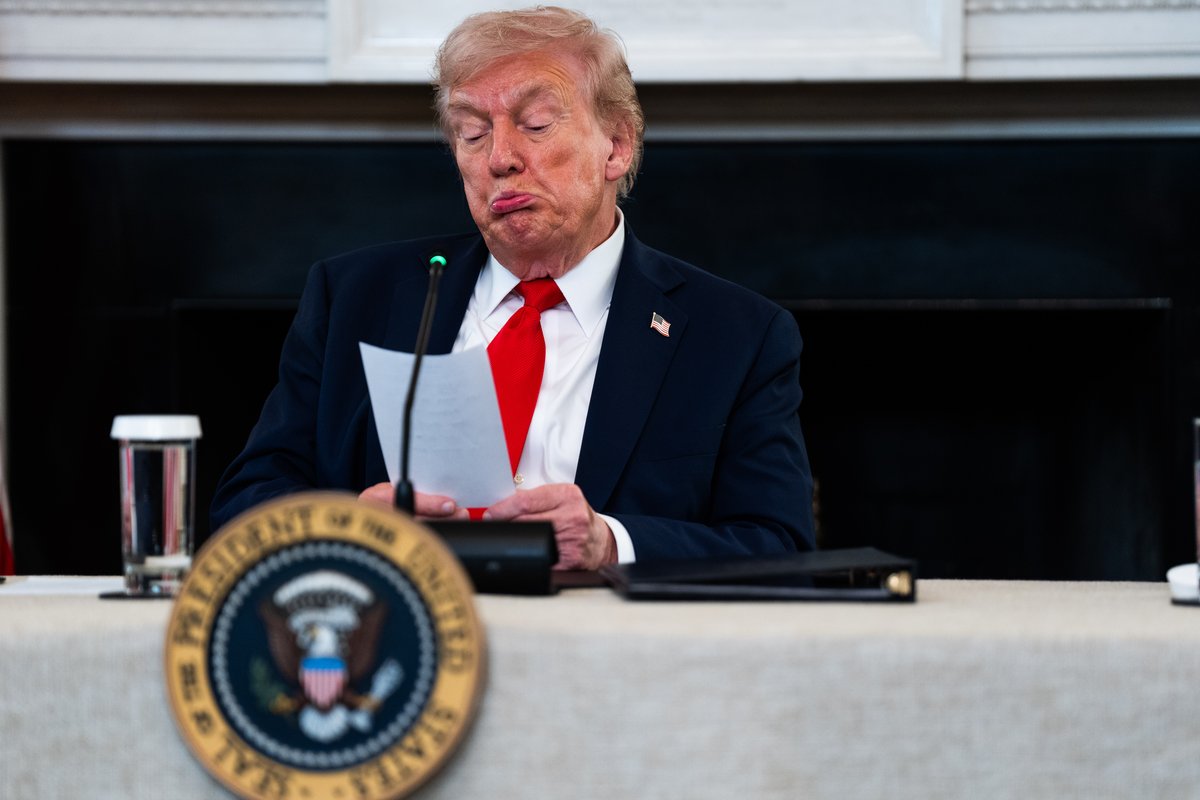
President Donald Trump reacts to a note handed to him by Secretary of State Marco Rubio regarding Middle East peace talks on Wednesday.
14:54 JST, October 11, 2025
No hostages had been released, no truce had been formally clinched, but the acclamations poured forth. The office of Israeli Prime Minister Benjamin Netanyahu posted an AI-produced image of the Israeli leader standing next to a triumphant President Donald Trump, who wore a giant gold Nobel Prize medallion around his neck. The attached message – issued after Trump had announced a deal to forge a ceasefire in Gaza and free all the Israeli hostages still held captive by militant group Hamas – urged the committee that administers the Nobel Peace Prize to give Trump the award.
Netanyahu was hardly alone. Israeli President Isaac Herzog followed suit Thursday, as did Egyptian President Abdel Fatah El-Sisi, joining other world leaders from a wide geography who have already championed Trump’s worthiness for the award. Trump recently claimed he didn’t want it for himself, yet both he and numerous lieutenants routinely talk about how much he deserves to be a Nobel laureate and how much of an insult it would be if Norway’s most famous committee chose to ignore Trump’s successes when it announces this year’s winner Friday morning. Norwegian politicians were bracing for an angry White House reaction in the event of such a snub.
Whatever happens in Oslo, Trump is expected to arrive in Israel by Sunday, ahead of the planned releases of the remaining hostages in Hamas captivity on Monday. He is slated to address the Knesset, Israel’s parliament, whose speaker hailed Trump as the “peace president.”
In both the war-ravaged Gaza Strip and Israel, there were scenes of celebration. The plight of Israel’s hostages has united the oft-divided Israeli public and fueled anger at Netanyahu’s government for balking at a deal in earlier stages of the conflict. In March, Israel broke a ceasefire brokered weeks earlier, a move that preceded months of further suffering and starvation for Gaza’s Palestinians – more than 67,000 of whom, including many women and children, have been killed in the ongoing war, according to the enclave’s Health Ministry.
The prospect of an imminent ceasefire and potential surge of humanitarian aid will offer much-needed respite for a population that international human rights groups and numerous governments say is in the grips of a genocidal campaign by Israel.
The parameters of the deal on offer – as The Washington Post has detailed – were in place for roughly a year. The first phase of the current agreement, which will also see hundreds of Palestinians in Israeli detention freed, is similar to the second phase of the previous agreement that collapsed in March.
Gershon Baskin, an Israeli peace activist who cultivated a back-channel to Hamas’s political leadership over the past two years, said in a social media post Thursday that Hamas “agreed to all of the same terms in September 2024.” But Netanyahu at the time, said Baskin, was not willing to accept the plan and the Biden administration was unable or unwilling to apply the necessary pressure to make it happen.
For months, the Israeli prime minister had resisted a truce, either accusing Hamas of spoiling a good deal or suggesting that Israel’s war aims weren’t yet satisfied. His far-right allies were opposed to any outcome other than a total military victory over Hamas and the conquest of Gaza, while Netanyahu’s own corruption trials would return to center stage in a postwar Israel.
“Over the course of two years, Netanyahu was never able to convince the Israeli public that Hamas was to blame” for the absence of a truce, Dahlia Scheindlin, an Israeli political analyst and pollster, told me. “Surveys repeatedly showed that a majority thought he was using his political or personal considerations in his decision-making throughout the war, sometimes even in relation to a hostage deal.”
Even Trump’s critics acknowledge the crucial role that the White House played in getting a ceasefire deal over the line. That includes the personal efforts made by Trump’s envoy, Steve Witkoff, and the interventions of his son-in-law Jared Kushner, who ran Middle East policy in the first term. The pair shuttled around the capitals of the Middle East, forging close ties to the region’s power brokers, especially the Gulf monarchies.
Arab officials say Israel’s strike last month on Hamas targets in Doha, Qatar’s capital, irked Trump and his team and gave new momentum to their efforts to persuade Netanyahu to accept a deal. After the strike, at Trump’s apparent request, Netanyahu was made to apologize publicly to Qatar’s prime minister during a visit to the White House – a humiliation no other president may have been able to impose upon an Israeli leader.
“Trump deserves credit for doing something all his predecessors, at least since Bill Clinton, were unwilling or afraid to do: exert real pressure on Netanyahu,” Alon Pinkas, a former Israeli diplomat and staunch Netanyahu critic, told me. “His flat learning curve sprang to life once he realized he was being manipulated and the callous attack in Qatar angered and tested his patience. He dictated the agreement to Netanyahu, determined the timing and made him endorse it publicly proving he does not trust his word.”
Aaron David Miller, a former U.S. diplomat who is a veteran of many rounds of Middle East diplomacy, suggested that Trump’s transactional approach to diplomacy and wholesale capture of the Republican Party gave him more latitude to be tough with Netanyahu. Both Clinton and former president Joe Biden had an “emotional identification” with Israel, he said, and Biden seemed “ideologically incapable” of wielding real leverage over Netanyahu even when politicians in his party and officials in his administration were calling for it.
Trump, who doled out myriad political gifts to the right-wing Israeli leader in his first term, was able to better coerce Netanyahu in his second. “No American president I worked for, Republican or Democrat, brought this kind of pressure on an Israeli prime minister,” Miller told me.
What happens in the coming weeks will be much more defining of Trump’s legacy than the victory lap he’ll take this weekend. Many elements that would contribute to a lasting peace deal have yet to be resolved, including arrangements around Hamas’s disarmament, Israel’s withdrawal from Gaza and the mechanisms that would lead to a broader reconciliation between Israelis and Palestinians. “The question becomes whether or not Trump will be able to ply the same waters as the negotiations get really complicated and whether he feels the need to focus that kind of attention to them, or whether this will be a ‘one and done’ moment,” Miller said.
In an interview with CNN, Husam Zomlot, head of the Palestinian mission in Britain, warned that Israel may simply resume hostilities after the hostages are freed. “Netanyahu is simply maneuvering and is waiting for another loophole somewhere to come back to [fighting],” he said, urging international vigilance and support to keep the fragile peace intact.
“Getting to a deal does not happen without President Trump leaning on Benjamin Netanyahu,” concluded Yousef Munayyer, senior fellow at the Arab Center Washington, a think tank. “But an agreement is only as good as it lasts and making sure Netanyahu actually ends the genocide and doesn’t restart it will require as much if not much more commitment from Trump to hold Netanyahu to account. I don’t think there is a Genocide Prize, but if Trump lets Netanyahu weasel out of a deal to end this, that is the only credit he’d deserve.”


Related Tags



Most Read
Popular articles in the past 24 hours
-

Voters Using AI to Choose Candidates in Japan's Upcoming General ...
-

Japan's Snow-Clad Beauty: Camellia Flowers Seen in Winter Bloom a...
-

Monkey Strikes Junior High School Girl from Behind in Japan's Yam...
-
Genichiro Inokuma's Mural in Ueno Station That Gave Hope in Postw...
-
Senior Japanese Citizens Return to University to Gain Knowledge, ...
-

Foreign and Security Policy: Political Parties Must Discuss How T...
-
Heavy Snow Linked to 30 Deaths across Japan since Late Jan.; JMA ...
-

Tokyo Police Arrest Head of Resignation Assistance Firm
Popular articles in the past week
-

Japan Institute to Use Domestic Commercial Optical Lattice Clock ...
-

Australian Woman Dies After Mishap on Ski Lift in Nagano Prefectu...
-
Foreign Snowboarder in Serious Condition After Hanging in Midair ...
-
Chinese Embassy in Japan Reiterates Call for Chinese People to Re...
-

Narita Airport, Startup in Japan Demonstrate Machine to Compress ...
-

Toyota Motor Group Firm to Sell Clean Energy Greenhouses for Stra...
-
Sakie Yokota, Last Surviving Parent of a North Korea Abductee, Ur...
-

Beer Yeast Helps Save Labor, Water Use in Growing Rice; Govt Hope...
Popular articles in the past month
-
Univ. in Japan, Tokyo-Based Startup to Develop Satellite for Disa...
-
JAL, ANA Cancel Flights During 3-day Holiday Weekend due to Blizz...
-
China Confirmed to Be Operating Drilling Vessel Near Japan-China ...
-

China Eyes Rare Earth Foothold in Malaysia to Maintain Dominance,...
-
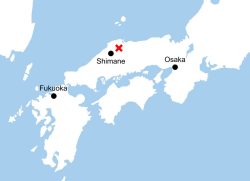
M6.2 Earthquake Hits Japan's Tottori, Shimane Prefectures; No Tsu...
-
Japan Institute to Use Domestic Commercial Optical Lattice Clock ...
-
Japan, Qatar Ministers Agree on Need for Stable Energy Supplies; ...
-
Japan, Italy to Boost LNG Cooperation; Aimed at Diversifying Japa...
Top Articles in News Services
-
Arctic Sees Unprecedented Heat as Climate Impacts Cascade
-

Prudential Life Expected to Face Inspection over Fraud
-

South Korea Prosecutor Seeks Death Penalty for Ex-President Yoon over Martial Law (Update)
-
Trump Names Former Federal Reserve Governor Warsh as the Next Fed Chair, Replacing Powell
-

Japan’s Nagasaki, Okinawa Make N.Y. Times’ 52 Places to Go in 2026
JN ACCESS RANKING
-
Univ. in Japan, Tokyo-Based Startup to Develop Satellite for Disaster Prevention Measures, Bears
-
JAL, ANA Cancel Flights During 3-day Holiday Weekend due to Blizzard
-
China Confirmed to Be Operating Drilling Vessel Near Japan-China Median Line
-
China Eyes Rare Earth Foothold in Malaysia to Maintain Dominance, Counter Japan, U.S.
-
Japan Institute to Use Domestic Commercial Optical Lattice Clock to Set Japan Standard Time