
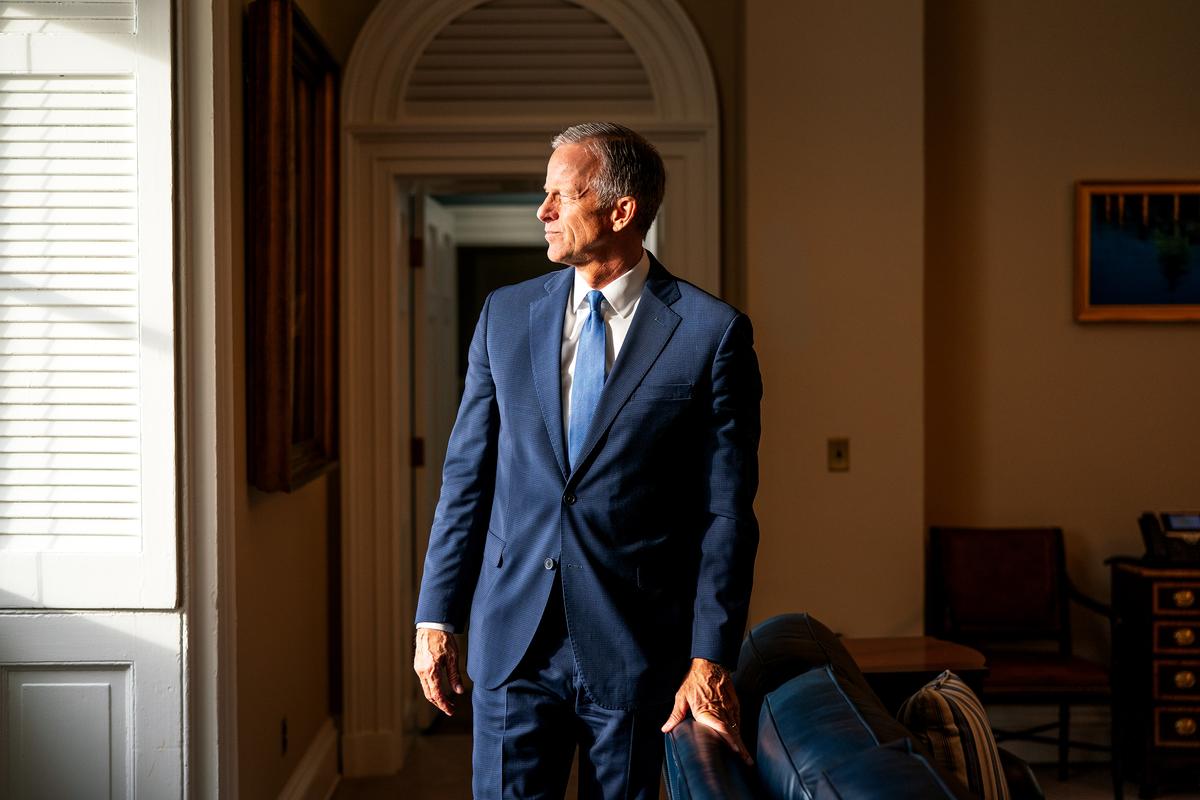
Senate Majority Leader John Thune (R-South Dakota) in his office Tuesday in the Capitol.
14:51 JST, October 11, 2025
In the nine months since John Thune became Senate majority leader, the South Dakota Republican has held his party together again and again on tough votes to move President Donald Trump’s agenda through Congress.
Now Thune is facing a new test: winning over enough Democrats to end the government shutdown.
With a 53-47 Senate majority, Thune did not need Democrats’ votes for almost anything he accomplished during the first months of his tenure.
He was able to confirm Trump’s Cabinet, pass Trump’s signature tax-and-spending bill and change the Senate’s rules to speed up confirmation of Trump’s nominees because those votes required only a simple majority of senators. But passing a funding bill to end the shutdown requires 60 votes – so Thune needs Democrats, who have demanded that Republicans make concessions on health care in exchange for their support.
Thune is not negotiating. Instead, he’s waiting for Democrats to fold.
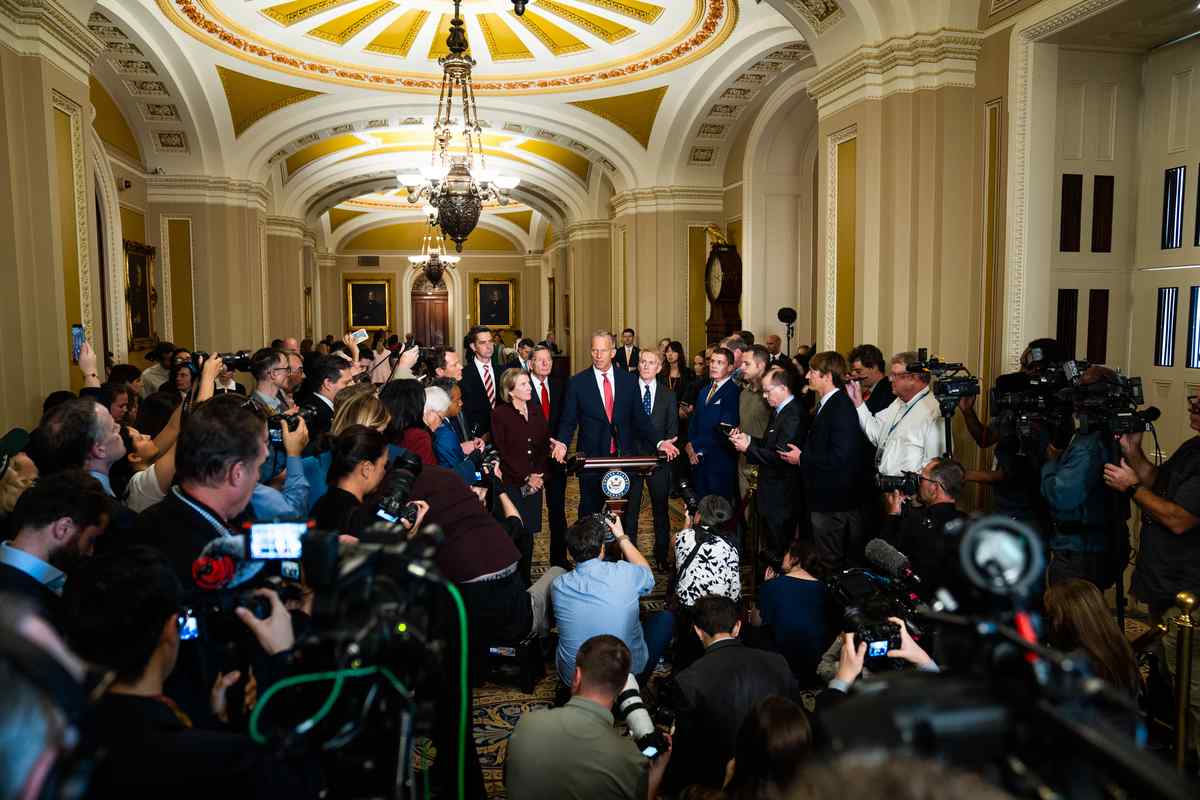
Thune speaks to reporters following the weekly Senate Republican policy luncheon on Sept. 30 outside the Senate Chamber.
He has not spoken to Senate Minority Leader Charles E. Schumer (D-New York) since a brief conversation last week on the Senate floor, according to Thune and Schumer aides. Instead, Thune is betting that Democrats will start to buckle as soldiers, Transportation Security Administration agents and other federal workers start missing their first paychecks in the coming days, he said in an interview Tuesday in his office in the Capitol.
“I’m hoping that that will start to get the attention of some of our Democrats, who really we have to have to get the government back open,” Thune said. “I mean it’s really – it’s up to them.”
Democrats have demanded Thune agree to extend Affordable Care Act health insurance subsidies that are set to expire at the end of the year in exchange for their votes. Thune made clear before the shutdown began that he was willing to discuss extending the subsidies, but not as part of government funding talks.
That stance has not changed, though Thune has opened the door ever so slightly to offering assurances to Democrats that he’ll work on their priorities.
Thune said he could not promise Democrats that Congress will extend the expiring ACA subsidies, even if Democrats agree to make the changes to the program that some Republicans have called for.
“I certainly can’t even guarantee it [in the Senate], let alone in the House,” Thune said. “But I think you could give them some assurances about what a process might look like.”
“I think I’ve indicated a willingness to have the conversation,” he added.
Talks between Republican and Democratic senators about how to end the shutdown have not gone anywhere. Sen. Jeanne Shaheen (D-New Hampshire), who has been part of those conversations, said Democrats suggested potential compromises on the ACA subsidies but that Republicans rejected them.
“We don’t necessarily believe that if we vote to reopen that there will be an honest dialogue around how to address” the expiring subsidies, Shaheen said.
Senate Democrats have castigated Thune for not negotiating with them on a bill that cannot pass without their votes. Republicans have countered by arguing that Democrats are making unreasonable demands.
Still, Democrats appear to view Thune as a more promising negotiating partner than Speaker Mike Johnson (R-Louisiana), who has repeatedly said he has nothing to discuss with Democrats.
Schumer has singled out Johnson – rather than Thune or Trump – repeatedly this week as the biggest roadblock to striking a deal. And House Minority Leader Hakeem Jeffries (D-New York) said Thune seemed more open to extending the ACA subsidies than Johnson during a meeting last week at the White House.
Johnson was the “only one in the room that doesn’t get that this is going to have to happen,” Jeffries told reporters, referring to extending the subsidies. “Thune clearly gets that this is going to have to happen.”
Schumer said Wednesday that he could not accept a commitment from Republicans to negotiate on extending ACA subsidies because he did not think Johnson would deliver.
“We’re not going to say, ‘Oh, let’s just discuss this’ and then Johnson just blocks it because he’s so afraid to bring it on the floor,” Schumer said. “We need to get this done.”
Democrats have warned that failing to renew the subsidies will cause health insurance premiums to rise for millions of Americans. Like Thune, Johnson has said he is open to extending them but not as part of government funding discussions.
Senate Republicans are divided about whether to extend ACA subsidies at all, putting Thune in a delicate position. Sens. Susan Collins (R-Maine), Lisa Murkowski (R-Alaska), Josh Hawley (R-Missouri) and Thom Tillis (R-North Carolina) have said they support extending them, while other Republicans are vehemently against it.
“Why are we even entertaining the conversation?” Sen. Ron Johnson (R-Wisconsin) said. “By even entering into a conversation, you’re emboldening Democrats to not reopen the government.”
Trump has said he is open to negotiating an extension of the subsidies once Democrats agree to end the shutdown. “We don’t want to have a gun held to our head,” Trump said Thursday in a Cabinet meeting. “We don’t like that. And the public doesn’t like it either.”
The White House has sought to pressure Democrats by threatening to lay off federal workers and withhold the back pay that is legally owed to them once the shutdown is over – which Thune acknowledged could undercut his strategy.
“You’ve got a narrative, I think, that’s starting to set in here that it’s the Democrats that are keeping this thing from getting passed,” Thune said. “I think it’s important not to step on that message.”
Abigail Jackson, a White House spokeswoman, said in a statement that Trump, Thune and Johnson “are all in complete lockstep and have been consistent: we are happy to have a policy conversation with the Democrats once the government is reopened.”
Thune’s strategy of waiting for Democrats to fold worked for him the only other time he has needed Democratic votes for a must-pass bill as the Republican Senate leader.
During the previous funding standoff in March, House Republicans surprised Schumer by passing a funding bill drafted without Democratic input days before the government was set to shut down. Thune took up the bill in the Senate and essentially dared Democrats to vote against it.
Schumer announced that Republicans did not have the votes to pass the bill, only to reverse himself the next day. (He later said that he was trying to buy more time for Democrats to negotiate.) Schumer voted to break a filibuster and allow the bill to pass despite misgivings, arguing that a shutdown would be “much, much worse” – but the move infuriated Democratic voters and Schumer vowed to take a different approach next time.
Thune has not bluffed in the same way since becoming majority leader, giving him credibility when he says he will not negotiate. But his strategy has not worked yet.
The Senate has voted seven times on the Republican funding bill. Each vote has failed, with Sens. Catherine Cortez Masto (D-Nevada), John Fetterman (D-Pennsylvania) and Angus King (I-Maine) breaking ranks with Democrats to vote for it and Sen. Rand Paul (R-Kentucky) voting against it. Thune needs five more Democratic votes if all senators are voting.
“The Democrats that I talk to trust John,” said Sen. Mike Rounds (R-South Dakota), who has known Thune for decades and has been part of bipartisan discussions on ending the shutdown. “They’re just concerned that he can’t control the president or the House of Representatives, and they are correct in that.”
Schumer has criticized Thune for weeks for failing to sit down with him to negotiate. Thune said in the interview that he is willing to meet – even though he’s not sure they have much to talk about.
“If there’s something he wants to talk about, I’m here,” Thune said. “We’ve had conversations, we go back off the floor occasionally if there’s a need to sit down and resolve something. But I haven’t sensed, at least at this point, that there’s really anything here that we can negotiate on.”








Most Read
Popular articles in the past 24 hours
-

Voters Using AI to Choose Candidates in Japan's Upcoming General ...
-

Japan's Snow-Clad Beauty: Camellia Flowers Seen in Winter Bloom a...
-

Monkey Strikes Junior High School Girl from Behind in Japan's Yam...
-

Genichiro Inokuma's Mural in Ueno Station That Gave Hope in Postw...
-

Senior Japanese Citizens Return to University to Gain Knowledge, ...
-

Foreign and Security Policy: Political Parties Must Discuss How T...
-

Heavy Snow Linked to 30 Deaths across Japan since Late Jan.; JMA ...
-

Tokyo Police Arrest Head of Resignation Assistance Firm
Popular articles in the past week
-

Japan Institute to Use Domestic Commercial Optical Lattice Clock ...
-

Australian Woman Dies After Mishap on Ski Lift in Nagano Prefectu...
-
Foreign Snowboarder in Serious Condition After Hanging in Midair ...
-

Chinese Embassy in Japan Reiterates Call for Chinese People to Re...
-

Narita Airport, Startup in Japan Demonstrate Machine to Compress ...
-

Toyota Motor Group Firm to Sell Clean Energy Greenhouses for Stra...
-

Sakie Yokota, Last Surviving Parent of a North Korea Abductee, Ur...
-

Beer Yeast Helps Save Labor, Water Use in Growing Rice; Govt Hope...
Popular articles in the past month
-

Univ. in Japan, Tokyo-Based Startup to Develop Satellite for Disa...
-

JAL, ANA Cancel Flights During 3-day Holiday Weekend due to Blizz...
-
China Confirmed to Be Operating Drilling Vessel Near Japan-China ...
-

China Eyes Rare Earth Foothold in Malaysia to Maintain Dominance,...
-

M6.2 Earthquake Hits Japan's Tottori, Shimane Prefectures; No Tsu...
-
Japan Institute to Use Domestic Commercial Optical Lattice Clock ...
-

Japan, Qatar Ministers Agree on Need for Stable Energy Supplies; ...
-

Japan, Italy to Boost LNG Cooperation; Aimed at Diversifying Japa...
Top Articles in News Services
-

Arctic Sees Unprecedented Heat as Climate Impacts Cascade
-

Prudential Life Expected to Face Inspection over Fraud
-

South Korea Prosecutor Seeks Death Penalty for Ex-President Yoon over Martial Law (Update)
-

Trump Names Former Federal Reserve Governor Warsh as the Next Fed Chair, Replacing Powell
-

Japan’s Nagasaki, Okinawa Make N.Y. Times’ 52 Places to Go in 2026
JN ACCESS RANKING
-
Univ. in Japan, Tokyo-Based Startup to Develop Satellite for Disaster Prevention Measures, Bears
-
JAL, ANA Cancel Flights During 3-day Holiday Weekend due to Blizzard
-
China Confirmed to Be Operating Drilling Vessel Near Japan-China Median Line
-
China Eyes Rare Earth Foothold in Malaysia to Maintain Dominance, Counter Japan, U.S.
-
Japan Institute to Use Domestic Commercial Optical Lattice Clock to Set Japan Standard Time