
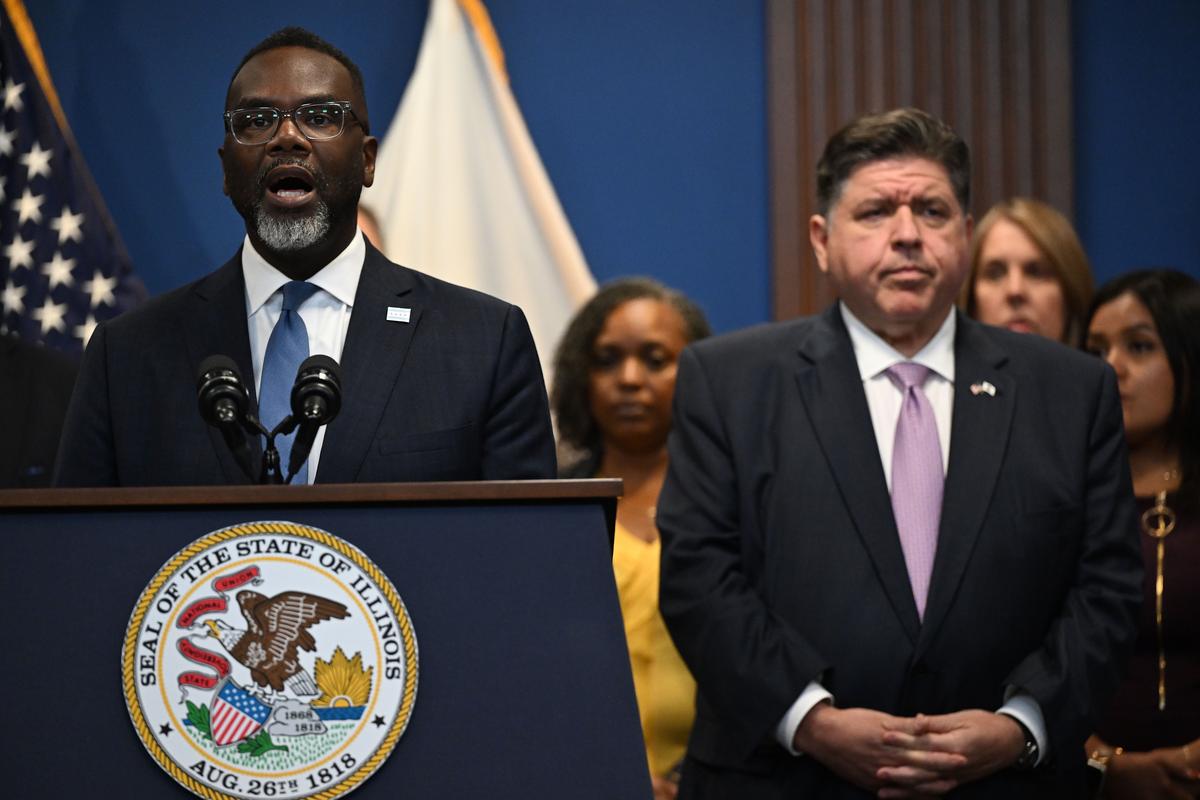
Chicago Mayor Brandon Johnson (D), left, speaks during a news conference in the city, standing next to Illinois Gov. JB Pritzker (D), Sept. 29.
16:27 JST, October 8, 2025
As President Donald Trump moves to deploy National Guard troops and federal immigration officers to cities with “sanctuary” policies, Democratic leaders in Chicago and elsewhere are responding with their own message: We will not capitulate.
Since taking office, the Trump administration has sued 14 jurisdictions, threatened criminal charges against local officials who do not comply with federal demands, conducted large-scale immigration operations and deployed troops over the objection of mayors and governors.
Just two jurisdictions – Louisville and the state of Nevada – have agreed to drop key policies that had restricted police and sheriffs from assisting U.S. Immigration and Customs Enforcement officers in making arrests. And Trump has faced a string of losses in court. A federal judge on Sunday blocked the president’s plan to send troops to Portland, Oregon, and leaders in Illinois filed a similar lawsuit Monday to block Trump’s attempt to deploy soldiers to Chicago.
“We will not tolerate ICE agents violating our residents’ constitutional rights, nor will we allow the federal government to disregard our local authority,” Chicago Mayor Brandon Johnson (D) said Monday. He announced an executive order barring ICE from using city property after reports the agency had used a school parking lot as a staging area.
Leaders of sanctuary jurisdictions said the lawsuits in Chicago and Portland show Democratic leaders are overwhelmingly deciding to fight back. Trump and his allies, meanwhile, accuse sanctuary city leaders of harboring violent criminals and refusing to cooperate in removing them from the country. And despite the pushback, the administration is still ramping up pressure through unilateral actions like launching ICE operations and deploying surge teams in sanctuary cities.
“We’re seeing that the litigation aspect is, on its own, largely not successful,” said Spencer Reynolds, a national security analyst at the Brennan Center for Justice. “Overall, I’m sure the government would like to win, but its big picture goal is to get cities and states to go along with immigration requests, and they are taking a broader, more whack-a-mole approach. These actions, taken together, can have an impact through intimidation.”
San Francisco City Attorney David Chiu was one of the first to launch a concerted effort against the administration’s campaign against sanctuary cities. In the spring his office led a coalition of 16 sanctuary jurisdictions that scored a victory when a federal judge blocked officials from halting federal funds to force them to comply with immigration enforcement.
Nearly three dozen other jurisdictions have since joined the lawsuit, prompting U.S. District Judge William H. Orrick in August to expand his temporary injunction to cover 50 localities.
“The Trump administration is trying to use its enforcement authority in ways they know are not legal or constitutional to get their way, and we’ve been forced to defend our rights,” Chiu said in an interview. “The vast majority of cities and counties have not changed their policies.”
Though there is no specific definition of a sanctuary jurisdiction, most have policies that prevent local police or sheriffs from asking about the immigration status of people in their custody and restrict their ability to detain inmates at the request of ICE, unless they are presented with a judicial warrant. Scores of cities, counties and states adopted or beefed up sanctuary laws during Trump’s first administration, arguing that assisting in his hard-line approach risked eroding trust between immigrant communities and local law enforcement.
In April, Trump signed an executive order instructing his administration to assemble a list of sanctuary jurisdictions and potential consequences if they do not amend their policies. “They protect Criminals,” he wrote on social media, “not the Victims.” In June, the Justice Department posted a roster of more than 500 cities, counties and states, sparking widespread anxiety and objections from some that their jurisdictions do not support sanctuary laws.
The administration took down the list amid the pushback, but the threat of further legal action and ICE raids led one city to change its policies. Louisville Mayor Craig Greenberg (D) announced the city would reinstate a 48-hour hold on immigrant inmates at local jails to allow the Department of Homeland Security to take custody of them, a policy that was scrapped in 2017.
Greenberg said he took the action after immigrant rights leaders agreed that doing so was the city’s best chance to be taken off the list and avoid the “terrifying increase” in federal immigration raids taking place in Los Angeles.
Attorney General Pam Bondi declared victory and warned other cities to follow suit or face legal action. “Instead of forcing us to sue you – which we will, without hesitation – follow the law, get rid of sanctuary policies and work with us to fix the immigration crisis,” she wrote on social media.
Three days later, however, U.S. District Judge Lindsay C. Jenkins dismissed the Trump administration’s sanctuary lawsuit against Chicago and Illinois. She ruled that their sanctuary policies were protected by the 10th Amendment, which prohibits the United States from commandeering local jurisdictions to enact federal laws.
Chicago Alderman Raymond Lopez (D) has criticized the city’s approach, saying it unnecessarily antagonized the Trump administration. He said officials should have amended sanctuary policies to allow local police to alert ICE if undocumented immigrants are arrested for violent crimes.
“This entire situation is, unfortunately, a travesty of our making,” Lopez said in an interview. Johnson and Pritzker, he said, “taunted the incoming Trump administration, saying, ‘If you want to go find targets, go find them yourselves.’ Fast-forward to where we are today. Trump is doing exactly what he said he would do. They called our bluff and are coming into our community and rounding up groups of individuals – not just ones who they are targeting, but anyone else who happens to be a noncitizen.”
Despite Jenkins’s ruling in the Chicago case, the Justice Department is continuing to pursue similar lawsuits against Los Angeles; New York City; Denver; Rochester, New York; four New Jersey cities including Newark and Hoboken; and the state of Minnesota, Minneapolis and St. Paul, and Hennepin County.
Bondi reiterated her demands in an Aug. 13 letter to leaders of sanctuary cities, threatening criminal charges against officials who do not comply. Local leaders responded that they would not amend their policies, and pointed to falling crime rates in their cities and cooperation with the federal government on other public safety issues as their justification.
In a letter to Bondi, Boston Mayor Michelle Wu (D), whose city has been the target of two sustained, large-scale ICE operations in recent months, cited Jenkins’s ruling in the Chicago and Illinois case and said her city and others were being unfairly targeted for “our refusal to bow down to unconstitutional threats and unlawful coercion.”
Hoboken Mayor Ravi S. Bhalla (D) told Bondi he would file an ethics complaint and suggested she was seeking to intimidate him while the city was defending itself against the Justice Department’s civil lawsuit. Hoboken, he wrote, would seek to strengthen sanctuary policies “in light of the daily unlawful federal immigration enforcement activities that we, and the rest of the country, witness on a daily basis.”
In an email to The Washington Post, Bhalla said the city “will be sending a clear and unequivocal message that Hoboken remains a city that values and protects all residents, no matter their immigration status.”
In San Francisco, Chiu’s office is preparing to fight the Trump administration’s appeal of Orrick’s ruling in the funding lawsuit. The U.S. Court of Appeals for the 9th Circuit has scheduled a hearing in December.
The parties have been here before. In 2018, during Trump’s first term, both Orrick and the appellate court ruled in favor of the sanctuary jurisdictions in a nearly identical case. “Here we go again,” Orrick wrote in his ruling this past spring.
This time, however, administration officials have continued to look for new ways to tie funding to immigration compliance, Chiu said, including targeting grants for housing, homeland security and transportation. That has prompted Orrick to clarify that his injunction applies broadly.
“They are absolutely being more aggressive,” Chiu said. “During the first Trump administration, they did what any party typically does after a ruling, which is respect the ruling. Now, we’ve seen them trying to do everything they can to get around the ruling.”


Related Tags



Most Read
Popular articles in the past 24 hours
-

Japan's Snow-Clad Beauty: Camellia Flowers Seen in Winter Bloom a...
-

Monkey Strikes Junior High School Girl from Behind in Japan's Yam...
-

Genichiro Inokuma's Mural in Ueno Station That Gave Hope in Postw...
-

Foreign and Security Policy: Political Parties Must Discuss How T...
-

Senior Japanese Citizens Return to University to Gain Knowledge, ...
-
Heavy Snow Linked to 30 Deaths across Japan since Late Jan.; JMA ...
-

Tokyo Police Arrest Head of Resignation Assistance Firm
-

Japan’s Nikkei Stock Average Jumps near 4%, Closes at Record High...
Popular articles in the past week
-

Japan Institute to Use Domestic Commercial Optical Lattice Clock ...
-
Australian Woman Dies After Mishap on Ski Lift in Nagano Prefectu...
-
Foreign Snowboarder in Serious Condition After Hanging in Midair ...
-

Chinese Embassy in Japan Reiterates Call for Chinese People to Re...
-

Narita Airport, Startup in Japan Demonstrate Machine to Compress ...
-

Toyota Motor Group Firm to Sell Clean Energy Greenhouses for Stra...
-

Sakie Yokota, Last Surviving Parent of a North Korea Abductee, Ur...
-

Beer Yeast Helps Save Labor, Water Use in Growing Rice; Govt Hope...
Popular articles in the past month
-

Univ. in Japan, Tokyo-Based Startup to Develop Satellite for Disa...
-
JAL, ANA Cancel Flights During 3-day Holiday Weekend due to Blizz...
-
China Confirmed to Be Operating Drilling Vessel Near Japan-China ...
-

China Eyes Rare Earth Foothold in Malaysia to Maintain Dominance,...
-
M6.2 Earthquake Hits Japan's Tottori, Shimane Prefectures; No Tsu...
-
Japan Institute to Use Domestic Commercial Optical Lattice Clock ...
-

Japan, Qatar Ministers Agree on Need for Stable Energy Supplies; ...
-

Japan, Italy to Boost LNG Cooperation; Aimed at Diversifying Japa...
Top Articles in News Services
-

Arctic Sees Unprecedented Heat as Climate Impacts Cascade
-

Prudential Life Expected to Face Inspection over Fraud
-

South Korea Prosecutor Seeks Death Penalty for Ex-President Yoon over Martial Law (Update)
-
Trump Names Former Federal Reserve Governor Warsh as the Next Fed Chair, Replacing Powell
-

Japan’s Nagasaki, Okinawa Make N.Y. Times’ 52 Places to Go in 2026
JN ACCESS RANKING
-
Univ. in Japan, Tokyo-Based Startup to Develop Satellite for Disaster Prevention Measures, Bears
-
JAL, ANA Cancel Flights During 3-day Holiday Weekend due to Blizzard
-
China Confirmed to Be Operating Drilling Vessel Near Japan-China Median Line
-
China Eyes Rare Earth Foothold in Malaysia to Maintain Dominance, Counter Japan, U.S.
-
Japan Institute to Use Domestic Commercial Optical Lattice Clock to Set Japan Standard Time