
High-Dose Administration of iPS Cell-Derived Cardiomyocyte Spheroids Shows Efficacy in Clinical Trial
13:28 JST, October 4, 2025
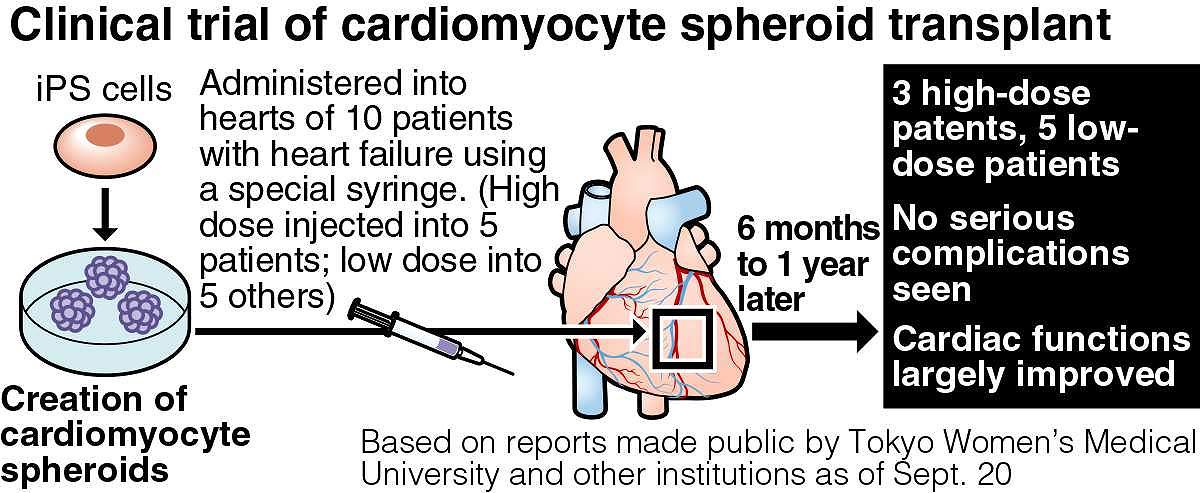
High doses of cardiomyocyte spheroids derived from induced pluripotent stem (iPS) cells are effective in treating severe heart failure, according to interim results of a clinical trial.
Cardiomyocyte spheroids are specialized muscle cells that make up the heart that have been cultured into a 3D shape.
The results, which were announced by a group of medical institutions at a meeting of the Japanese College of Cardiology on Sept. 20, also confirmed that it is safe for patients to be administered doses three times higher than previously thought.
The clinical trial was conducted by Heartseed Inc., a Tokyo-based startup funded by Keio University.
From 2022 to January this year, cardiomyocyte spheroids were transplanted into the hearts of 10 patients with severe heart failure at Tokyo Women’s Medical University, the Tokyo Metropolitan Geriatric Hospital and Institute of Gerontology, Nihon University Itabashi Hospital and other medical institutions. Initially, a low dose of about 50,000 cardiomyocyte spheroids was administered to five patients, which enabled the researchers to confirm that there were no safety concerns. Higher doses of about 150,000 cardiomyocyte spheroids were then transplanted into the remaining five patients.
At the meeting, participating doctors from the institutions reported that three patients who received the high dose had no serious complications and showed improvements in areas such as cardiac contractility, which is the ability of the heart muscle to pump blood.
Heartseed plans to confirm whether the high doses yield greater efficacy in improving heart conditions than current methods. The company intends to submit the results of the clinical trial to the Health, Labor and Welfare Ministry and apply for approval to manufacture and market the therapeutic product as early as 2026, with the aim of putting it into practical use in 2027.
“We want to make this new treatment available to patients as soon as possible,” said Heartseed Chief Executive Officer Keiichi Fukuda, who is also a professor emeritus at Keio University.
Shinshu University Prof. Koichiro Kuwahara, who specializes in cardiology, said, “It’s still too early to say for sure, but the results suggest that there are therapeutic effects and give us hope that the method can advance to the next phase.”



Most Read
Popular articles in the past 24 hours
-
Japanese High School Student Aims to Share Kaiten History Through...
-
PM Takaichi Spells out Plans to Advance Bold Policy Shifts in Spe...
-
Chronic Issues Erode Thailand’s Economy as Political Confusion Pe...
-

Japanese Version of Shohei Ohtani's Picture Book Published
-
Tottori: 95-Year-Old Japanese Descendent from Philippines Visits ...
-

Japan to Monitor Trump Administration's Response to U.S. Supreme ...
-
Milano Cortina 2026: Speed Skater Takagi Finishes 6th in the 1,50...
-
Osaka: 40 Ninjas Display Shuriken Throwing Skills at Japan Champi...
Popular articles in the past week
-

Japan PM Takaichi’s Cabinet Resigns en Masse
-

Man Infected with Measles Reportedly Dined at Restaurant in Tokyo...
-

Sanae Takaichi Elected Prime Minister of Japan; Keeps All Cabinet...
-

Japan's Govt to Submit Road Map for Growth Strategy in March, PM ...
-

Bus Carrying 40 Passengers Catches Fire on Chuo Expressway; All E...
-

Milano Cortina 2026: Figure Skaters Riku Miura, Ryuichi Kihara Pa...
-

Japan, U.S. Name 3 Inaugural Investment Projects; Reached Agreeme...
-

U.S. Firm to Build Training Hub in Fukushima N-plant for Debris R...
Popular articles in the past month
-
Japan PM Takaichi’s Cabinet Resigns en Masse
-

Japan Institute to Use Domestic Commercial Optical Lattice Clock ...
-

Israeli Ambassador to Japan Speaks about Japan’s Role in the Reco...
-
Man Infected with Measles Reportedly Dined at Restaurant in Tokyo...
-

Videos Plagiarized, Reposted with False Subtitles Claiming ‘Ryuky...
-

Man Infected with Measles May Have Come in Contact with Many Peop...
-

Prudential Life Insurance Plans to Fully Compensate for Damages C...
-

Woman with Measles Visited Hospital in Tokyo Multiple Times Befor...
Top Articles in Science & Nature
-
Japan Institute to Use Domestic Commercial Optical Lattice Clock to Set Japan Standard Time
-
Japan to Face Shortfall of 3.39 Million Workers in AI, Robotics in 2040; Clerical Workers Seen to Be in Surplus
-
Record 700 Startups to Gather at SusHi Tech Tokyo in April; Event Will Center on Themes Like Artificial Intelligence and Robotics
-

iPS Treatments Pass Key Milestone, but Broader Applications Far from Guaranteed
-
iPS Cell Products for Parkinson’s, Heart Disease OK’d for Commercialization by Japan Health Ministry Panel
JN ACCESS RANKING
-
Japan PM Takaichi’s Cabinet Resigns en Masse
-
Japan Institute to Use Domestic Commercial Optical Lattice Clock to Set Japan Standard Time
-
Israeli Ambassador to Japan Speaks about Japan’s Role in the Reconstruction of Gaza
-
Man Infected with Measles Reportedly Dined at Restaurant in Tokyo Station
-
Videos Plagiarized, Reposted with False Subtitles Claiming ‘Ryukyu Belongs to China’; Anti-China False Information Also Posted in Japan