
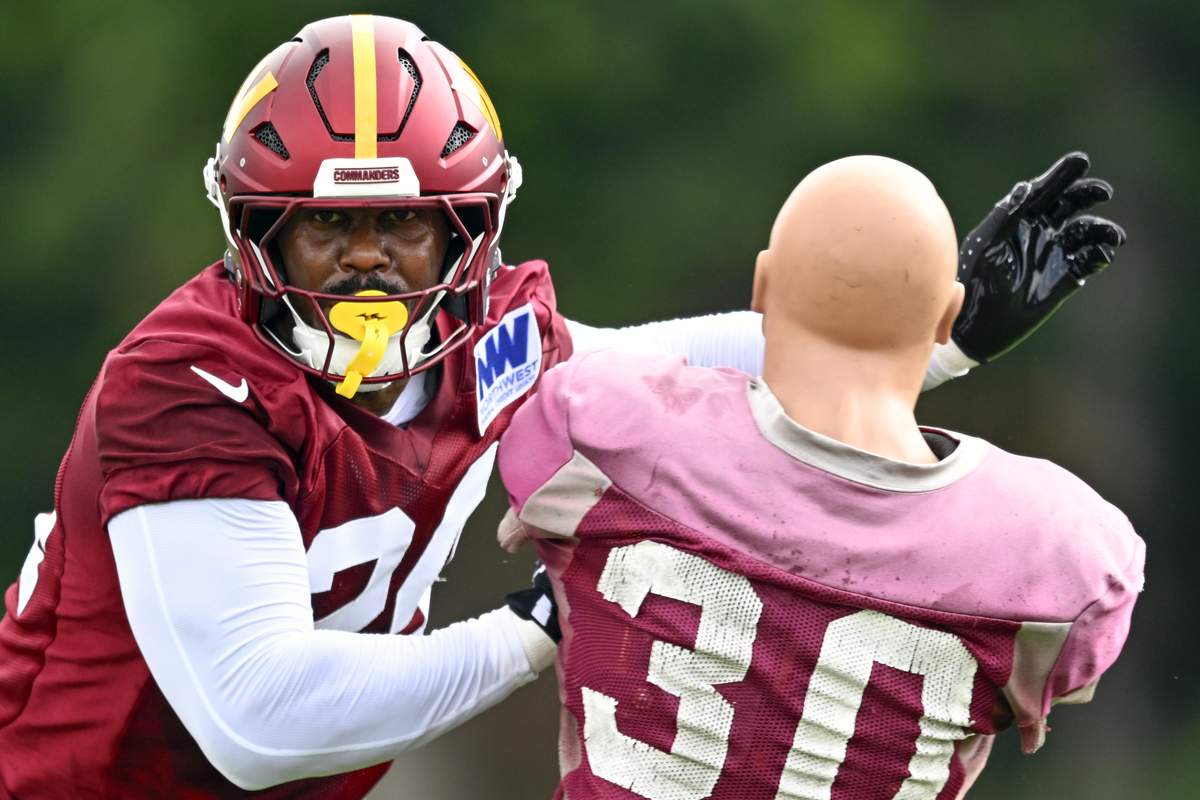
There’s not a perfect way for players like Von Miller to practice for the violence of an NFL game.
12:11 JST, October 4, 2025
When a carpenter is striving to build a better chair, she practices by building chairs. When a painter is trying to perfect his art, he spends hours putting brush to canvas. And when an NFL defender wants to become a more violent, impactful tackler, he practices by … running up to a teammate and gently tapping him during a midweek practice?
“It’s like practicing to cook something without ever cooking it,” safety Darnell Savage said.
To protect their players from injury, NFL coaches almost never allow full-blown tackling in practice during the season, no matter how many tackles their teams missed on game day. And therein lies a familiar football paradox: How can a team improve tackling without, you know, actually tackling?
The question is not unique to the Washington Commanders, nor unusual in the early part of the season. But it is among the most pressing issues for the defense to address ahead of Sunday’s game against the Los Angeles Chargers (3-1).
The tackling miscues were frequent and glaring in Washington’s 34-27 loss to the Atlanta Falcons on Sunday. In between miscommunications in coverage and a general inability to pressure opposing quarterback Michael Penix Jr., the team missed tackles in bunches, often on crucial plays.
In the second quarter, safety Jeremy Reaves unsuccessfully tried to strip the ball from Falcons running back Bijan Robinson, who kept running and spun through another arm tackle en route to a 14-yard touchdown. In the third quarter, Tyler Allgeier evaded a diving Von Miller then bounced off Reaves for a 15-yard score.
Washington (2-2) missed nine total tackles against the Falcons, according to Pro Football Reference. But Coach Dan Quinn said the team’s internal count stretched into double digits.
“And if you hit double digits between defense and special teams, that is too many,” Quinn said Monday. “… Yeah, we were not pleased with our tackling performance. And yes, there is plenty you can do to work on that.”
That path to improvement, though, is slightly more complicated than adjusting a scheme or practicing on-field communication – both of which can be done without putting players at risk.
While tackling is a fundamental part of football, players said it is perhaps the most difficult skill to safely replicate in practice, given the inherent violence involved. There are drills that can be done with dummies, sleds and pads. Footwork that can be refined. Techniques that can be practiced. But it all has a limit, in a way that other core skills in the sport do not.
“It’s tough, bro,” defensive lineman Javon Kinlaw said. “There’s a lot of things you need to work on [in tackling] that you can’t really work on.”
NFL teams used to embrace more full-blown tackling in practice, at least during the preseason. “When I first got in the league – or even a couple years ago, when I was in Cleveland – we went live all the time in training camp,” said defensive coordinator Joe Whitt Jr., referencing a one-year stint as secondary coach with the Browns in 2019. But it’s not that way anymore, largely due to concerns over potential injuries.
Whitt explained that the concern with live tackling in practice isn’t so much about the players involved in the actual tackles. It’s the legs of all the players nearby, who could be rolled into.
Instead, coaches will sometimes call for a “thud” tempo during practices in full pads, where defenders are allowed to square up for a tackle as long as they make direct eye contact with their target and collide without actually taking him to the ground. During the season, defenders usually do no more than tap. A linebacker or defensive back will sprint up to a ballcarrier in tackling position, then stop or step past him.
“We always talk about getting the body in position and finishing in a bending position,” Whitt said. “A lot of times, people just come in and tag you. That’s not good enough. You have to bend at the end and finish, as if you are making that tackle.”
Under those conditions, it might seem like there’s only so much improvement that a defensive player could make in the tackling department during a season. But players cautioned against that idea. “Oh no, you can get better,” Miller said.
Safety Quan Martin explained that the act of physically bringing someone to the ground is just one final piece of a lengthier process. There’s the angle one takes toward the ballcarrier, and the proper way to close down space depending on their body positioning. There’s eye placement and tracking. Pad level. Foot placement, particularly with the foot closest to the ballcarrier, and establishing a strong base from which to launch.
“Just all those little fundamental things – near foot, near shoulder, angles,” Martin said. “There’s all kinds of stuff that goes into preparing to tackle.”
All of those details can be refined in practice, or emphasized in drills – and they all show up on film. Other times, of course, the issues are more obvious. Whitt referenced a few plays last week in which a Commanders defender tried to punch out the ball rather than secure a tackle. “We don’t need anybody to put capes on,” he said.
Kinlaw explained that he missed three tackles because he was lunging at Falcons running backs, rather than taking the extra few steps to close the space.
“You can’t just dive and expect to reach out and tackle guys,” he said. “I just try to watch the film and know what to do. Instead of reaching for guys, putting body on body.”
The Commanders’ early tackling issues could prove to be yet another early warning sign for a defense that has been inconsistent at all levels. They’ve missed 31 tackles through the first four games of the season, which is tied for eighth-worst in the NFL, according to Pro Football Reference.
But there is reason to believe this could be an early-season blip, too. Last season at this time, the Commanders had missed 26 tackles, but they rapidly improved. Only four teams finished the season with fewer missed tackles than Washington’s 80.
“Especially early in the season, you don’t run your feet like you normally do,” linebacker Bobby Wagner said when asked about the team’s tackling issues. “I think that comes with the way preseason is now, and things of that nature.
“I would like to say that’s an anomaly, what happened last week.”
Sunday’s game at SoFi Stadium will offer the first indication of whether that’s the case. The Commanders can spend all week reviewing film and refining technique, putting together the ingredients for a stronger tackling performance. But to borrow Savage’s analogy: They still have to actually cook the meal.







Most Read
Popular articles in the past 24 hours
-

Voters Using AI to Choose Candidates in Japan's Upcoming General ...
-

Japan's Snow-Clad Beauty: Camellia Flowers Seen in Winter Bloom a...
-

Monkey Strikes Junior High School Girl from Behind in Japan's Yam...
-

Genichiro Inokuma's Mural in Ueno Station That Gave Hope in Postw...
-

Senior Japanese Citizens Return to University to Gain Knowledge, ...
-
Heavy Snow Linked to 30 Deaths across Japan since Late Jan.; JMA ...
-

Foreign and Security Policy: Political Parties Must Discuss How T...
-

Tokyo Police Arrest Head of Resignation Assistance Firm
Popular articles in the past week
-

Japan Institute to Use Domestic Commercial Optical Lattice Clock ...
-

Australian Woman Dies After Mishap on Ski Lift in Nagano Prefectu...
-

Foreign Snowboarder in Serious Condition After Hanging in Midair ...
-

Chinese Embassy in Japan Reiterates Call for Chinese People to Re...
-

Narita Airport, Startup in Japan Demonstrate Machine to Compress ...
-

Toyota Motor Group Firm to Sell Clean Energy Greenhouses for Stra...
-

Sakie Yokota, Last Surviving Parent of a North Korea Abductee, Ur...
-

Beer Yeast Helps Save Labor, Water Use in Growing Rice; Govt Hope...
Popular articles in the past month
-
Univ. in Japan, Tokyo-Based Startup to Develop Satellite for Disa...
-
JAL, ANA Cancel Flights During 3-day Holiday Weekend due to Blizz...
-

China Confirmed to Be Operating Drilling Vessel Near Japan-China ...
-

China Eyes Rare Earth Foothold in Malaysia to Maintain Dominance,...
-

M6.2 Earthquake Hits Japan's Tottori, Shimane Prefectures; No Tsu...
-
Japan Institute to Use Domestic Commercial Optical Lattice Clock ...
-

Japan, Qatar Ministers Agree on Need for Stable Energy Supplies; ...
-

Japan, Italy to Boost LNG Cooperation; Aimed at Diversifying Japa...
Top Articles in News Services
-

Arctic Sees Unprecedented Heat as Climate Impacts Cascade
-

Prudential Life Expected to Face Inspection over Fraud
-

South Korea Prosecutor Seeks Death Penalty for Ex-President Yoon over Martial Law (Update)
-

Trump Names Former Federal Reserve Governor Warsh as the Next Fed Chair, Replacing Powell
-

Japan’s Nagasaki, Okinawa Make N.Y. Times’ 52 Places to Go in 2026
JN ACCESS RANKING
-
Univ. in Japan, Tokyo-Based Startup to Develop Satellite for Disaster Prevention Measures, Bears
-
JAL, ANA Cancel Flights During 3-day Holiday Weekend due to Blizzard
-
China Confirmed to Be Operating Drilling Vessel Near Japan-China Median Line
-
China Eyes Rare Earth Foothold in Malaysia to Maintain Dominance, Counter Japan, U.S.
-
Japan Institute to Use Domestic Commercial Optical Lattice Clock to Set Japan Standard Time