
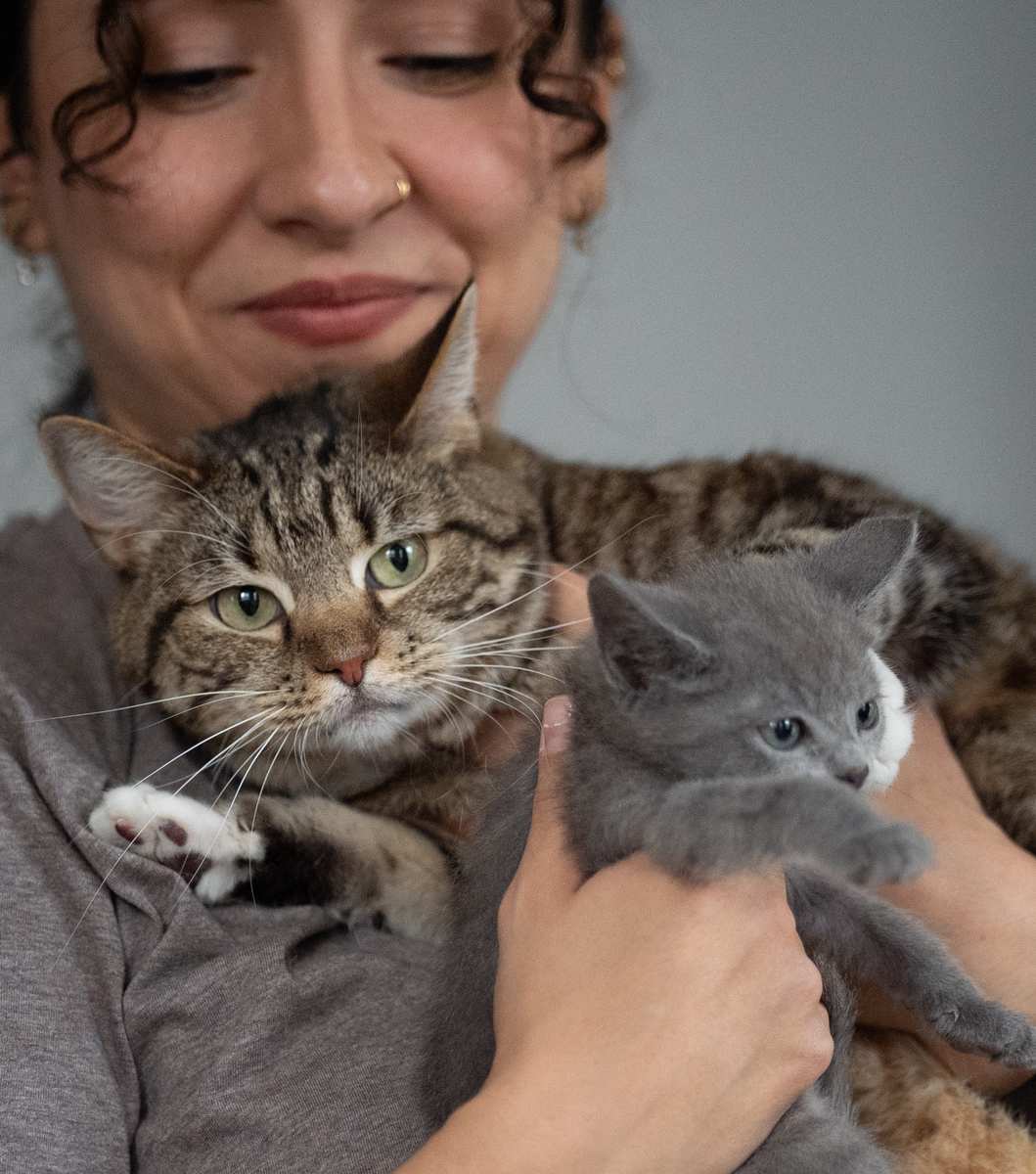
Shamiyan Hawramani first had the idea to put videos on social media featuring her husband tending to tiny kittens.
13:53 JST, October 3, 2025
Abdul Raheem grew up with a dog. He was not a cat person.
“My family told me cats were mean, cats were dirty, so we were never allowed to have any cats,” he says. He thought they didn’t really like people.
Because the universe loves a good laugh, today Raheem is a social media star thanks to his love of fostering kittens.
Raheem’s wife, Shamiyan Hawramani, started sharing short videos of Raheem and his rotating cast of tiny kittens with family and friends because she thought it was adorable to see her 6-foot-4 husband doting on tiny fluffballs. Now “Abdul’s Cats” has a devoted audience on social media – about 600,000 followers across platforms – about fostering, adoption and the charms of being a cat owner in D.C.
The posts range from serious to silly: Bottle feeding the smallest floofs. Hanging out with Raheem’s human buddies who are all cuddling kittens. Playing video games with a kitten at his side. (Spoiler: very distracting.)
In the past six years, the couple has fostered more than 200 kittens, many of them newborns who need bottle-feeding every two hours. Their current fosters are two gray littermates named Dust and Bunny.
Raheem, 35, and the kittens are the stars of the videos; Hawramani, 32, is the power behind the camera, and their 10-month-old-daughter, Haveen, an occasional co-star. It’s a full-time job for him, thanks to a growing audience and sponsorships.
This unlikely journey began when Raheem starting dating Hawramani seven years ago. Together, they fostered a gray tabby named Bambi, rescued from a high-kill shelter and scheduled to be euthanized. Raheem discovered that being around Bambi was, surprisingly, a balm for his anxiety and depression.
“She brought me so much just happiness, and she made my mental health better,” says Raheem, a self-described introvert. “My anxiety was better when I was around her. So I just want to give other people that feeling.”
Bambi was their first and only foster fail, meaning they ended up adopting her. Inspired by her transformation from a scared, anxious creature to a trusting, loving pet, they began fostering kittens from local shelters.
There was never a conversation about caring for litter after litter of abandoned and orphaned kittens. Instead, there was an understanding that this was what they were meant to do. And there was never a plan to become social media darlings.
“Abdul is really cute and really funny and he’d always played with the cats and did like really cute things,” Hawramani says. “I’d always be recording him and I’d send it to my mom or I’d send it my sister and I’m like, ‘Oh look what happened – this is so sweet.’”
In 2020, she thought maybe she should do something more because the videos brought her a lot of joy. By this time, the two were married, and she approached her husband with the idea of posting on social media to spread awareness about fostering and adopting.
Five years later, the accounts have blown up, and Raheem has left his job with Amazon to become a full-time kitten influencer (and now stay-at-home dad for their daughter).
The videos share each litter’s journey from arrivals to adoption: bottle feeding, baths and trimming sharp claws. Plus, kitten high jinks: wrestling matches, demanding meows, hiding in paper boxes.
The sunroom is the official kitten center. They are placed in a cozy gated pen first, then allowed to roam on the main floor as they get older and stronger. Social media followers choose the names by likes. There was the breakfast litter (Waffles, Pancake, Flapjack and French Toast), orange sodas (Fanta, Crush and Sunkist) and the Golden Girls.
Hawramani still works full-time in education; Raheem is the face of fostering, thanks to sponsorships and collaborations with in-kind products and underwriting. It’s a balancing act since even viral posts generate little income and sponsors fluctuate. “Abdul’s Cats” generates $20,000 to $60,000 annually, and they budget to be able to take in as many fosters as possible. Shelters cover vet costs, but not all provide food and other supplies.
The demand for fosters is heaviest in the spring and summer. A few newborns arrive from the shelters with a mother cat; most are alone and vulnerable, requiring bottle-feeding every two hours and often need medical care. The goal is to get them healthy and socialized until they reach around eight weeks and are spayed or neutered and ready to go to forever homes.
Raheem and Hawramani are frequently asked how they can bear to give up their tiny charges. Do they fall in love with the kittens? Of course. Are they tempted to keep one? Or five? Absolutely. That’s when they have a talk.
“We have to take turns whenever this happens,” Hawramani says. “If it’s me trying to adopt a cat, he has to talk to me and be like, ’Listen, this can’t happen. We have a plan. If you adopt this one, this is going to be it. It’ll be really hard to foster after this.’ And then similarly, when he wants to adopt a cat, I have to be like, “Listen, we can’t do this.’”
The plan from here? Fostering for the rest of their lives, they say, and helping cats find homes.
Kittens raised in a home with people, children and pets adjust faster to new environments. Raheem and Hawramani often meet the people adopting their fosters. Some are fans from social media, and some are personal friends. The primary concern is finding loving homes, but there is the secondary benefit, Raheem says, of placing more rescues into minority households.
“A lot of my friends who I grew up with never had cats,” he says. “They came over and played with the cats, and a couple of them have adopted cats now. One of them has four.”
This is the dream scenario for Brandywine Valley SPCA, the shelter that placed Dust and Bunny with the couple, as well as three previous litters.
“The flexibility, the experience, that’s what makes them amazing foster parents,” says Marissa Wimmer, who oversees the foster program. (Her title is Life Saving Manager.)
In the first eight months of 2025, 94 percent of the 4,623 animals that came into the shelter have been reunified with their owners, placed in new homes or returned to the wild when appropriate. Fostering kittens is vital to their survival – rescue shelters don’t have enough resources to give newborns the overnight care they require.
“It’s definitely a time commitment, but there’s a reason why they make kittens so cute,” Wimmer jokes. At the height of kitten season this year, more than 150 were placed in foster homes.
The stereotypes of Cat Ladies are true: Wimmer says about 90 percent of the shelter’s foster parents are women. But more men are stepping up, thanks to accounts like “Abdul’s Cats.” It reaches younger audiences, especially on Instagram and TikTok.
No one knows how long the social media ride will last. For now, “Abdul’s Cats” is alive and well, but Raheem and Hawramani have other dreams: A cat cafe where people can interact with kittens and order ice cream.
In the meanwhile, there are kittens who need homes and people who need cats.
“I feel like once I was around Bambi, came home to Bambi after work, my day was better and I was at ease,” Raheem says. “I’m not sure why. I just feel like cats just bring everyone peace.”








Most Read
Popular articles in the past 24 hours
-

Japan's Snow-Clad Beauty: Camellia Flowers Seen in Winter Bloom a...
-

Monkey Strikes Junior High School Girl from Behind in Japan's Yam...
-
Genichiro Inokuma's Mural in Ueno Station That Gave Hope in Postw...
-

Foreign and Security Policy: Political Parties Must Discuss How T...
-

Senior Japanese Citizens Return to University to Gain Knowledge, ...
-

Heavy Snow Linked to 30 Deaths across Japan since Late Jan.; JMA ...
-

Tokyo Police Arrest Head of Resignation Assistance Firm
-

Japan’s Nikkei Stock Average Jumps near 4%, Closes at Record High...
Popular articles in the past week
-

Japan Institute to Use Domestic Commercial Optical Lattice Clock ...
-

Australian Woman Dies After Mishap on Ski Lift in Nagano Prefectu...
-

Foreign Snowboarder in Serious Condition After Hanging in Midair ...
-

Chinese Embassy in Japan Reiterates Call for Chinese People to Re...
-
Narita Airport, Startup in Japan Demonstrate Machine to Compress ...
-

Toyota Motor Group Firm to Sell Clean Energy Greenhouses for Stra...
-

Sakie Yokota, Last Surviving Parent of a North Korea Abductee, Ur...
-

Beer Yeast Helps Save Labor, Water Use in Growing Rice; Govt Hope...
Popular articles in the past month
-
Univ. in Japan, Tokyo-Based Startup to Develop Satellite for Disa...
-

JAL, ANA Cancel Flights During 3-day Holiday Weekend due to Blizz...
-

China Confirmed to Be Operating Drilling Vessel Near Japan-China ...
-

China Eyes Rare Earth Foothold in Malaysia to Maintain Dominance,...
-
Japan Institute to Use Domestic Commercial Optical Lattice Clock ...
-

M6.2 Earthquake Hits Japan's Tottori, Shimane Prefectures; No Tsu...
-

Japan, Qatar Ministers Agree on Need for Stable Energy Supplies; ...
-

Japan, Italy to Boost LNG Cooperation; Aimed at Diversifying Japa...
Top Articles in News Services
-

Arctic Sees Unprecedented Heat as Climate Impacts Cascade
-

Prudential Life Expected to Face Inspection over Fraud
-

South Korea Prosecutor Seeks Death Penalty for Ex-President Yoon over Martial Law (Update)
-

Trump Names Former Federal Reserve Governor Warsh as the Next Fed Chair, Replacing Powell
-

Japan’s Nagasaki, Okinawa Make N.Y. Times’ 52 Places to Go in 2026
JN ACCESS RANKING
-
Univ. in Japan, Tokyo-Based Startup to Develop Satellite for Disaster Prevention Measures, Bears
-
JAL, ANA Cancel Flights During 3-day Holiday Weekend due to Blizzard
-
China Confirmed to Be Operating Drilling Vessel Near Japan-China Median Line
-
China Eyes Rare Earth Foothold in Malaysia to Maintain Dominance, Counter Japan, U.S.
-
Japan Institute to Use Domestic Commercial Optical Lattice Clock to Set Japan Standard Time