
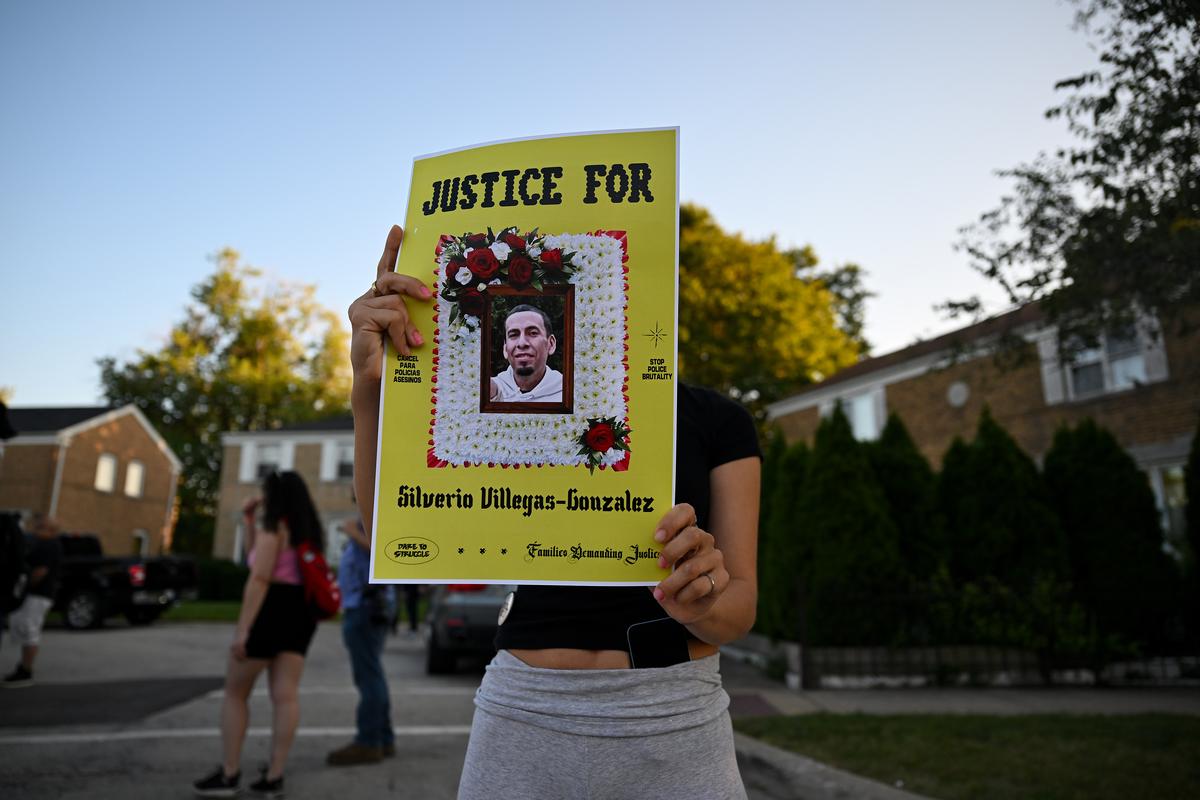
A person holds a poster during a vigil for Silverio Villegas-Gonzalez on Sept. 15 in Franklin Park, Illinois.
12:08 JST, September 29, 2025
CHICAGO – Silverio Villegas-Gonzalez had just dropped off his 3-year-old son at day care when an unmarked vehicle pulled in front of his car. Less than a minute later, the father of two was shot dead by a U.S. Immigration and Customs Enforcement officer.
The U.S. Department of Homeland Security says ICE was targeting a “criminal illegal alien” who refused to follow their commands. In a statement, DHS said Villegas-Gonzalez drove his car at law enforcement officers, hitting one and dragging him a “significant distance.” “Seriously injured” and “fearing for his own life,” DHS said, the officer fired his gun.
“We are praying for the speedy recovery of our law enforcement officer,” DHS spokeswoman Tricia McLaughlin said. “He followed his training, used appropriate force, and properly enforced the law to protect the public and law enforcement.”
But videos collected from nearby businesses and bystanders show both officers engaged in tactics that experts in policing said put them at unnecessary risk. Video also shows the hurt officer was fully mobile after the shooting and described his injuries as “nothing major.” And while DHS has said it is targeting the “worst of the worst,” records from Chicago’s Cook County show Villegas-Gonzalez had no record of violence. Since illegally crossing the border nearly two decades ago, he has been charged only with traffic violations in the city where he settled.
“Reckless conduct, in my opinion, may have led to the officer being in a situation where they were, quote, ‘dragged,’” said Philip Stinson, a professor of criminal justice and founder of the Police Integrity Research Group at Bowling Green State University. “And I would use the term drag with a bit of caution in terms of accepting that as the truth, because we really don’t know.”
Stinson is one of four experts with decades of experience in criminal justice who reviewed the footage at The Washington Post’s request. The experts said the videos provide too little information to determine whether the use of fatal force was proportionate to the officer’s perceived threat. ICE officers do not routinely wear body cameras, and the only available such footage is from responding agencies capturing the aftermath.
In a statement, DHS said the officer who fired his weapon is a military veteran who has worked at ICE since 2021 and was previously employed by another federal law enforcement agency. The agency said it was his first time firing in a “use of force incident” and that both officers are “well seasoned and trained professionals.”
“The smears and misleading reporting in the days since the incident have been disgusting and contribute to our officers facing more resistance and assaults against them,” McLaughlin said.
Villegas-Gonzalez’s shooting death has triggered calls for an independent investigation and raised concern about whether officers assigned to conduct street arrests have been properly trained. Chicago’s Democratic elected leaders argued that the shooting is an example of ICE’s unnecessarily aggressive tactics against immigrants who do not pose a danger.
“Thus far DHS’s story doesn’t seem to add up and a man is dead and a family is shattered,” said U.S. Rep. Jesús “Chuy” Garcia (D-Illinois), who called on anyone with evidence from the incident, including law enforcement, to come forward. “The agency responsible just keeps hiding behind the rhetoric that it continues to espouse.”
A final stop
Villegas-Gonzalez, 38, was a single father caring for two boys, ages 7 and 3, both U.S. citizens. He arrived in the United States from west-central Mexico in 2007 but the details of his migration story are unclear. Family members said he worked as a cook and delivery driver, and had married a U.S. citizen but was separated from her.
DHS declined to explain why ICE agents targeted Villegas-Gonzalez, but said in a news release that he had “a history of reckless driving.”
Cook County court records show Villegas-Gonzalez had received citations 11 times for traffic violations between 2010 and 2019; about half were dropped. Most were civil infractions such as driving an uninsured vehicle and driving with an expired license. The most serious offense was speeding in 2013, a misdemeanor. The citation states he had exceeded the speed limit by more than 31 mph.
Records show Villegas-Gonzalez complied with supervision, which typically consists of avoiding new tickets for a period of time and paying a fine, which he satisfied through payment or community service.
“He was cooperative with the officers – he was never fleeing or eluding. And he realized his mistake and didn’t do it again,” said Manuel Cárdenas, who represented Villegas-Gonzalez in two of his traffic cases. “The perspective that DHS gave that he was some violent person just doesn’t fit the facts.”
The morning of the shooting, Villegas-Gonzalez stopped at a day care in Franklin Park where workers remembered him as “always polite and respectful.”
Soon after, cameras from two businesses on Grand Avenue – a busy thoroughfare lined with fast food restaurants, grocery stores and shops – captured him driving his silver four-door Subaru. A silver Jeep SUV followed closely. The Jeep had no markings to identify it as a law enforcement vehicle, but officers turned on hidden flashing strobe lights to signal to him to pull over.
Villegas-Gonzalez parked alongside a nail salon shortly before 9 a.m. As his car slowed, the Jeep pulled ahead and parked at a diagonal in front of him, a tactic that blocked him from driving forward.
That strategy is considered risky because it puts officers directly in view of a suspect who may or may not be armed. It also means that if a suspect flees, agents would have to back their car into the path of oncoming traffic.
“We don’t stop in front of the vehicle for routine stops,” said Ed Obayashi, deputy sheriff and policy adviser for the Modoc County Sheriff’s Office in Northern California. “That’s just an officer safety issue.”
Video captured by Happy Nails’ security camera shows two men quickly stepped out of the Jeep, both wearing tactical vests with “Police” in large letters. One, dressed in a green T-shirt and black pants, approached the passenger window. The other, dressed in a blue T-shirt and jeans, approached the driver’s side.
Two shots and a crashed car
The surveillance video shows the two officers trying to communicate with Villegas-Gonzalez through the car’s partially opened windows. One pulls on the passenger door handle and reaches through the window. The other rests his hands outside the driver’s side window.
It is unclear from the video whether the officers identified themselves audibly or if Villegas-Gonzalez understood what they said. The nail salon security camera footage reviewed by The Post does not have audio. Immigrant advocates say the use of unmarked cars and officers in street clothes creates confusion, and that some people may fear they are being robbed or kidnapped – not being apprehended by a law enforcement officer.
Twenty-one seconds after he was stopped, Villegas-Gonzalez tries to back up.
The passenger-side officer draws his weapon and points it toward the car. His partner on the driver’s side continues to hold onto the partially lowered window. Seconds later, he appears to reach one hand inside.
Experts said it is dangerous to hold onto any vehicle while the driver is behind the wheel – especially if it starts to move. Seth Stoughton, faculty director for the Excellence in Policing & Public Safety (EPPS) Program at the University of South Carolina, said that as soon as it becomes clear a suspect is trying to flee, “you have to realize that your body is not going to win against that vehicle.”
“You don’t want to overextend and reach into a vehicle, only for that vehicle to start moving. The potential for getting dragged or struck or run over are just too high,” Stoughton said. “So before I’m going to physically go into a car, I’m going to make sure that car is not moving.”
Villegas-Gonzalez stopped momentarily before lurching his vehicle forward and accelerating. Then the Subaru moves swiftly out of frame. The officer in jeans is no longer visible. The other ICE agent pursues on foot.
Seconds later, security footage from a nearby auto shop captured the sound of two gun shots. The vehicle then crashed into a truck.
Both officers were off camera when the trigger was pulled, so it is unclear which one fired. Stoughton said shooting at the vehicle would not be “a reliable way of actually stopping that vehicle.” And if the driver is hit and incapacitated, he added, the officers “just created an uncontrolled, unguided missile.”
Video taken by a bystander shows the officer in jeans break the car window and drag a limp Villegas-Gonzalez out. On the side of the road, both officers begin administering aid.
Both officers appear fully mobile, though the officer in jeans has a tear on his left pant leg. Available video does not show whether either officer was indeed hit or dragged involuntarily, as DHS said.
‘Nothing major’
Images of the ICE officers do not appear to show them wearing body cameras. ICE initiated a pilot program under the Biden administration that required federal law enforcement agencies to develop policies for greater camera use. But the pilot program was never fully funded, and President Donald Trump reversed the mandate.
DHS said in a statement that providing ICE agents with body cameras “is a priority.” McLaughlin blamed the Biden administration for the lack of body cameras and said that the massive spending bill Trump signed into law over the summer would provide agents “with the resources they need – including body cameras.”
Franklin Park police officers did have body cameras on and captured the ICE officers in the immediate aftermath. The officer with the tear in his jeans says, “I got dragged a little bit” and describes his injuries as “nothing major.” The other officer says, “He tried to run us over,” and says his partner sustained a “left knee injury and some lacerations to his fingers.”
The officer with the knee injury remarks that Villegas-Gonzalez has children at two nearby schools.
“We’ve got to let them know,” he says.
The Federal Bureau of Investigation responded to the scene but declined to say whether the agency is leading an investigation into the officer’s use of deadly force. Local leaders in Chicago and Mexican officials said they are monitoring the case closely.
Meanwhile, Villegas-Gonzalez’s family is working with authorities to repatriate his remains to his hometown in the Mexican highlands.






Most Read
Popular articles in the past 24 hours
-

Voters Using AI to Choose Candidates in Japan's Upcoming General ...
-

Japan's Snow-Clad Beauty: Camellia Flowers Seen in Winter Bloom a...
-

Monkey Strikes Junior High School Girl from Behind in Japan's Yam...
-
Genichiro Inokuma's Mural in Ueno Station That Gave Hope in Postw...
-

Senior Japanese Citizens Return to University to Gain Knowledge, ...
-

Foreign and Security Policy: Political Parties Must Discuss How T...
-
Heavy Snow Linked to 30 Deaths across Japan since Late Jan.; JMA ...
-

Tokyo Police Arrest Head of Resignation Assistance Firm
Popular articles in the past week
-

Japan Institute to Use Domestic Commercial Optical Lattice Clock ...
-
Australian Woman Dies After Mishap on Ski Lift in Nagano Prefectu...
-
Foreign Snowboarder in Serious Condition After Hanging in Midair ...
-

Chinese Embassy in Japan Reiterates Call for Chinese People to Re...
-

Narita Airport, Startup in Japan Demonstrate Machine to Compress ...
-

Toyota Motor Group Firm to Sell Clean Energy Greenhouses for Stra...
-

Sakie Yokota, Last Surviving Parent of a North Korea Abductee, Ur...
-

Beer Yeast Helps Save Labor, Water Use in Growing Rice; Govt Hope...
Popular articles in the past month
-
Univ. in Japan, Tokyo-Based Startup to Develop Satellite for Disa...
-
JAL, ANA Cancel Flights During 3-day Holiday Weekend due to Blizz...
-

China Confirmed to Be Operating Drilling Vessel Near Japan-China ...
-

China Eyes Rare Earth Foothold in Malaysia to Maintain Dominance,...
-
M6.2 Earthquake Hits Japan's Tottori, Shimane Prefectures; No Tsu...
-
Japan Institute to Use Domestic Commercial Optical Lattice Clock ...
-

Japan, Qatar Ministers Agree on Need for Stable Energy Supplies; ...
-

Japan, Italy to Boost LNG Cooperation; Aimed at Diversifying Japa...
Top Articles in News Services
-

Arctic Sees Unprecedented Heat as Climate Impacts Cascade
-

Prudential Life Expected to Face Inspection over Fraud
-

South Korea Prosecutor Seeks Death Penalty for Ex-President Yoon over Martial Law (Update)
-
Trump Names Former Federal Reserve Governor Warsh as the Next Fed Chair, Replacing Powell
-

Japan’s Nagasaki, Okinawa Make N.Y. Times’ 52 Places to Go in 2026
JN ACCESS RANKING
-
Univ. in Japan, Tokyo-Based Startup to Develop Satellite for Disaster Prevention Measures, Bears
-
JAL, ANA Cancel Flights During 3-day Holiday Weekend due to Blizzard
-
China Confirmed to Be Operating Drilling Vessel Near Japan-China Median Line
-
China Eyes Rare Earth Foothold in Malaysia to Maintain Dominance, Counter Japan, U.S.
-
Japan Institute to Use Domestic Commercial Optical Lattice Clock to Set Japan Standard Time