
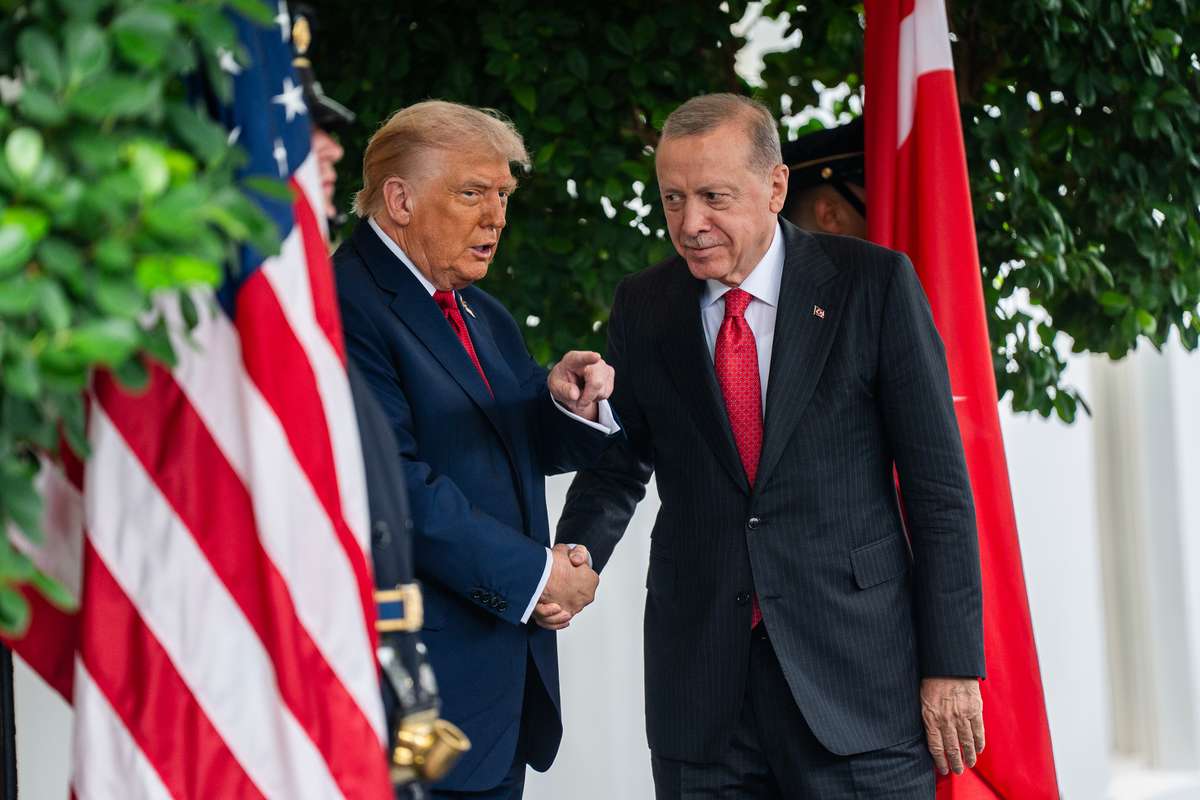
urkish President Recep Tayyip Erdogan meets with Trump on Thursday at the White House.
11:58 JST, September 29, 2025
When Donald Trump went before the U.N. General Assembly for the first time in 2017 and boasted that his eight-month-old presidency had “accomplished more than almost any administration in the history of our country,” he was met by laughter from the assembled world leaders and diplomats.
“I didn’t expect that reaction, but that’s okay,” he said.
Last week, the audience at the United Nations sat in stunned silence as he told them: “I’m really good at this stuff. Your countries are going to hell.” For nearly an hour, Trump piled on criticisms large and small, including that the escalator and the teleprompter didn’t work.
But that was only the beginning of a frenzied week for Trump on foreign policy, one of swerves and swagger. He stands astride the world community with a more commanding presence than he enjoyed in his first term, but what remains largely missing are the kind of foundational principles that historians might someday refer to as a “Trump doctrine.”
The populist and nationalist catchphrase that Trump and his supporters use is “America First.” What it means, however, is whatever he wants it to.
As Trump told the Atlantic in June: “Considering that I’m the one that developed ‘America First,’ and considering that the term wasn’t used until I came along, I think I’m the one that decides that.” (In fact, the slogan goes at least as far back as the 19th century, and has a checkered history that includes associations with racism and xenophobia.)
On the same day as his U.N. address, the president made a startling rhetorical pivot on the Ukraine war, saying that Russia is a “paper tiger” and that Kyiv has the potential to reclaim all of the territory that Russia has captured.
In February, during a contentious session in the White House, Trump told Ukrainian President Volodymyr Zelensky: “You’re not in a good position. You don’t have the cards right now.” A little more than a month ago, Trump literally had a red carpet rolled out for what turned out to be an apparently fruitless meeting with Russian President Vladimir Putin in Alaska.
But in a social media post shortly after meeting with Zelensky last week, Trump wrote: “With time, patience, and the financial support of Europe and, in particular, NATO, the original Borders from where this War started, is very much an option. Why not?”
Thursday found him holding a warm session in the Oval Office with Turkish President Recep Tayyip Erdogan, whom his predecessor, Joe Biden, had kept at a distance because of Erdogan’s oppressive human rights record. Trump said his longtime friend Erdogan is a valuable ally and potential go-between in bringing peace to Ukraine and the Middle East.
On Friday, Trump boasted once again that he was “very close to a deal on Gaza” – an end to the war there that would include the return of the Israeli hostages taken by Hamas on Oct. 7, 2023. Israeli Prime Minister Benjamin Netanyahu, making a defiant address before the United Nations at nearly that same hour, did not make any reference to progress; he spoke to a largely empty chamber because dozens of delegations had walked out.
So how do all these moves add up? Or do they?
“I don’t think there’s a Trump doctrine. I don’t think he has a philosophy. I don’t think he does grand strategy. I don’t even think he does policy as that term is conventionally understood in Washington,” said John Bolton, who was U.N. ambassador under George W. Bush and national security adviser during Trump’s first term. “There isn’t any Trumpism that’s going to survive. It’s all about his interest and what he wants.”
In Trump’s second term, Bolton has become one of the president’s most vocal antagonists on foreign policy – and the hostility is mutual, with Trump referring to his former adviser as “a lowlife.” On Aug. 22, FBI agents descended on Bolton’s home and office as part of an investigation into whether he illegally kept classified documents.
While Trump’s approach is unconventional, those who support it say it is indeed grounded in a philosophy.
“Rather than pursuing a traditional establishment foreign policy, President Trump is weighing all these international engagements through the lens of U.S. national security. In other words, he is guiding his policies on what will contribute to the security and prosperity of the American people rather than in pursuit of some abstract greater good,” argued Victoria Coates of the Heritage Foundation, a former deputy national security adviser to Trump. “At the same time, his patience is not infinite.”
With his criticism of the United Nations – albeit not in the words he used – Trump is far from alone. Foreign policy specialists across the ideological spectrum say the eight-decade-old international organization today is ill-equipped for being what President Harry S. Truman described at its founding: “machinery for the just settlement of international differences.” The U.N., part of a postwar international order largely built by Washington, was also meant to be a place where smaller nations could stand up to big powers.
“I don’t think it can be fixed. The U.N. is a reflection of, more than anything, of great power relations. It can’t be fixed because anything you try to change will be blocked by one or another of the five veto-wielding members who believe the changes are at odds with their interests,” said Richard Haass, who for 20 years was president of the Council on Foreign Relations. “The U.N. no longer reflects the world as it is. It reflects the world as it was.”
“People will come to New York, but less because of the U.N. per se,” Haass added, saying the organization has become “a venue to have side meetings. I call it Davos for diplomats.”
And while the anti-Russian shift in Trump’s rhetoric on Ukraine sparked hope for a different direction, it was not clear he is prepared to put any new policies, such as tougher sanctions, behind it.
More likely, say some experts, is that he has become disillusioned by the idea that he can bring the two sides together by leveraging his personal relationship with Putin and pressuring Zelensky.
“This has been sort of the education of Donald Trump when it comes to trying to negotiate the end of war, the end of a brutal conflict,” said Max Bergmann, the director of the Europe, Russia and Eurasia Program at the Center for Strategic and International Studies. “He came in thinking that the Ukrainians were a problem and that they were the ones refusing to stop fighting, and that Russia was stronger, and that he could offer all these incentives and carrots to Putin, and he could pressure Ukraine to end the war. I think he has come to realize that was not true.”
Haass described Trump’s latest statements on Ukraine as those of an “observer in chief. It was almost as if he were observing U.S. foreign policy, rather than making it.”
For all of these swings back and forth, however, Trump remains focused on at least one international goal: the Nobel Peace Prize. Though a Washington Post-Ipsos poll indicated more than three-quarters of Americans think he doesn’t deserve one, he told the U.N. General Assembly that “everyone says” he should receive the honor.


Related Tags




Most Read
Popular articles in the past 24 hours
-

Voters Using AI to Choose Candidates in Japan's Upcoming General ...
-

Japan's Snow-Clad Beauty: Camellia Flowers Seen in Winter Bloom a...
-
Monkey Strikes Junior High School Girl from Behind in Japan's Yam...
-

Genichiro Inokuma's Mural in Ueno Station That Gave Hope in Postw...
-

Senior Japanese Citizens Return to University to Gain Knowledge, ...
-

Foreign and Security Policy: Political Parties Must Discuss How T...
-
Heavy Snow Linked to 30 Deaths across Japan since Late Jan.; JMA ...
-
Tokyo Police Arrest Head of Resignation Assistance Firm
Popular articles in the past week
-

Japan Institute to Use Domestic Commercial Optical Lattice Clock ...
-
Australian Woman Dies After Mishap on Ski Lift in Nagano Prefectu...
-
Foreign Snowboarder in Serious Condition After Hanging in Midair ...
-
Chinese Embassy in Japan Reiterates Call for Chinese People to Re...
-

Narita Airport, Startup in Japan Demonstrate Machine to Compress ...
-

Toyota Motor Group Firm to Sell Clean Energy Greenhouses for Stra...
-
Sakie Yokota, Last Surviving Parent of a North Korea Abductee, Ur...
-

Beer Yeast Helps Save Labor, Water Use in Growing Rice; Govt Hope...
Popular articles in the past month
-
Univ. in Japan, Tokyo-Based Startup to Develop Satellite for Disa...
-
JAL, ANA Cancel Flights During 3-day Holiday Weekend due to Blizz...
-
China Confirmed to Be Operating Drilling Vessel Near Japan-China ...
-

China Eyes Rare Earth Foothold in Malaysia to Maintain Dominance,...
-
M6.2 Earthquake Hits Japan's Tottori, Shimane Prefectures; No Tsu...
-
Japan Institute to Use Domestic Commercial Optical Lattice Clock ...
-
Japan, Qatar Ministers Agree on Need for Stable Energy Supplies; ...
-
Japan, Italy to Boost LNG Cooperation; Aimed at Diversifying Japa...
Top Articles in News Services
-
Arctic Sees Unprecedented Heat as Climate Impacts Cascade
-

Prudential Life Expected to Face Inspection over Fraud
-

South Korea Prosecutor Seeks Death Penalty for Ex-President Yoon over Martial Law (Update)
-
Trump Names Former Federal Reserve Governor Warsh as the Next Fed Chair, Replacing Powell
-

Japan’s Nagasaki, Okinawa Make N.Y. Times’ 52 Places to Go in 2026
JN ACCESS RANKING
-
Univ. in Japan, Tokyo-Based Startup to Develop Satellite for Disaster Prevention Measures, Bears
-
JAL, ANA Cancel Flights During 3-day Holiday Weekend due to Blizzard
-
China Confirmed to Be Operating Drilling Vessel Near Japan-China Median Line
-
China Eyes Rare Earth Foothold in Malaysia to Maintain Dominance, Counter Japan, U.S.
-
Japan Institute to Use Domestic Commercial Optical Lattice Clock to Set Japan Standard Time