
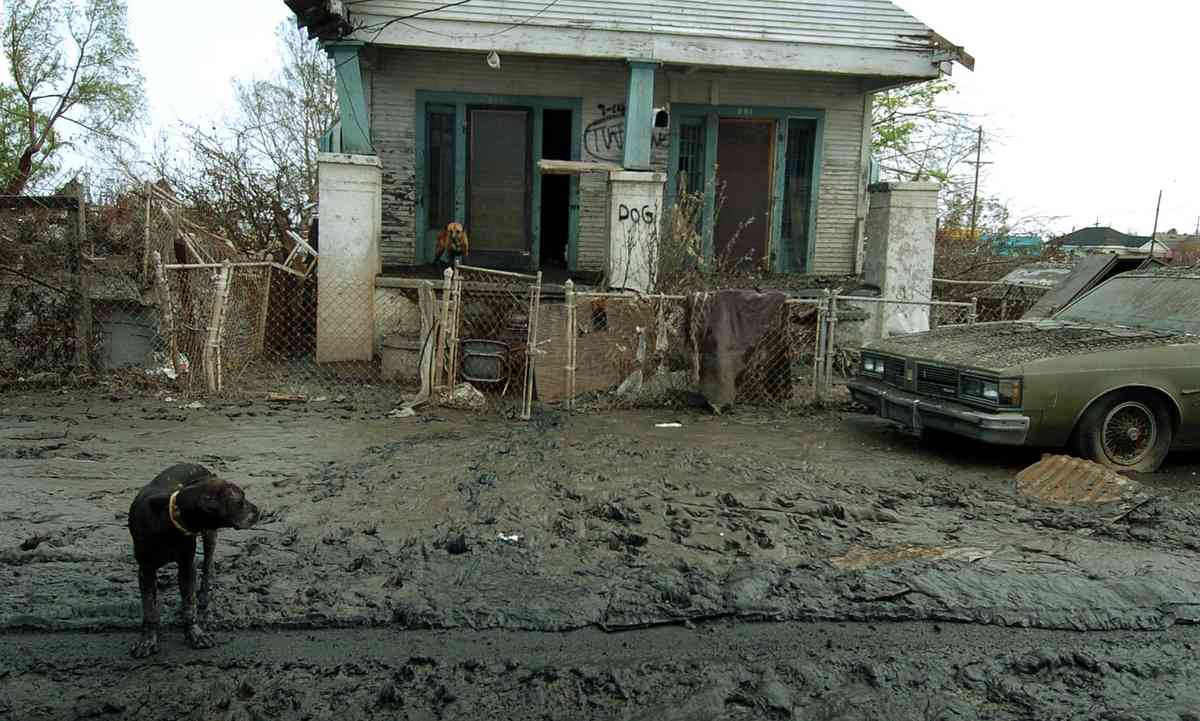
A home in New Orleans damaged during Hurricane Katrina in 2005, the largest single loss in U.S. insurance history.
11:49 JST, September 26, 2025
It’s been a record year for placing bets against Mother Nature’s wrath – $18.6 billion and counting.
That’s how much large investors such as pensions and hedge funds are estimated to have spent so far in 2025 buying catastrophe bonds, which insurers and reinsurance firms sell to shed some of the risk of massive natural disasters.
Cat bonds, as they’re known in the industry, often pay double-digit interest rates, but insurers can tap the investment to pay claims if the bond is triggered by big losses from a particular catastrophe – or, in some cases, even if a storm just hits certain wind speeds.
Cat bonds help ease the pressure on insurers, said Michel Leonard, chief economist at the Insurance Information Institute trade group, “and we have a hard market right now” as the industry struggles to get a handle on the threat posed by very expensive disasters. Cat bonds spread the risk to outside investors, protecting insurance companies from getting wiped out by a single event.
The potential for calamitous natural disasters such as wildfires or hurricanes already has led some insurance companies to claim they had to stop writing homeowners’ policies in some markets or abandon them entirely.
“Insurance prices would be much higher today without cat bonds,” said Robert Hartwig, who directs the Center for Risk and Uncertainty Management at the University of South Carolina.
The big risk for investors is a major U.S. hurricane. That’s what drives the cat bond market. About 70 percent of the risks covered by the $56 billion in cat bonds outstanding worldwide are tied to damage from named storms slamming into places such as Texas or Florida. The potential for crushing losses is so great that these bond sales mostly shut down during the Atlantic hurricane season, running from June 1 to Nov. 30. Instead, the cat bond world spends its time watching what’s brewing out at sea.
“The Weather Channel is the one you have on in the background,” said Philipp Kusche, global head of insurance-linked securities at Howden Capital Markets and Advisory. “It’s fingers-crossed time.”
The National Oceanic and Atmospheric Administration had predicted an above-normal season with 13 to 18 named storms and 2 to 5 major hurricanes, but it’s been quiet so far. Hurricane Erin failed to reach the United States in August. This week, Hurricane Gabrielle was being tracked as it passed near Bermuda.
The cat bond market was created in response to Hurricane Andrew, which was the costliest U.S. hurricane in history when it hit South Florida in 1992, causing about $27 billion in insured losses. At least 16 insurers were driven into the ground by the storm.
That is when insurers realized they needed new sources of funding. One of the first cat bond deals arrived in 1997, organized for the USAA insurance company, a $500 million offering that protected the insurer for one year from losses greater than $1 billion from a single Category 3, 4 or 5 hurricane along the East Coast.
The cat bond market grew steadily for years and then exploded after Hurricane Katrina hit New Orleans in 2005, the costliest natural disaster in U.S. history. These are mostly purchased by institutional investors, although some exchange-traded funds have exposure to them.
Over the past decade, the cat bond market has nearly tripled, according to Artemis, which tracks insurance-linked securities. Most of these deals are centered on climate disasters. But there are also smaller cat bonds that cover cyber risk and terrorism. Life insurance companies offer extreme mortality bonds to cover mass death events. The Danish Red Cross sponsored a small cat bond in 2023 tied to eruptions at 10 different volcanos as a way to pay for aid delivery should lava flow.
Investors scored a 17.3 percent average return last year and 19.7 percent in 2023, according to the Swiss Re Cat Bond Total Return Index. So far this year, the average yield is about 10 percent.
But the average return was -2.2 percent in 2022, thanks in part to Hurricane Ian making landfall in Florida in September of that year as a Category 4 storm. Ian caused an estimated $54 billion in insured property losses, according to estimates.
Nothing spurs interest from insurers in cat bonds like a pricey disaster.
Just weeks after the Southern California wildfires in January torched more than 15,000 homes and buildings, California FAIR plan, the state’s insurer of last resort, said it would look into cat bonds “to further enhance its ability to pay claims in the event of future disasters.”
Today, U.S. hurricanes are considered the best understood disaster risk thanks to intense modeling built on decades of data about what happens when these storms make landfall. Both sides in a cat bond deal have a good idea of what they’re getting into.
It’s harder with so-called secondary perils, such as severe storms and hail, flooding or even forest fires. These events are harder to predict, so investors tend to want a bigger return for shouldering the risk, said Jean-Louis Monnier, head of insurance-linked securities at Swiss Re, one of the world’s largest reinsurance firms.
The California wildfires and large thunderstorms in the Midwest made the first six months of 2025 the second costliest half-year period on record for catastrophe losses, reaching $80 billion, according to a Swiss Re report.
The average property insurance premium has jumped 70 percent nationwide since 2000, according to the ICE Mortgage Monitor Report. Although experts say it would be higher without cat bonds, most of the increase is because people keep moving into hurricane-prone parts of Florida and Texas, as well as earthquake-prone areas in California. The average size of a U.S. home is also larger than in the past. And inflation has pushed up the cost of replacement building materials.
If Hurricane Ian had hit during the 1970s, insured losses would have been half or even a third less expensive, according to a Swiss Re report.






Most Read
Popular articles in the past 24 hours
-

Voters Using AI to Choose Candidates in Japan's Upcoming General ...
-

Japan's Snow-Clad Beauty: Camellia Flowers Seen in Winter Bloom a...
-

Monkey Strikes Junior High School Girl from Behind in Japan's Yam...
-

Genichiro Inokuma's Mural in Ueno Station That Gave Hope in Postw...
-

Senior Japanese Citizens Return to University to Gain Knowledge, ...
-

Foreign and Security Policy: Political Parties Must Discuss How T...
-
Heavy Snow Linked to 30 Deaths across Japan since Late Jan.; JMA ...
-

Tokyo Police Arrest Head of Resignation Assistance Firm
Popular articles in the past week
-

Japan Institute to Use Domestic Commercial Optical Lattice Clock ...
-

Australian Woman Dies After Mishap on Ski Lift in Nagano Prefectu...
-

Foreign Snowboarder in Serious Condition After Hanging in Midair ...
-

Chinese Embassy in Japan Reiterates Call for Chinese People to Re...
-
Narita Airport, Startup in Japan Demonstrate Machine to Compress ...
-

Toyota Motor Group Firm to Sell Clean Energy Greenhouses for Stra...
-

Sakie Yokota, Last Surviving Parent of a North Korea Abductee, Ur...
-

Beer Yeast Helps Save Labor, Water Use in Growing Rice; Govt Hope...
Popular articles in the past month
-

Univ. in Japan, Tokyo-Based Startup to Develop Satellite for Disa...
-
JAL, ANA Cancel Flights During 3-day Holiday Weekend due to Blizz...
-

China Confirmed to Be Operating Drilling Vessel Near Japan-China ...
-

China Eyes Rare Earth Foothold in Malaysia to Maintain Dominance,...
-
M6.2 Earthquake Hits Japan's Tottori, Shimane Prefectures; No Tsu...
-
Japan Institute to Use Domestic Commercial Optical Lattice Clock ...
-

Japan, Qatar Ministers Agree on Need for Stable Energy Supplies; ...
-

Japan, Italy to Boost LNG Cooperation; Aimed at Diversifying Japa...
Top Articles in News Services
-
Arctic Sees Unprecedented Heat as Climate Impacts Cascade
-

Prudential Life Expected to Face Inspection over Fraud
-

South Korea Prosecutor Seeks Death Penalty for Ex-President Yoon over Martial Law (Update)
-

Trump Names Former Federal Reserve Governor Warsh as the Next Fed Chair, Replacing Powell
-

Japan’s Nagasaki, Okinawa Make N.Y. Times’ 52 Places to Go in 2026
JN ACCESS RANKING
-
Univ. in Japan, Tokyo-Based Startup to Develop Satellite for Disaster Prevention Measures, Bears
-
JAL, ANA Cancel Flights During 3-day Holiday Weekend due to Blizzard
-
China Confirmed to Be Operating Drilling Vessel Near Japan-China Median Line
-
China Eyes Rare Earth Foothold in Malaysia to Maintain Dominance, Counter Japan, U.S.
-
Japan Institute to Use Domestic Commercial Optical Lattice Clock to Set Japan Standard Time