

19:16 JST, September 22, 2025
During World War II, the Japanese military constructed the Thai-Burma Railway connecting Thailand and Burma, now Myanmar.
While the section in Thailand has become a tourist destination showcasing war relics, the train tracks on the Myanmar side were removed by British forces after the war.
Myanmar has been in the grip of a civil war between the country’s military and ethnic minority armed groups, and little information about the railway’s condition has surfaced.
In July 2019, I was able to explore that section.
Three pagodas

Three pagodas stand at the Three Pagodas Pass in this picture taken in January 2013.
On the mountainous border between Thailand and Myanmar lies a pass called the Three Pagodas Pass, and as per the name, there are three pagodas there standing in a row. The town on the Myanmar side is called Payathonzu, meaning “three pagodas.” The Japanese military divided construction of the railway into Thai and Burmese zones, and this was the dividing line.
About three kilometers away is an area controlled by the New Mon State Party, an ethnic minority group in Myanmar. The village’s name, which is in the Mon language, translates to “Japan Well Village.”
When I asked a party leader about its origin, he said with a grin, “It seems to be named after a well that was built by the Japanese forces.”
That well still exists in the tropical forest. Its circular opening had a thick concrete lid, and there was also a dilapidated water storage tank.
“The well has never run dry,” an elderly villager said.
Along a nearby path, pieces of what appeared to be lauan wood were embedded at intervals in the ground. These were the remnants of railroad ties.
Beyond these ties was a grass-covered embankment, about 1 meter high and 2 meters wide.
It is said that during the war, tracks were laid on the embankment and paths for locomotives and freight cars to carry military supplies. A border station must have existed nearby.
Road full of holes
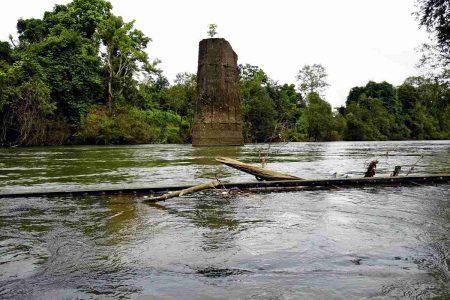
A bridge pier and submerged girders are seen in the Zami River in July 2019.
Thirty-six stations were built on the Thai side and 19 on the Burmese side. To avoid British air raids, most were built deep within forests. Station buildings were simple huts made of bamboo and wood, so by now, they have probably decayed down to nothing.
The exact route is unknown because the Japanese military burned the relevant documents. But around 2012, under the Thein Sein administration, there was road construction along the route.
There were settlements along the roads with names identical to or resembling the station names, such as Kyondaw, Apalon, Mezali, Taungzun, Anankwin and Wegare. However, construction had been halted, and most of the sections of road were unpaved, potholed and littered with stones.
After about an hour’s slow drive from Payathonzu, I reached the Zami River, which is about 30 to 50 meters wide and winds through the wild plains. During the war, there was a station called Apalon several kilometers to the west, and a factory for military machine tools was reportedly built in the tropical forest.
The Mon people prepared a long, narrow boat for me. Seven people including myself sat on the floor and drifted downstream for a few minutes. Then, a bridge pier, protruding about five meters above the water, came into view. The deck that once ran over the pier and carried trains was gone.
“In the 1990s, fighting intensified between the Karen National Union [KNU] and the [Myanmar] military. The KNU blew up the bridge deck to disrupt military operations,” a young fellow passenger explained.
Two sturdy trapezoidal supports stood on either side of the river, while downstream, the remains of iron girders lay submerged.
During WWII, a military base with facilities and equipment for railway and communications systems was built in the surrounding forest. After a long period of time, however, the pier of the Zami River bridge stood alone in its solitude.
Memories of soldiers

A bridge pier topped with a stupa is seen in July 2019.
About 35 kilometers farther to the northwest, there is a settlement called Anankwin. Guided by a Mon-Karen couple, we waded through a stream in knee-deep water and walked about 10 minutes through grassy thickets to reach a dimly lit forest.
There was a roughly 3-meter-tall concrete bridge pier, with grass growing all around it, and on top of it was a small stupa, or Buddhist shrine. It is said that, about 40 years ago, a monk advised the villagers to build the stupa, saying, “Do not ever destroy this structure.”
Another bridge pier stood about 100 meters farther into the forest. However, with six years having passed, it has probably been completely enveloped by trees, becoming part of the forest.
The Japanese military established a large base with railway and communications equipment in this area as well.
In a village outside Thanbyuzayat, I spoke with a woman in her 90s who traded with nearby Japanese soldiers during the war. Thanbyuzayat was the starting point for the Thai-Burma Railway in Burma.
A summer shower pounded the roof of the small house, frequently drowning out her faint voice. The woman said that, when she was around 20, she and her elder sister sold tobacco and sweets to Japanese soldiers in Anankwin and started a small eatery.
“Many Japanese soldiers came, and life became prosperous. It’s a good memory,” she said, cheerfully humming a verse of a Japanese song she remembered.
Last year, when I asked a Mon friend I met in Tokyo about how the woman was doing, I learned she had passed away.
‘Many remains to be found’
On the plains eight kilometers away from Thanbyuzayat, one can still find a hot spring that was dug out by the Japanese forces.
Four concrete rooms for private bathing have been preserved on the grounds of a local recreational facility. The rooms were built for high-ranking officers. The facility’s guest bath area has an old, 5-meter-long trough for hot water, which may have been used by soldiers.
Adjacent to the facility is a Myanmar military site, where the railway’s Wegare station was located during the war.
The facility manager said, “There was a field hospital nearby, and my grandfather said he helped bury deceased Japanese soldiers.” He said that the nearby forest was a burial ground. “You’re sure to find many remains there,” he added.
Town for placating lost souls

A memorial erected by the Japanese military during World War II
Thanbyuzayat is about a 20-minute drive from the facility. The Thai-Burma Railway was connected to existing tracks, allowing supplies to be transported toward Rangoon, now known as Yangon.
The town is for the repose of the dead. In a vast war cemetery for Allied forces, more than 3,500 gravestones for soldiers, mainly from Britain, Australia and the Netherlands who died building the railway, stand in orderly rows among the grass. Each bears a name, an age and a message from family. Many of those who died were young men in their 20s.
About one kilometer south, a solitary memorial erected by the Japanese military stands on grass beside a national highway. Entering the woods beyond, embankments that will never see another locomotive were overgrown with weeds.
Tens of thousands dead
Officially called the “Tai-Men Rensetsu Tetsudo” (Thai-Burma Link Railway) in Japanese, the railway is famous because of the film “The Bridge on the River Kwai,” which has the theme music “The River Kwai March.”
Following a devastating defeat at the Battle of Midway, the Japanese military, looking to secure supply routes to Burma such as for the Imphal Campaign and other operations, constructed a 415-kilometer railway linking Nong Pladuk in Thailand and Thanbyuzayat in Burma in a grueling 15-month construction period. It opened in October 1943.
Prisoners of war from Allied forces — namely British, Australian, Dutch and American soldiers — along with Asian laborers were conscripted for the arduous task of cutting through dense jungle. Diseases such as cholera and dysentery were rampant in the unsanitary labor camps. Tens of thousands died from disease and malnutrition. In Thailand, Myanmar, Europe, the United States and Australia, the project became known as the “Death Railway.”
Estimates of the dead include “13,000 prisoners of war and 33,000 Asian laborers,” as mentioned in “Taimen Tetsudo: Senjo ni Nokoru Hashi” (The Thai-Burma Railway: Bridges left on the battlefield), written by Toshio Hiroike and published by The Yomiuri Shimbun. However, no precise records exist.
The railway is considered to have had insufficient logistics capabilities as it was a single-track line and suffered from frequent landslides, bridge washouts and derailments. To avoid British air raids, operations were reportedly restricted to the nighttime.
***
Japan expected to play leading role
Along the Myanmar section of the railway, the situation has deteriorated since I visited in 2019, due to the 2021 military coup and the encroachment of China-affiliated fraud groups.
Based near the borders of China and Thailand, groups conducting fraud online and internationally have begun building bases and casinos in Payathonzu, raising concerns that the town might become a new hotbed for international crime.
“Chinese nationals are expanding their area of operations to Payathonzu,” said a senior official of the KNU in July. “Their aim is not to avoid crackdowns, but to expand their bases in Myanmar.”
The fraud groups first set up bases in the state of Shan, which borders China. Then they advanced south to Myawaddy, a city bordering Thailand, several years ago. And continuing farther south, they eventually hit Payathonzu. Since May 2024, local digital media outlets have been reporting that Chinese nationals are “operating casinos and conducting fraud in Payathonzu.”
Since the 2021 coup, the Myanmar military has been battling armed groups including ethnic minority forces in many parts of the country, making it virtually impossible to follow the Myanmar section of the Thai-Burma Railway. The military plans to hold a general election in December to effectively make the military regime permanent, raising concerns that conflict with ethnic minority groups will intensify.
The people of Myanmar are striving for democracy and peace. The international community must help to achieve these goals and eradicate international crime. Japan has an invaluable part to play.
For the future good of the region, Japan should propose that the Thai-Burma Railway, known as the “Death Railway” in the 20th century, be transformed into the “Route of Peace and Prosperity” in the 21st century.
When the Thai-Burma Railway was being built, the Japanese military discussed nearly 10 routes and concluded that the one through Payathonzu was best. When I followed the route myself, I found that it went along gentle hills through the mountains. The slopes were not steep.
From Payathonzu to Thanbyuzayat, it is only about 100 kilometers. Why not build a road facilitating shipping that meets international standards along this route, instead of building a railway, which would require much funding and time? If the road links up with the Southern Economic Corridor — which connects Thailand, Cambodia and Vietnam — there will be a major artery tying the South China Sea with the Indian Ocean. It will bring economic benefits to Myanmar and other countries along the network, as well as to Japanese companies.
Given the current circumstances, this may sound like a pipe dream. However, if Japan can get the United States, Europe and countries along the artery to cooperate in turning the Thai-Burma Railway into a road for peace and prosperity, it may also serve to placate the souls of those who died constructing the railway.




Most Read
Popular articles in the past 24 hours
-

Voters Using AI to Choose Candidates in Japan's Upcoming General ...
-

Japan's Snow-Clad Beauty: Camellia Flowers Seen in Winter Bloom a...
-

Monkey Strikes Junior High School Girl from Behind in Japan's Yam...
-
Genichiro Inokuma's Mural in Ueno Station That Gave Hope in Postw...
-
Senior Japanese Citizens Return to University to Gain Knowledge, ...
-
Heavy Snow Linked to 30 Deaths across Japan since Late Jan.; JMA ...
-

Foreign and Security Policy: Political Parties Must Discuss How T...
-

Tokyo Police Arrest Head of Resignation Assistance Firm
Popular articles in the past week
-

Japan Institute to Use Domestic Commercial Optical Lattice Clock ...
-
Australian Woman Dies After Mishap on Ski Lift in Nagano Prefectu...
-
Foreign Snowboarder in Serious Condition After Hanging in Midair ...
-

Chinese Embassy in Japan Reiterates Call for Chinese People to Re...
-
Narita Airport, Startup in Japan Demonstrate Machine to Compress ...
-

Toyota Motor Group Firm to Sell Clean Energy Greenhouses for Stra...
-

Sakie Yokota, Last Surviving Parent of a North Korea Abductee, Ur...
-
Beer Yeast Helps Save Labor, Water Use in Growing Rice; Govt Hope...
Popular articles in the past month
-
Univ. in Japan, Tokyo-Based Startup to Develop Satellite for Disa...
-
JAL, ANA Cancel Flights During 3-day Holiday Weekend due to Blizz...
-
China Confirmed to Be Operating Drilling Vessel Near Japan-China ...
-
China Eyes Rare Earth Foothold in Malaysia to Maintain Dominance,...
-
M6.2 Earthquake Hits Japan's Tottori, Shimane Prefectures; No Tsu...
-
Japan Institute to Use Domestic Commercial Optical Lattice Clock ...
-
Japan, Qatar Ministers Agree on Need for Stable Energy Supplies; ...
-

Japan, Italy to Boost LNG Cooperation; Aimed at Diversifying Japa...
Top Articles in World
-
China Confirmed to Be Operating Drilling Vessel Near Japan-China Median Line
-
China Eyes Rare Earth Foothold in Malaysia to Maintain Dominance, Counter Japan, U.S.
-
Japan, Qatar Ministers Agree on Need for Stable Energy Supplies; Motegi, Qatari Prime Minister Al-Thani Affirm Commitment to Cooperation
-

North Korea Possibly Launches Ballistic Missile
-

10 Universities in Japan, South Korea, Mongolia to Establish Academic Community to Promote ICC Activities, Rule of Law
JN ACCESS RANKING
-
Univ. in Japan, Tokyo-Based Startup to Develop Satellite for Disaster Prevention Measures, Bears
-
JAL, ANA Cancel Flights During 3-day Holiday Weekend due to Blizzard
-
China Confirmed to Be Operating Drilling Vessel Near Japan-China Median Line
-
China Eyes Rare Earth Foothold in Malaysia to Maintain Dominance, Counter Japan, U.S.
-
Japan Institute to Use Domestic Commercial Optical Lattice Clock to Set Japan Standard Time