
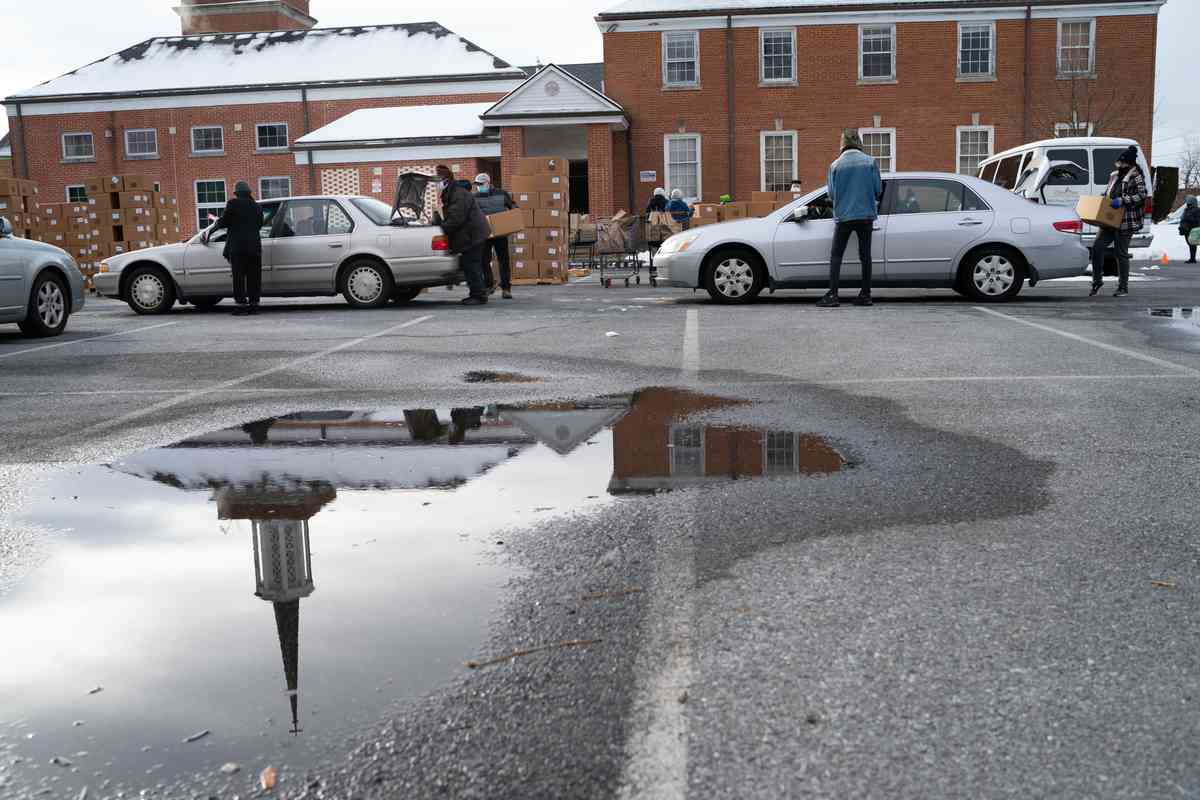
People line up at a food bank at Clifton Park Baptist Church in Silver Spring, Maryland, in 2021.
15:10 JST, September 16, 2025
More Americans are facing stretches of unemployment of six months or more, a worrisome sign for the U.S. economy.
More than 1 in 4 workers without jobs have been unemployed for at least half a year, new data shows. That number is a post-pandemic high and a level typically only seen during periods of economic turmoil.
In all, more than 1.9 million Americans had been unemployed “long term” in August, meaning they have been out of work for 27 weeks or more, a critical cliff when it comes to finding a job. That’s nearly double the 1 million people who were in a similar position in early 2023.
“We have a low-hire, low-fire environment – and that stagnancy means there aren’t a lot of new positions for people to move into,” said Laura Ullrich, director of economic research at the jobs site Indeed. “The probability of becoming unemployed has not gone up that much, but if you become unemployed, it’s much harder to find a job.”
Six months of unemployment often signals a turning point in a person’s job search, according to economists. They’ve likely run out of unemployment insurance benefits and severance payments by then, leaving them on shakier financial ground. People who have been unemployed for more than six months are also more likely to become discouraged and stop looking for work altogether.
The data shows how broadly the job market has cooled ahead of the Federal Reserve’s highly-anticipated meeting this week, when policymakers are expected to lower interest rates for the first time this year. Two months of weaker-than-expected jobs numbers, including widespread revisions, have led policymakers to voice concerns that the labor market could continue deteriorating.
Since 1950, the long-term unemployment rate has exceeded 25 percent in only a few other instances and always after a recession: for one month, June 1983, after an inflation-fueled recession; for an eight-year stretch following the Great Recession in 2009; and for about a year and a half during the coronavirus pandemic.
The pickup in months-long unemployment coincides with broader cooling in the labor market. Although the overall unemployment rate, 4.3 percent, is near longtime lows, many employers have frozen hiring as they wait to see how new tariffs and other economic policies will affect business. Layoffs are rising, too, with weekly claims for unemployment insurance reaching the highest level since October 2021.
For the unemployed, it’s becoming increasingly difficult to find new work – now taking an average of six months, a month longer than before the pandemic, according to Labor Department data. And for the first time in four years, there are more unemployed people in the United States than there are job openings.
“I have 15-plus years in IT. I thought I should be able to step into any job,” said Steve Beal, 47, who has been unemployed since March 2024, when he was laid off from a six-figure job at Best Buy’s corporate office in Minnesota. “But so far I’ve applied to at least 300 jobs, and it’s all rejections. Even with referrals, networking, résumé services, I haven’t gotten anywhere.”
Separate data this week showed that Americans’ confidence in their ability to find a new job is at a record low. A survey by the Federal Reserve Bank of New York found that people say there is less than a 45 percent chance they could find a job in the next three months if they were to suddenly become unemployed, which is the lowest reading since the survey began in 2013.
Felicia Enriquez, a paralegal in Los Angeles, lost her job in July 2024. In the 14 months since, she has applied to hundreds of openings without success. Local government jobs have dried up, and even temp agencies are coming up empty, she said.
Her unemployment benefits – $400 a week – ran out in February, and she is six months behind on rent. So far Enriquez’s landlord has been understanding, but she said she worries about what will happen to her and her 16-year-old daughter when that goodwill runs out. Already, she is relying on food stamps to buy groceries.
“It gets harder the longer it gets. That’s the vicious part,” the 47-year-old said. “At the beginning when you lose your job, you have money saved up, you get unemployment, things are okay. But when that runs out, then you really have to worry.”
Studies have found that workers who are unemployed long-term are less likely to find jobs than others. They’re also more likely to drop out of the workforce entirely. A 2014 study by economists at Princeton University found that nearly half of those unemployed for seven months or longer, in the aftermath of the Great Recession, ended up leaving the labor force.
“The longer people linger in unemployment, the more likely they are to lose their contacts and connections, and after an extended period of time, their skills can depreciate,” said Francine Blau, a labor economist and professor emeritus at Cornell University. “And there is the possibility that employers see [long-term unemployment] as a sign of a less desirable worker.”
Finding work has been especially tough for younger workers and recent college graduates, who are entering a job market with few entry-level openings. The share of unemployed workers who are new to the labor force remains elevated after hitting a 37-year high this summer.
Nelson E. Caballero graduated in December with a degree in communications from Marymount University in Arlington, Virginia. He said he has emailed his résumé and cover letter to every public relations firm in the D.C. area with entry-level openings but has gotten just three responses in nine months – all telling him they’re not hiring at the moment.
The 27-year-old is living with his parents and fretting about what comes next.
“I feel stuck,” Caballero said. “Moving out, buying a car, getting married – it all feels like a pipe dream right now. I don’t mind living with Mom and Dad, but they can’t keep supporting me forever.”
In Grantsville, Utah, Jessica Howard lost her job seven months ago at a health care technology company, after 17 years there. Since then, she has spruced up her résumé several times and applied to nearly 400 jobs. But finding a new position feels impossible, she said, especially because she is competing with many others laid off this year.
For now, Howard has temporarily put her mortgage on hold and is using savings to pay for food, gas and other necessities. But it’s been tough to keep sending out applications and preparing for interviews after months of trying.
“They say not to take it personally, but after a while the rejections really get to you,” she said. “It kills your confidence and you start to wonder: Do I really have these skills? Have I ever had these skills? It starts to break you down emotionally.”







Most Read
Popular articles in the past 24 hours
-

Voters Using AI to Choose Candidates in Japan's Upcoming General ...
-

Japan's Snow-Clad Beauty: Camellia Flowers Seen in Winter Bloom a...
-

Monkey Strikes Junior High School Girl from Behind in Japan's Yam...
-
Genichiro Inokuma's Mural in Ueno Station That Gave Hope in Postw...
-

Senior Japanese Citizens Return to University to Gain Knowledge, ...
-

Foreign and Security Policy: Political Parties Must Discuss How T...
-
Heavy Snow Linked to 30 Deaths across Japan since Late Jan.; JMA ...
-

Tokyo Police Arrest Head of Resignation Assistance Firm
Popular articles in the past week
-

Japan Institute to Use Domestic Commercial Optical Lattice Clock ...
-

Australian Woman Dies After Mishap on Ski Lift in Nagano Prefectu...
-

Foreign Snowboarder in Serious Condition After Hanging in Midair ...
-

Chinese Embassy in Japan Reiterates Call for Chinese People to Re...
-
Narita Airport, Startup in Japan Demonstrate Machine to Compress ...
-

Toyota Motor Group Firm to Sell Clean Energy Greenhouses for Stra...
-

Sakie Yokota, Last Surviving Parent of a North Korea Abductee, Ur...
-

Beer Yeast Helps Save Labor, Water Use in Growing Rice; Govt Hope...
Popular articles in the past month
-

Univ. in Japan, Tokyo-Based Startup to Develop Satellite for Disa...
-

JAL, ANA Cancel Flights During 3-day Holiday Weekend due to Blizz...
-

China Confirmed to Be Operating Drilling Vessel Near Japan-China ...
-

China Eyes Rare Earth Foothold in Malaysia to Maintain Dominance,...
-

M6.2 Earthquake Hits Japan's Tottori, Shimane Prefectures; No Tsu...
-
Japan Institute to Use Domestic Commercial Optical Lattice Clock ...
-

Japan, Qatar Ministers Agree on Need for Stable Energy Supplies; ...
-

Japan, Italy to Boost LNG Cooperation; Aimed at Diversifying Japa...
Top Articles in News Services
-

Arctic Sees Unprecedented Heat as Climate Impacts Cascade
-

Prudential Life Expected to Face Inspection over Fraud
-

South Korea Prosecutor Seeks Death Penalty for Ex-President Yoon over Martial Law (Update)
-

Trump Names Former Federal Reserve Governor Warsh as the Next Fed Chair, Replacing Powell
-

Japan’s Nagasaki, Okinawa Make N.Y. Times’ 52 Places to Go in 2026
JN ACCESS RANKING
-
Univ. in Japan, Tokyo-Based Startup to Develop Satellite for Disaster Prevention Measures, Bears
-
JAL, ANA Cancel Flights During 3-day Holiday Weekend due to Blizzard
-
China Confirmed to Be Operating Drilling Vessel Near Japan-China Median Line
-
China Eyes Rare Earth Foothold in Malaysia to Maintain Dominance, Counter Japan, U.S.
-
Japan Institute to Use Domestic Commercial Optical Lattice Clock to Set Japan Standard Time