
Hopes High for Takaichi, Koizumi in LDP Presidential Race; Distance From Ishiba May Be Pivotal In Securing Votes
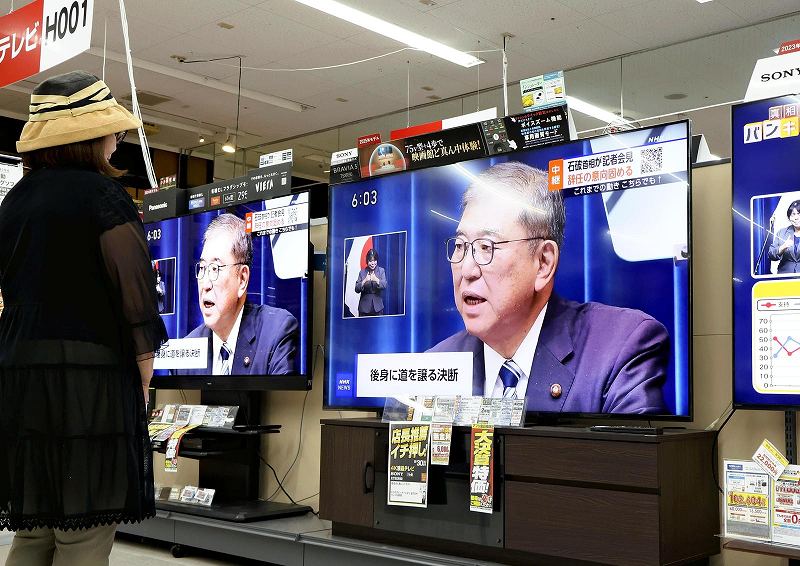
A person watches a TV screen reporting Prime Minister Shigeru Ishiba’s announcement that he would step down, in Utsunomiya on Sunday.
1:01 JST, September 10, 2025
The race for the presidency of the ruling Liberal Democratic Party effectively began on Monday, the day after Prime Minister Shigeru Ishiba’s announcement that he would step down.
People who ran in the previous presidential election in September last year are seen as strong post-Ishiba contenders this time around, with expectations particularly high for Sanae Takaichi, former minister in charge of economic security, and Agriculture, Forestry and Fisheries Minister Shinjiro Koizumi.
“We must unite and build a new party,” former LDP Secretary General Toshimitsu Motegi told reporters at the Diet Building on Monday morning. Motegi has already declared his candidacy for the LDP’s top post.
At noon Monday, 12 mid-ranking and junior lawmakers who once belonged to the now-defunct Motegi faction led by Motegi gathered in a room in the Diet Building to analyze the situation. Motegi finished sixth out of nine candidates in last year’s leadership race, and his early declaration appears to be aimed at appealing to party lawmakers.
Chief Cabinet Secretary Yoshimasa Hayashi, who placed fourth last time, has also expressed his desire to run. On Monday night, he attended a meeting with lawmakers and others from the now-defunct Kishida faction, in which he served as an executive.
Another LDP member considering a run is Takayuki Kobayashi. A former minister in charge of economic security, Kobayashi placed fifth in the previous race. On Monday, lawmakers and others supporting Kobayashi discussed their approach.
Motegi, Hayashi and Kobayashi all struggled to gain votes from rank-and-file party members in last year’s leadership race, so boosting their popularity this time around is a vital task.
‘Face of LDP’ for elections
The LDP suffered consecutive defeats in the House of Representatives election in October last year and this July’s House of Councillors election, so it is essential that the party regains its momentum. Takaichi and Koizumi have been popular in surveys and are therefore seen as the frontrunners, although neither has declared their candidacy yet.
Takaichi reportedly spent the day Monday at the lower house members’ residential building in Tokyo’s Akasaka district, while Koizumi primarily handled official duties at the agriculture ministry.
Supporting lawmakers are already active. Keiji Furuya, former chairperson of the National Public Safety Commission, and former Foreign Minister Hirofumi Nakasone — both key figures in Takaichi’s camp during the last leadership race — exchanged views at the Diet Building.
In a nationwide survey conducted by The Yomiuri Shimbun in August, Takaichi was chosen as the politician most suitable to be the next LDP president by 24% of respondents. She was followed by Koizumi at 21%, with both of them far ahead of those in third place and lower.
Among LDP supporters, Koizumi was the top choice at 31%, while Takaichi was backed by 12%.
Some LDP lawmakers hope Takaichi will win back conservative voters who have drifted to Sanseito. Others have expressed hope that Koizumi could regain support from independent voters and the working generations by reforming the party.
The timing of the next lower house election is uncertain. “Many lawmakers will likely seek someone who can become the ‘face of the party’ for elections,” said a senior lawmaker in one of the LDP’s four key party posts.
Fate of votes for Ishiba
The post-Ishiba candidates expected to run this time share the common trait of having participated in last year’s leadership election. However, their distance from Ishiba varies significantly and attention within the party is focused on how their different relationships with the prime minister might influence the race.
Both Takaichi and Kobayashi declined offers for executive posts after the last leadership race, clearly positioning themselves as “non-mainstream.” Takaichi declared in July during the final stretch of the upper house election campaign: “I’ve made up my mind. It’s time to realign the party’s backbone.”
Kobayashi had been pressing Ishiba to step down since the end of the upper election, and Motegi is also distant from Ishiba.
In contrast, Hayashi supported Ishiba as chief cabinet secretary in such matters as negotiations with the United States over tariff measures.
Koizumi served as the party’s Election Strategy Committee chairperson during the previous lower house election and took over in May as the successor to former agriculture minister Taku Eto, who was dismissed over a gaffe. Koizumi has worked closely with Ishiba on shifting rice policy.
Ishiba received 108 votes from rank-and-file party members in the previous leadership election, a close second to Takaichi’s 109 votes.
The relationship between Ishiba and the post-Ishiba candidates could influence who receives the votes Ishiba garnered in the previous race.
However, Ishiba’s leadership weakened significantly in the leadup to his resignation announcement. A mid-ranking party lawmaker said, “If the impression grows that someone is carrying on the Ishiba line, the votes of party lawmakers could slip away.”
The post-Ishiba candidates will likely need to carefully gauge their distance from Ishiba.


Related Tags



Most Read
Most read in the last 24 hours
-

India's Arms Indigenization Quest for Self-Reliance / Desert Dril...
-
Japan Passport Fees Going Down to ¥9,000 in July
-

26-year-old U.S. National Falls While Climbing Mt. Fuji; Accompan...
-

Japanese Side Machida Zelvia Faces Ah-Ahli in Asian Champions Lea...
-

Transfer of Defense Equipment: Increase the Number of Like-minded...
-

Charm of Meiji-Era Poet Takuboku Examined from Viewpoint of Donal...
-
Japan Eyes Trialing Dual-Use Tech Developed by Startups to Promot...
-

CARTOON OF THE DAY (April 24)
Most read in the last 7 days
-
Earthquake Hits Japan's Tohoku Region; 3-meter Tsunami Warning Is...
-

Trump Extends the Ceasefire with Iran but Keeps the Blockade
-
China, South Korea Object to Japanese PM Takaichi's Ritual Offeri...
-

India's Arms Indigenization Quest for Self-Reliance / New Delhi S...
-

Japan to Ban Use of Portable Chargers on Airplanes from April 24,...
-

¥1,000 Coins to Be Issued to Mark Anniversary of Beginning of Jap...
-

Most Serious Cyberattacks against the UK Now from Russia, Iran an...
-
New Challenges Await as Miura-Kihara Retires; Blade Maker, Ex-Coa...
Most read in the last 30 days
-
Earthquake Hits Japan's Tohoku Region; 3-meter Tsunami Warning Is...
-
Police Find Child's Shoe During Search for Missing Boy in Nantan,...
-
Body Found in Nantan, Kyoto Prefecture, During Search for 11-Year...
-
Cherry Blossoms, Rapeseed Flowers Perform Colorful ‘Duet’ in Niig...
-
Trump Extends the Ceasefire with Iran but Keeps the Blockade
-

Olympic Gold Medal-Winning Figure Skaters Riku-Ryu Announce Retir...
-

Nori Prices Surge in Japan Due to Poor Seaweed Production Amid Ri...
-
China, South Korea Object to Japanese PM Takaichi's Ritual Offeri...
Top Articles in Politics
-
India’s Arms Indigenization Quest for Self-Reliance / New Delhi Sticks to Its ‘All-Alignment’ Guns Even after Iran Warship Attack
-
Japan Aims to Enhance Deterrence, Defense Industry by Allowing Exports of Weapons
-
Former Japan PM Murayama’s Farewell Ceremony Held; Former Deputy PM Kono Vows to ‘Carry on Path Toward Peace’
-

Ritsumeikan Asia Pacific University Stripped of Certification for Simplified Visa Procedures Due to Document Failure
-

Japan’s PM Takaichi Seeks to Advance Policies Bearing Her Own ‘Color,’ Eyes Amending Constitution, Building Strong Economy
JN ACCESS RANKING
-
Earthquake Hits Japan’s Tohoku Region; 3-meter Tsunami Warning Issued (Update 1)
-
Police Find Child’s Shoe During Search for Missing Boy in Nantan, Kyoto Prefecture
-
Body Found in Nantan, Kyoto Prefecture, During Search for 11-Year-Old Boy in Area (Update 1)
-
Cherry Blossoms, Rapeseed Flowers Perform Colorful ‘Duet’ in Niigata
-
Trump Extends the Ceasefire with Iran but Keeps the Blockade
Most read in the last 24 hours
-
India's Arms Indigenization Quest for Self-Reliance / Desert Dril...
-
Japan Passport Fees Going Down to ¥9,000 in July
-
26-year-old U.S. National Falls While Climbing Mt. Fuji; Accompan...
-
Japanese Side Machida Zelvia Faces Ah-Ahli in Asian Champions Lea...
-
Transfer of Defense Equipment: Increase the Number of Like-minded...
Most read in the last 7 days
-
Earthquake Hits Japan's Tohoku Region; 3-meter Tsunami Warning Is...
-
Trump Extends the Ceasefire with Iran but Keeps the Blockade
-
China, South Korea Object to Japanese PM Takaichi's Ritual Offeri...
-
India's Arms Indigenization Quest for Self-Reliance / New Delhi S...
-
Japan to Ban Use of Portable Chargers on Airplanes from April 24,...
Most read in the last 30 days
-
Earthquake Hits Japan's Tohoku Region; 3-meter Tsunami Warning Is...
-
Police Find Child's Shoe During Search for Missing Boy in Nantan,...
-
Body Found in Nantan, Kyoto Prefecture, During Search for 11-Year...
-
Cherry Blossoms, Rapeseed Flowers Perform Colorful ‘Duet’ in Niig...
-
Trump Extends the Ceasefire with Iran but Keeps the Blockade