
South Korea Looks to Cozy Up to U.S. by Way of Japan, Leaving Some of Lee’s Supporters Discontent
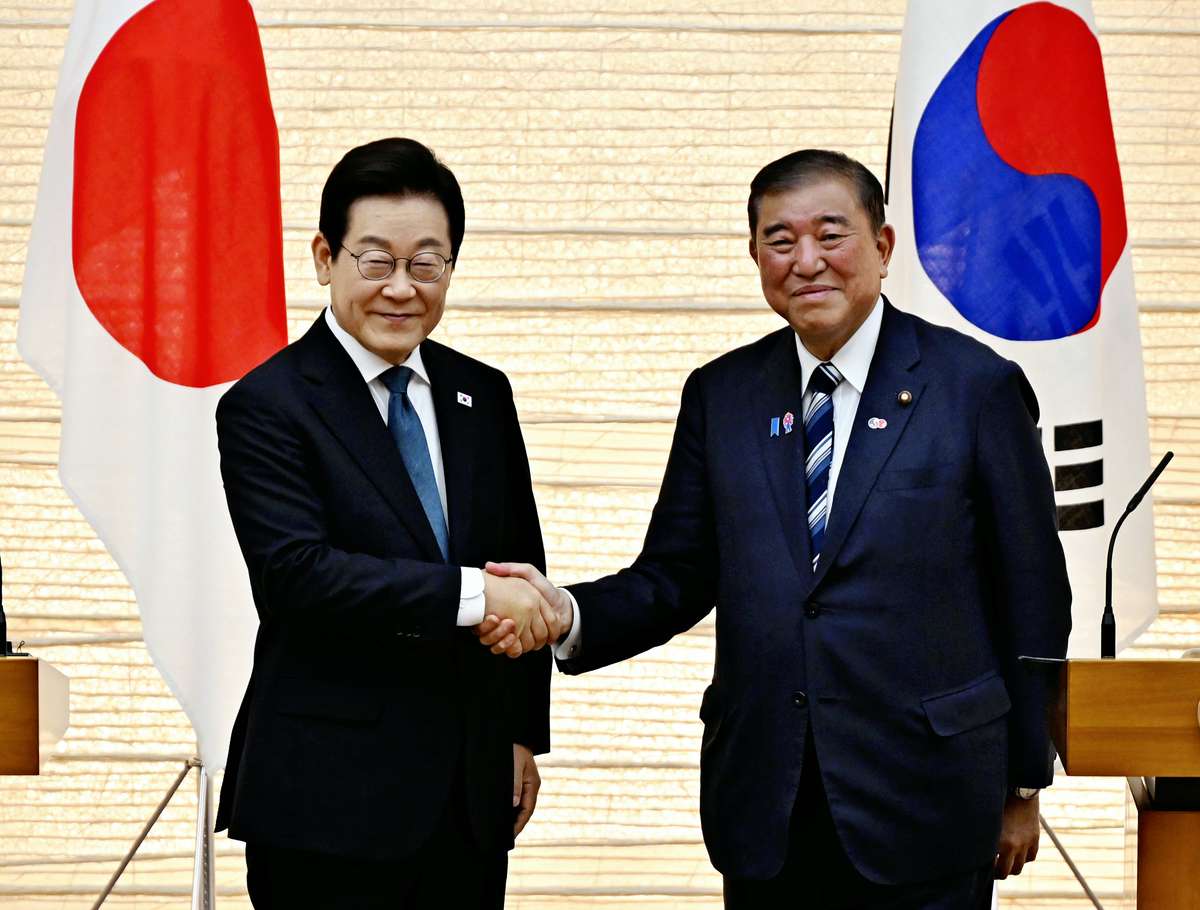
South Korean President Lee Jae Myung, left, shakes hands with Prime Minister Shigeru Ishiba after a joint press conference at the Prime Minister’s Office on Saturday.
14:53 JST, August 24, 2025
“It seems I am the first South Korean president to stop in Japan for their first diplomatic visit since the normalization of diplomatic ties between Japan and South Korea,” said South Korean President Lee Jae Myung on Saturday, at a press conference with Prime Minister Shigeru Ishiba.
“I think it shows the importance that we place on South Korea-U.S. relations and South Korea-Japan relations, and it has an important meaning,” Lee added. The new president values ties with Japan due to his basic diplomatic and security policies, which aim to strengthen his country’s relationship with the United States.
During the press conference, Lee also said, “Amid a rapidly changing international situation, I decided to build a virtuous cycle in which developments in South Korea-Japan ties lead to a stronger relationship among South Korea, the United States and Japan.”
While the situation in East Asia has been destabilized by China, which is increasingly making hegemonic moves, and North Korea, which continues to develop nuclear weapons and missiles, U.S. administrations have in recent years worried about disagreements over historical issues between Japan and South Korea, which are both U.S. allies.
The United States has been particularly concerned about left-wing movements in South Korea, which have a strong tendency to take anti-Japan and anti-U.S. stances.
Lee, who is on the left, repeatedly took a hard line against Japan when he was leading his party in the opposition.
In March 2023, the administration of former South Korean President Yoon Suk Yeol announced a plan to resolve the lawsuits concerning wartime requisitioned workers from the Korean Peninsula. He proposed that a foundation affiliated with the South Korean government pay an amount equal to the compensation owed plaintiffs whose lawsuit victories were finalized.
Lee condemned the proposal, describing it is as a path to becoming “Japan’s stooge.”
Since becoming president, Lee has treated the U.S.-South Korea alliance as a foundation of diplomatic and security policy, aiming to dispel concerns in the United States. He has also placed importance on cooperative ties among Japan, the United States and South Korea.
To stabilize the relationship with Japan, Lee made clear that he would uphold agreements made by previous South Korean presidents on the historical issues, such as requisitioned workers and so-called comfort women.
However, many of Lee’s supporters on the left dislike the president’s approach in this area. Whether Lee will be able to contain such discontent and avoid raking over the ashes of the historical issues remains to be seen.




Most Read
Most read in the last 24 hours
-
Japan Monitoring Situation Surrounding Revocation of Taiwan Presi...
-
3 Japanese Megabanks Mull Loaning ¥3.6 Tril. as Part of Huge Inve...
-
Japan Should Serve as Bridge between Nuclear, Non-nuclear States,...
-
Promote Support, Respect to Help Prevent Harassment of Athletes
-

Japanese Company Zoom Wins ¥180 Mil. Lawsuit Against U.S. Operat...
-
29 New Infections Confirmed in Measles Outbreak at Elementary Sch...
-

Yamato Museum Reopens in Hiroshima Pref. Following Extensive Reno...
-
Charm of Meiji-Era Poet Takuboku Examined from Viewpoint of Donal...
Most read in the last 7 days
-
Earthquake Hits Japan's Tohoku Region; 3-meter Tsunami Warning Is...
-

Trump Extends the Ceasefire with Iran but Keeps the Blockade
-
China, South Korea Object to Japanese PM Takaichi's Ritual Offeri...
-

India's Arms Indigenization Quest for Self-Reliance / New Delhi S...
-
Japan to Ban Use of Portable Chargers on Airplanes from April 24,...
-
¥1,000 Coins to Be Issued to Mark Anniversary of Beginning of Jap...
-

Most Serious Cyberattacks against the UK Now from Russia, Iran an...
-

Trump Opposes United–American Merger, Signals Support for Spirit
Most read in the last 30 days
-
Earthquake Hits Japan's Tohoku Region; 3-meter Tsunami Warning Is...
-
Police Find Child's Shoe During Search for Missing Boy in Nantan,...
-
Body Found in Nantan, Kyoto Prefecture, During Search for 11-Year...
-
Cherry Blossoms, Rapeseed Flowers Perform Colorful ‘Duet’ in Niig...
-
Trump Extends the Ceasefire with Iran but Keeps the Blockade
-

Olympic Gold Medal-Winning Figure Skaters Riku-Ryu Announce Retir...
-
China, South Korea Object to Japanese PM Takaichi's Ritual Offeri...
-
Japanese Prime Minister Takaichi Speaks to Pakistani Prime Minist...
Top Articles in World
-
China, South Korea Object to Japanese PM Takaichi’s Ritual Offering to Yasukuni Shrine
-
Japanese Prime Minister Takaichi Speaks to Pakistani Prime Minister Sharif, Emphasizes Importance of Reaching Agreement Through Dialogue
-

Japan Ekiden Road Relay Race Held near New Delhi to Deepen Japan-India Exchanges
-

Used School Backpacks Ready to Be Shipped to Afghanistan
-

Ishiba, Lee Meet in Seoul, Agree to Continue Future-Oriented, Cooperative Relations
JN ACCESS RANKING
-
Earthquake Hits Japan’s Tohoku Region; 3-meter Tsunami Warning Issued (Update 1)
-
Police Find Child’s Shoe During Search for Missing Boy in Nantan, Kyoto Prefecture
-
Body Found in Nantan, Kyoto Prefecture, During Search for 11-Year-Old Boy in Area (Update 1)
-
Cherry Blossoms, Rapeseed Flowers Perform Colorful ‘Duet’ in Niigata
-
Trump Extends the Ceasefire with Iran but Keeps the Blockade
Most read in the last 24 hours
-
Japan Monitoring Situation Surrounding Revocation of Taiwan Presi...
-
3 Japanese Megabanks Mull Loaning ¥3.6 Tril. as Part of Huge Inve...
-
Japan Should Serve as Bridge between Nuclear, Non-nuclear States,...
-
Promote Support, Respect to Help Prevent Harassment of Athletes
-
Japanese Company Zoom Wins ¥180 Mil. Lawsuit Against U.S. Operat...
Most read in the last 7 days
-
Earthquake Hits Japan's Tohoku Region; 3-meter Tsunami Warning Is...
-
Trump Extends the Ceasefire with Iran but Keeps the Blockade
-
China, South Korea Object to Japanese PM Takaichi's Ritual Offeri...
-
India's Arms Indigenization Quest for Self-Reliance / New Delhi S...
-
Japan to Ban Use of Portable Chargers on Airplanes from April 24,...
Most read in the last 30 days
-
Earthquake Hits Japan's Tohoku Region; 3-meter Tsunami Warning Is...
-
Police Find Child's Shoe During Search for Missing Boy in Nantan,...
-
Body Found in Nantan, Kyoto Prefecture, During Search for 11-Year...
-
Cherry Blossoms, Rapeseed Flowers Perform Colorful ‘Duet’ in Niig...
-
Trump Extends the Ceasefire with Iran but Keeps the Blockade