
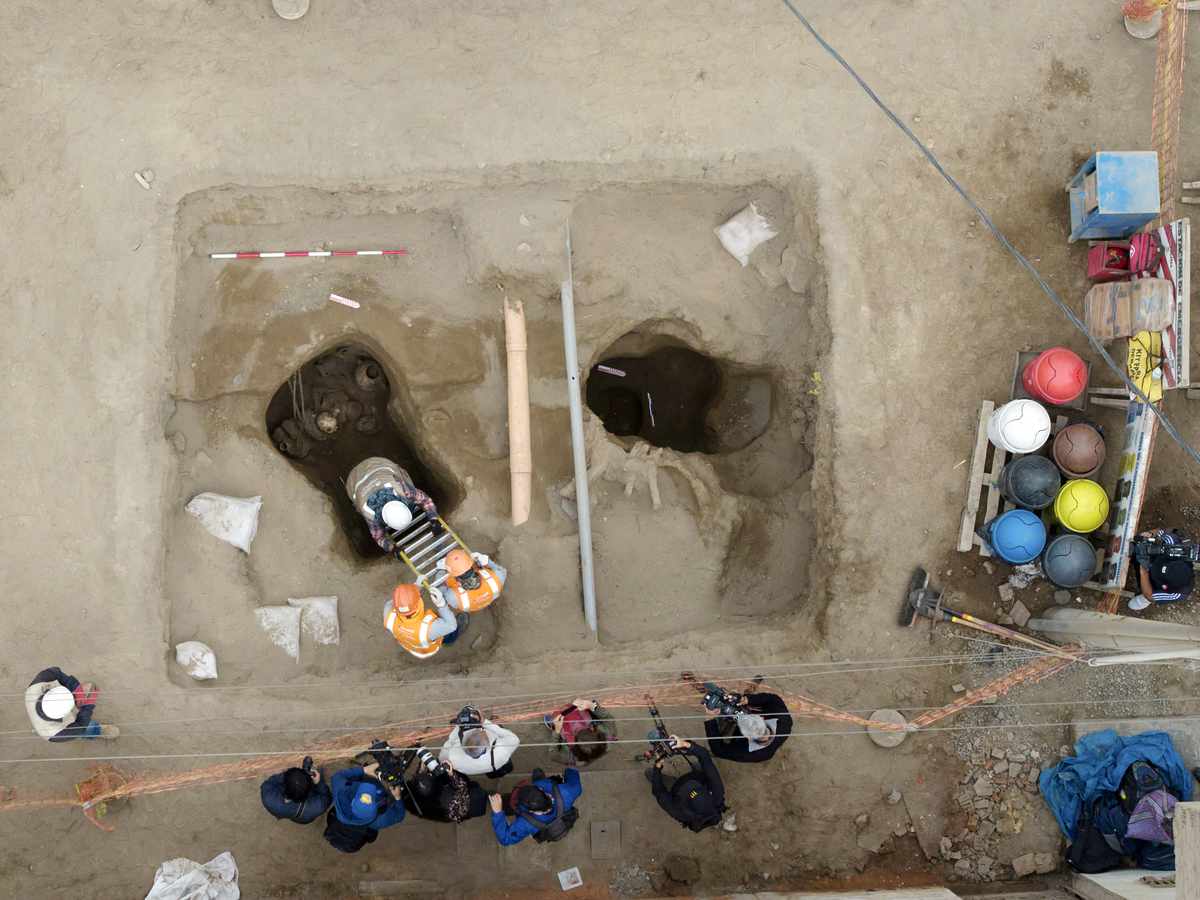
Archaeologists work at the site where city workers discovered ancient remains from the pre-Incan Chancay culture and artifacts on the outskirts of Lima on July 31.
10:36 JST, August 6, 2025
LIMA (AP) — Utility workers excavating trenches to expand underground gas networks in Peru’s capital unearthed two pre-Incan tombs on July 31. One was empty, but the other held the 1,000-year-old remains of an individual, alongside four clay vessels and three pumpkin shell artifacts.
This isn’t the first time Calidda, the company that distributes natural gas in Lima, has found archaeological remains. Over more than two decades of excavation work to expand the underground network, the company says it has made more than 2,200 discoveries.
According to archaeologist Jose Aliaga, the vessels’ iconography and their black, white and red colors “allow us to establish a connection with the pre-Incan Chancay culture, which is approximately 1,000 to 1,470 years old.” Aliaga told The Associated Press that the individual was found wrapped in a torn bundle, in a sitting position with his legs against his chest, and his team will continue cleaning the remains.
“Lima is unique among Latin American capitals,” Aliaga said, “in that various archaeological finds are unearthed during nearly every civil project.”
The Peruvian capital, a city of 10 million people, has more than 400 archaeological sites from the Inca era, the 15th century, or earlier, from the pre-Inca period, according to the Ministry of Culture.
On the same day, passersby stopped in their tracks to observe the burial site, even taking out their cellphones to take a picture.
“I always thought they were paths where no one had lived,” said Flor Prieto, who was walking with her 7-year-old daughter. “But now I know that people older than the Incas have lived there … it feels so exciting.”
“It is very common to find archaeological remains on the Peruvian coast, including Lima, mainly funerary elements: tombs, burials and, among these, mummified individuals,” said Pieter Van Dalen, dean of the College of Archaeologists of Peru. Van Dalen was not involved in the July 31 discovery.





Most Read
Popular articles in the past 24 hours
-
Japanese High School Student Aims to Share Kaiten History Through...
-
PM Takaichi Spells out Plans to Advance Bold Policy Shifts in Spe...
-
Chronic Issues Erode Thailand’s Economy as Political Confusion Pe...
-

Japanese Version of Shohei Ohtani's Picture Book Published
-
Tottori: 95-Year-Old Japanese Descendent from Philippines Visits ...
-

Japan to Monitor Trump Administration's Response to U.S. Supreme ...
-

Milano Cortina 2026: Speed Skater Takagi Finishes 6th in the 1,50...
-
Osaka: 40 Ninjas Display Shuriken Throwing Skills at Japan Champi...
Popular articles in the past week
-

Japan PM Takaichi’s Cabinet Resigns en Masse
-

Man Infected with Measles Reportedly Dined at Restaurant in Tokyo...
-

Sanae Takaichi Elected Prime Minister of Japan; Keeps All Cabinet...
-

Japan's Govt to Submit Road Map for Growth Strategy in March, PM ...
-

Bus Carrying 40 Passengers Catches Fire on Chuo Expressway; All E...
-

Milano Cortina 2026: Figure Skaters Riku Miura, Ryuichi Kihara Pa...
-

Japan, U.S. Name 3 Inaugural Investment Projects; Reached Agreeme...
-

U.S. Firm to Build Training Hub in Fukushima N-plant for Debris R...
Popular articles in the past month
-
Japan PM Takaichi’s Cabinet Resigns en Masse
-

Japan Institute to Use Domestic Commercial Optical Lattice Clock ...
-

Israeli Ambassador to Japan Speaks about Japan’s Role in the Reco...
-
Man Infected with Measles Reportedly Dined at Restaurant in Tokyo...
-

Videos Plagiarized, Reposted with False Subtitles Claiming ‘Ryuky...
-

Man Infected with Measles May Have Come in Contact with Many Peop...
-

Prudential Life Insurance Plans to Fully Compensate for Damages C...
-

Woman with Measles Visited Hospital in Tokyo Multiple Times Befor...
Top Articles in Science & Nature
-
Japan Institute to Use Domestic Commercial Optical Lattice Clock to Set Japan Standard Time
-
Japan to Face Shortfall of 3.39 Million Workers in AI, Robotics in 2040; Clerical Workers Seen to Be in Surplus
-
Record 700 Startups to Gather at SusHi Tech Tokyo in April; Event Will Center on Themes Like Artificial Intelligence and Robotics
-

iPS Treatments Pass Key Milestone, but Broader Applications Far from Guaranteed
-
iPS Cell Products for Parkinson’s, Heart Disease OK’d for Commercialization by Japan Health Ministry Panel
JN ACCESS RANKING
-
Japan PM Takaichi’s Cabinet Resigns en Masse
-
Japan Institute to Use Domestic Commercial Optical Lattice Clock to Set Japan Standard Time
-
Israeli Ambassador to Japan Speaks about Japan’s Role in the Reconstruction of Gaza
-
Man Infected with Measles Reportedly Dined at Restaurant in Tokyo Station
-
Videos Plagiarized, Reposted with False Subtitles Claiming ‘Ryukyu Belongs to China’; Anti-China False Information Also Posted in Japan