
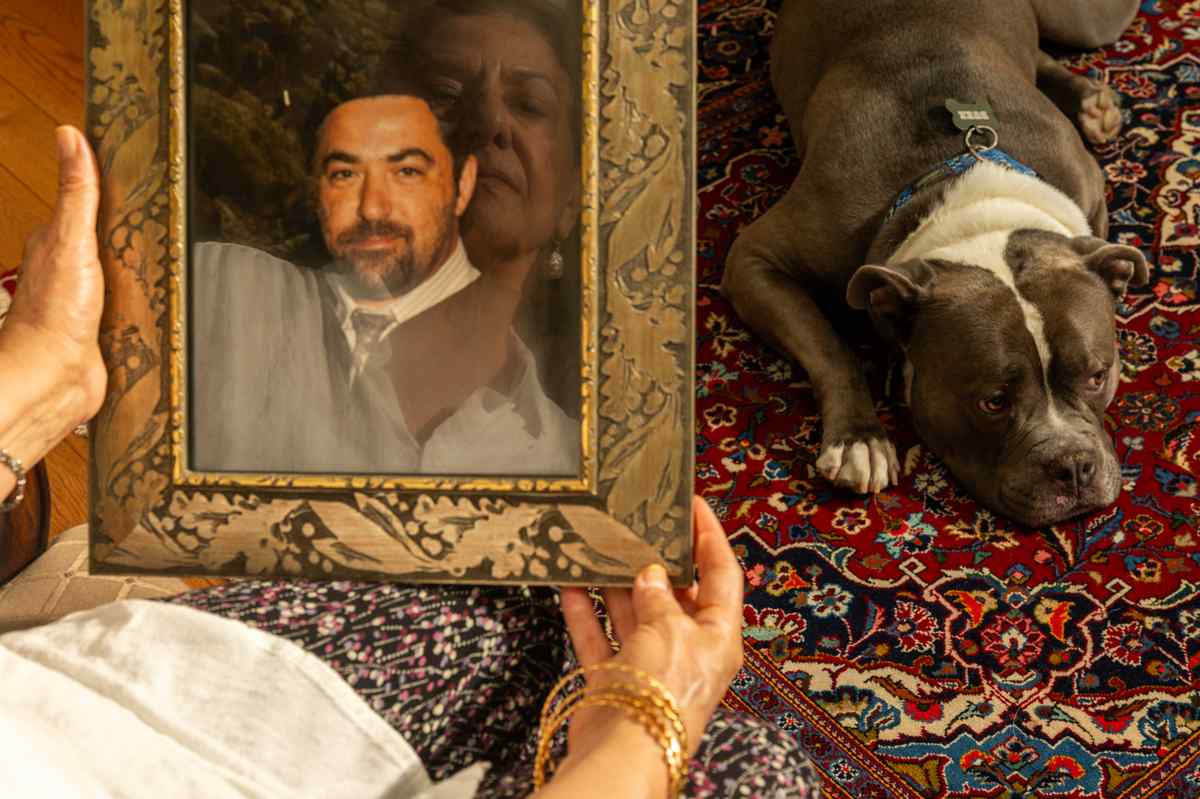
Firouzeh Firouzabadi looks at a photo of her son, Reza Zavvar, as his dog, Duke, rests on July 18 in Gaithersburg, Maryland.
13:26 JST, August 5, 2025
Sharp knocks on the front door interrupted Firouzeh Firouzabadi’s Saturday morning coffee. On the porch of her suburban Maryland home were two law enforcement agents and a very familiar pit bull mix named Duke.
“Can you take this dog?” Firouzabadi recalled one of the men saying. “I said, ‘This is my son’s dog. Where is he?’ They wouldn’t say.”
At that moment, her adult son, Reza Zavvar, was handcuffed in the back of an SUV parked two houses down in the Gaithersburg neighborhood where the Iranian-born family has lived since 2009 – apprehended, he later said, that late June day by at least five federal immigration agents in tactical gear who told Zavvar they had been waiting for him to take Duke out for his regular morning walk.
More than a month later, Zavvar, 52, remains in U.S. Immigration and Customs Enforcement custody, part of a surge of arrests of immigrants with standing court orders barring their deportation to their native countries.
The Trump administration has increasingly turned to sending people to third countries. In court papers, ICE said it plans to send Zavvar to Australia or Romania. He has no ties to either place.
Zavvar left Tehran alone when he was 12, arriving in Virginia in 1985 on a student visa secured by his parents as a way to escape conscription into the Iranian army. He eventually received U.S. asylum, and then a green card.
His family joined him and they settled in Maryland, but in his 20s, Zavvar’s guilty pleas in two misdemeanor marijuana possession cases jeopardized his immigration status. In 2007, an immigration judge issued a withholding of removal order, determining it was unsafe for Zavvar to return to Iran. He built a life, went to college and has been working as a white-collar recruiter for a consulting firm.
But now, President Donald Trump’s ramped-up immigration enforcement has left families like Zavvar’s with what feels like a random and sudden disappearance, facing an unpredictable road ahead as the administration deploys tactics in ways immigration lawyers say they haven’t seen before.
Vanessa Dojaquez-Torres, counsel at the nonprofit American Immigration Lawyers Association, said the organization’s 18,000 members have reported a rapid expansion of clients being similarly detained, shifting the role of such withholding of removal orders from a protection against deportation into a tool for delivering one.
The federal statute that created those withholding orders, passed by Congress in the 1990s under the international Convention Against Torture, allows deportation to a third country, but it has rarely happened. On paper, “it had always been a possibility” the government could use such orders to deport someone to a third country, Dojaquez-Torres said. “But this is the first time it’s happened on such a large scale.”
Shortly after the U.S. bombed Iranian nuclear facilities on June 22, the Trump administration began publicizing enforcement against Iranian nationals – people with and without criminal convictions.
The Department of Homeland Security highlighted the arrests of 11 Iranian nationals whose records included drug charges, convictions of child abuse or gun crimes, along with allegations that one was a former Iranian Army sniper and that another had ties to the terrorist group Hezbollah. The agency also detained a married Iranian couple who are Louisiana State University students with pending U.S. asylum applications, arrested in June after a ruse led them to waiting ICE agents. An Iranian father in Oregon, accused of overstaying his visa, was detained outside his son’s preschool in July.
In response to questions about Zavvar’s case, DHS spokeswoman Tricia McLaughlin described him as “a criminal illegal alien from Iran” and offered no explanation for his detainment beyond enforcing the 2007 order.
The agency did not respond when asked whether Zavvar fit the characterization it used for other Iranian nationals detained under an effort of “keeping known and suspected terrorists out of American communities.” In the habeas corpus case filed in Maryland’s U.S. district court by Zavvar’s lawyer to seek his release, the U.S. government has not made any allegations against him besides the marijuana possession charges.
“Under President Trump and Secretary [Kristi L.] Noem, if you break the law, you will face the consequences,” McLaughlin said in a statement. “Criminal illegal aliens are not welcome in the U.S.”
An upended life
Everyone else in the family, besides Zavvar, became U.S. citizens three decades ago, his mother said. Firouzabadi, 73, stays at home most days, strategizing how to deal with an upended life.
“Just, why?” she asked from her living room recently, Duke at her feet. “I just hope no mother experiences this. The unknown is killing me.”
In a plain manila folder, she keeps everything Zavvar’s family and friends gathered as their evidence he belongs in the United States.
She flips through photos as if auditioning which best demonstrates his worthiness to strangers: a smiling boy in Tehran or on the high school football team one town over from where they now live? Maybe with her, pinning something to his chest at the eighth-grade graduation from the military boarding school in Virginia that sponsored his first visa back in 1985?
Firouzabadi said her son’s sudden absence awoke a grief she hadn’t known since her husband, Zavvar’s father, died of an aggressive pancreatic cancer in 1997. Zavvar was 24. “He became the man of the house,” she said.
“I don’t want to compare that situation to this, but I am going through the same thing: devastation,” she said.
She shuffled through letters that supporters dropped off to help his case. One neighbor explains Zavvar was to kind to animals. Another points out he brings the newspaper to the porch of a woman unable to leave her house.
In May, Zavvar and Duke left behind a nearby apartment and moved into the family home to help his mom and uncle care for his grandmother who, at 94, has dementia.
Zavvar insisted on the move, his mother says, after she called him to quickly come over and lift up the older woman after a fall. Firouzabadi smiled as she said he also calms her down when the frustrations of dealing with dementia boil over.
“That’s why he’s my backbone,” she said.
When Israel launched strikes on Iran on June 12 and then the U.S. bombed her home country’s nuclear facilities 10 days later, Firouzabadi braced herself for the impact on extended family in Iran. “We were worried about them, mostly, not about us,” she said.
The worry shifted to Zavvar, as his friends and extended family reach for anything that could help.
Someone hired a dog walker to handle all 60 pounds of Duke a few times a day. An uncle drove an hour each way to the ICE holding facility in Baltimore to deliver warmer clothes, which were turned away. A family friend arranged an interview with a local television station. Food keeps coming.
“We need to convince the authorities that, hey, he’s a pure American boy,” said his older sister, Maryam Zavar, who spells her Americanized last name differently than her brother. “He’s been here since he was 12 – the past 40 years,” his sister continued. “All his family’s here. We’re all here. We’re not going anywhere.”
‘They were trying to save him’
Zavvar was the first person in his immediate family to move to the United States.
In 1985, his parents secured a student visa and enrolled him at Linton Hall Military School in Northern Virginia. The family said it paid $28,000 for Zavvar’s seventh- and eighth-grade schooling, a way to spare him from being conscripted into the Iranian army during the height of the conservative Islamic regime’s eight-year war with Iraq.
“They were trying to save him,” his sister said.
Zavvar spoke only Farsi, but he knew the English word “car” and already had a love of the Washington area’s football team. His father had fallen for the team, now called the Commanders, when he was a student in the U.S. in the late 1960s, and he exported the fandom to Tehran when he returned there, Maryam Zavar said.
Firouzabadi immigrated from Iran two years after Zavvar, leaving her daughter and husband behind for a few years. She enrolled her son at Walter Johnson High School in Bethesda, Maryland, and applied for his green card. She got her first job ever, in a department store, learned English and became a U.S. citizen in the mid-1990s.
After graduation, in his 20s, Zavvar faced legal trouble a few times.
In 1994, he pleaded guilty to possession of a controlled substance in Maryland, paid a $100 fine for the marijuana-related charge and served a year’s probation, according to court records. In 1998, he pleaded guilty to attempted possession of marijuana in D.C. and paid a $50 fine.
Separately, in 1996, a female acquaintance asked a judge for a civil protective order against him. The court, which classified the request as a domestic violence dispute, denied it. No criminal charges were filed.
In 2004, Zavvar spent five months in Iran trying to sell the Tehran home in which he grew up, his family said. When he returned to the U.S., immigration agents at Dulles International Airport noticed that the FBI had flagged the cannabis charges, which ultimately triggered deportation proceedings that stretched for three years, according to court records.
Unlike now, Zavvar during that time had been granted bail and was free to live and work in the U.S. until the case was resolved in 2007, with a judge issuing an order barring his removal to Iran.
Now, that same order is the basis of the Trump administration’s claim that Zavvar should be deported – just not to Iran – and its argument that he should have chosen to settle in another country.
“Zavvar had almost 20 years to self-deport and leave the U.S.,” said McLaughlin, the DHS spokeswoman.
Until recently, the U.S. government rarely tried to deport people to countries where they were not citizens or recent residents. An American Immigration Council analysis of data from the 2017 fiscal year, for example, found that 1.6 percent of the 1,274 people granted withholding of removal orders that year were deported to third countries.
“They weren’t going to just roll up on some guy walking his dog in the suburbs,” Zavvar’s lawyer, Ava Benach, said about how ICE previously treated such orders. In this case, the agency used the order to detain Zavvar in the Texas facility for more than a month.
“The idea that I may have to go to Texas about the deportation of an Iranian man to Romania is something I have never contemplated in 30 years of immigration law,” she said. “It’s just so far outside the bounds of anticipated reality that it’s hard to get your head around.”
On Sunday, after this story published online, Benach was notified that Zavvar was moved to an Ohio jail. No explanation was given for his transfer.
The embassies of Romania and Australia did not respond to requests for comment on whether they have agreed to accept Zavvar.
‘I miss silence’
Firouzabadi has tried to visualize her son’s experience, but all the images she conjured were just scenes from the “Orange Is the New Black” TV show he used to tease her for watching, she said.
Every day of his detention in Texas, Zavvar calls briefly from the dorms. He brushes off his mom’s questions about conditions there. She hasn’t mentioned she’s lost 10 pounds.
She cajoles him to meditate, warns him to conduct himself safely and threatens to put Duke up for adoption if he doesn’t listen to her advice.
“I keep telling Reza maybe something good comes out of it, and you use this quiet time for you,” she said.
He and his sister didn’t tell their mother he once abruptly ended a call when a fight broke out, telling his sister: “I have to go sit in a corner and not get caught up in it.”
He urges his mom to rejoin the Persian singing groups she’s been skipping. He tells her to find a way to have fun. Firouzabadi’s been turning down her friends’ offers to get out of the house, she said.
“I feel like if I leave home, I’m losing control,” she said. “What if he calls?”
As she spoke, a robotic voice on her cellphone announced, “unknown caller.”
“That’s him!” she said.
Duke perked up when she put Zavvar on speaker phone.
“My only fear is that they will wrongfully deport me at any second without letting my lawyer know, or anybody else, and send me to a third country that I don’t know,” Zavvar said in a pay-by-the-minute call from Texas.
He said he noticed a beige sedan with tinted windows parked on his block that June morning a few seconds before a man wearing “ICE POLICE” body armor stepped out of it, asking if his dog was friendly. As more agents surrounded him, he said, “I kept asking him, ‘Why are you guys doing this?’ And they wouldn’t answer me.”
He said he wished he’d applied for citizenship when he was younger, but it seemed like something he would get to eventually. He said he didn’t know 27 years ago that pleading guilty to cannabis charges could trigger a deportation and make him ineligible for citizenship; the judge didn’t tell him, and he didn’t have a lawyer then, he said.
In the detention dorm, he plays cards or chess with a handful of other Iranian men. He tries to walk around and watches the news. He said he talks with as many people as possible about the circumstances, taking notes and writing about his experiences.
“I get a little bit of what they’re trying to do,” he said of the Trump administration, “but I think how they’re going about it is wrong. It’s kind of like going out to sea and trying to fish for a certain type of fish and throwing a wide net into it and just gathering up every kind of fish. And then, in time, sorting through them to see what fish they can find.”
He said he sleeps during the early half of the day, when it’s slightly quieter. “I miss silence. I haven’t had any silence in three weeks. It’s constant noise in this place,” he said.
After he hung up, Firouzabadi cried. She said she tries to visualize his return. She sees him dropping to the living room carpet to play with Duke, the hug she’ll give him, the party she’ll throw in the driveway, the slap she’ll deliver for all the trouble he caused.
His bare-bones studio apartment in the basement is how he left it. Every night, Duke sleeps on his bed. Every morning, she goes down and remakes it, just in case.






Most Read
Popular articles in the past 24 hours
-

Voters Using AI to Choose Candidates in Japan's Upcoming General ...
-

Japan's Snow-Clad Beauty: Camellia Flowers Seen in Winter Bloom a...
-

Monkey Strikes Junior High School Girl from Behind in Japan's Yam...
-
Genichiro Inokuma's Mural in Ueno Station That Gave Hope in Postw...
-

Senior Japanese Citizens Return to University to Gain Knowledge, ...
-

Foreign and Security Policy: Political Parties Must Discuss How T...
-
Heavy Snow Linked to 30 Deaths across Japan since Late Jan.; JMA ...
-

Tokyo Police Arrest Head of Resignation Assistance Firm
Popular articles in the past week
-

Japan Institute to Use Domestic Commercial Optical Lattice Clock ...
-
Australian Woman Dies After Mishap on Ski Lift in Nagano Prefectu...
-
Foreign Snowboarder in Serious Condition After Hanging in Midair ...
-

Chinese Embassy in Japan Reiterates Call for Chinese People to Re...
-
Narita Airport, Startup in Japan Demonstrate Machine to Compress ...
-

Toyota Motor Group Firm to Sell Clean Energy Greenhouses for Stra...
-
Sakie Yokota, Last Surviving Parent of a North Korea Abductee, Ur...
-

Beer Yeast Helps Save Labor, Water Use in Growing Rice; Govt Hope...
Popular articles in the past month
-
Univ. in Japan, Tokyo-Based Startup to Develop Satellite for Disa...
-
JAL, ANA Cancel Flights During 3-day Holiday Weekend due to Blizz...
-
China Confirmed to Be Operating Drilling Vessel Near Japan-China ...
-

China Eyes Rare Earth Foothold in Malaysia to Maintain Dominance,...
-
M6.2 Earthquake Hits Japan's Tottori, Shimane Prefectures; No Tsu...
-
Japan Institute to Use Domestic Commercial Optical Lattice Clock ...
-

Japan, Qatar Ministers Agree on Need for Stable Energy Supplies; ...
-

Japan, Italy to Boost LNG Cooperation; Aimed at Diversifying Japa...
Top Articles in News Services
-
Arctic Sees Unprecedented Heat as Climate Impacts Cascade
-

Prudential Life Expected to Face Inspection over Fraud
-

South Korea Prosecutor Seeks Death Penalty for Ex-President Yoon over Martial Law (Update)
-
Trump Names Former Federal Reserve Governor Warsh as the Next Fed Chair, Replacing Powell
-

Japan’s Nagasaki, Okinawa Make N.Y. Times’ 52 Places to Go in 2026
JN ACCESS RANKING
-
Univ. in Japan, Tokyo-Based Startup to Develop Satellite for Disaster Prevention Measures, Bears
-
JAL, ANA Cancel Flights During 3-day Holiday Weekend due to Blizzard
-
China Confirmed to Be Operating Drilling Vessel Near Japan-China Median Line
-
China Eyes Rare Earth Foothold in Malaysia to Maintain Dominance, Counter Japan, U.S.
-
Japan Institute to Use Domestic Commercial Optical Lattice Clock to Set Japan Standard Time