
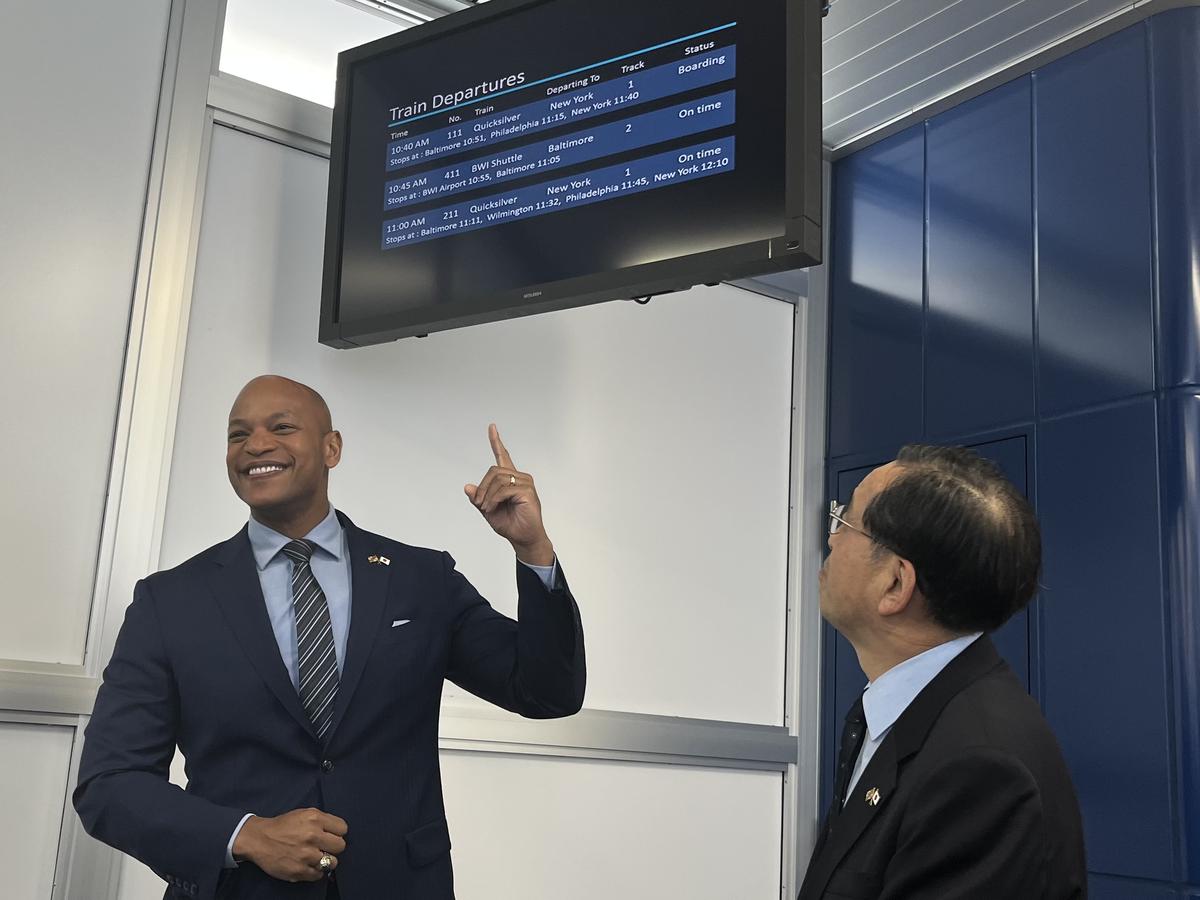
Maryland Gov. Wes Moore stands with Central Japan Railway chairman Shin Kaneko in front of a mock departures board put together for the Maryland delegation visiting Japan in April.
11:54 JST, August 2, 2025
The Federal Railroad Administration has withdrawn support for a high-speed train project from D.C. to Baltimore, saying conflicts over federal property and protected wildlife in the path of the proposed rail line are insurmountable.
The maglev train was supposed to be the first leg of a route connecting D.C. to New York City in under an hour. It would use powerful magnetic forces that lift and propel trains above a U-shaped guideway at over 300 mph. Gov. Wes Moore (D) has been enthusiastic about the idea – earlier this year, he took an exhibition maglev in Japan that traveled 27 miles in less than 10 minutes.
Northeast Maglev, the private investors behind the project, called the cancellation “the missed opportunity of a generation to deploy the fastest and safest ground transportation system in the world.”
The proposal to bring that technology to Maryland has been stalled for years; it’s been a decade since the federal government gave the state $28 million to start work on it. The train line would have cost tens of billions of dollars to build and cost passengers going between D.C. and Baltimore about $60 a ride.
“This project did not have the means to go the distance, and I can’t in good conscience keep taxpayers on the hook for it,” U.S. Transportation Secretary Sean P. Duffy said in a statement. The Maryland Department of Transportation did not oppose the decision; Transportation Secretary Paul J. Wiedefeld, on his last day in office, responded to the FRA that the state “understands … the significant challenges posed by the project.”
Lawmakers and residents in the path of the planned train have long argued the price was not worth the disruption. A group of state delegates from Prince George’s County put out a statement celebrating the decision, calling it “the result of relentless and unified opposition from our community and elected leaders.”
The federal government had its own concerns: The train route would cut into residential areas as well as a wildlife refuge and the world’s largest agricultural research complex, and it would touch on Secret Service and NASA property. “The project is not feasible as proposed” due to its “substantial negative effects,” the federal agency said in a notice to the state officials made public Friday.
Most high-speed rail uses older, less costly electric train technology. The handful of maglev trains in operation in Asia are modest in length because they require straight, level tunnels that are expensive and difficult to build. China and Japan are working on intercity routes.
Eric Goldwyn, a transportation researcher at New York University, said maglevs offer “faster travel speed, lower maintenance costs, higher reliability” and are “less noisy – there are no wheels or brakes to screech and wear out. But “the benefits are all mainly theoretical,” because very few have been built, and “simultaneously, fixed rail has continued to get faster and faster.”
Under President Joe Biden, billions were allocated to improve the Northeast Corridor Amtrak lines, which the FRA said might undercut the justification for a new train line. “We have existing right-of-ways. We have existing infrastructure,” agreed Del. Nicole A. Williams (D-Prince George’s). “I think as a state and as a country, it would probably be wise for us to invest more resources into what currently exists.”









Most Read
Popular articles in the past 24 hours
-

Green Tea Exports Hit Record High in 2025 Amid Growing Demand, Li...
-

Tokyo Had 65,000 More People Move In Than Out In 2025; Osaka Area...
-

Hunting for Small Details in PokéPark KANTO, Keep a Sharp Eye Out...
-

Japan's Nikkei Stock Average Slips after Sharp Gain as Software F...
-

Not Ready for Robots in Homes? The Maker of a Friendly New Humano...
-

Sapporo Snow Festival Opens with 210 Snow and Ice Sculptures at 3...
-

Astronomers Unveil Map of Dark Matter’s Distribution
-

TEPCO’s Restructuring Plan: Develop Business Partnership Plans fo...
Popular articles in the past week
-
Australian Woman Dies After Mishap on Ski Lift in Nagano Prefectu...
-
Foreign Snowboarder in Serious Condition After Hanging in Midair ...
-

Chinese Embassy in Japan Reiterates Call for Chinese People to Re...
-

Narita Airport, Startup in Japan Demonstrate Machine to Compress ...
-

Toyota Motor Group Firm to Sell Clean Energy Greenhouses for Stra...
-

Sakie Yokota, Last Surviving Parent of a North Korea Abductee, Ur...
-

Beer Yeast Helps Save Labor, Water Use in Growing Rice; Govt Hope...
-
Japan Tourism Agency Calls for Strengthening Measures Against Ove...
Popular articles in the past month
-
Univ. in Japan, Tokyo-Based Startup to Develop Satellite for Disa...
-

JAL, ANA Cancel Flights During 3-day Holiday Weekend due to Blizz...
-

China Confirmed to Be Operating Drilling Vessel Near Japan-China ...
-
China Eyes Rare Earth Foothold in Malaysia to Maintain Dominance,...
-

Japan Institute to Use Domestic Commercial Optical Lattice Clock ...
-
M6.2 Earthquake Hits Japan's Tottori, Shimane Prefectures; No Tsu...
-

Japan, Qatar Ministers Agree on Need for Stable Energy Supplies; ...
-

Japan, Italy to Boost LNG Cooperation; Aimed at Diversifying Japa...
Top Articles in News Services
-

Prudential Life Expected to Face Inspection over Fraud
-

Arctic Sees Unprecedented Heat as Climate Impacts Cascade
-

South Korea Prosecutor Seeks Death Penalty for Ex-President Yoon over Martial Law (Update)
-

Trump Names Former Federal Reserve Governor Warsh as the Next Fed Chair, Replacing Powell
-

Suzuki Overtakes Nissan as Japan’s Third‑Largest Automaker in 2025
JN ACCESS RANKING
-
Univ. in Japan, Tokyo-Based Startup to Develop Satellite for Disaster Prevention Measures, Bears
-
JAL, ANA Cancel Flights During 3-day Holiday Weekend due to Blizzard
-
China Confirmed to Be Operating Drilling Vessel Near Japan-China Median Line
-
China Eyes Rare Earth Foothold in Malaysia to Maintain Dominance, Counter Japan, U.S.
-
Japan Institute to Use Domestic Commercial Optical Lattice Clock to Set Japan Standard Time