
Upper House Election: LDP Lawmakers Want Ishiba Step Down After Election Rout; However, Few Seem Inclined to Force Prime Minister Out
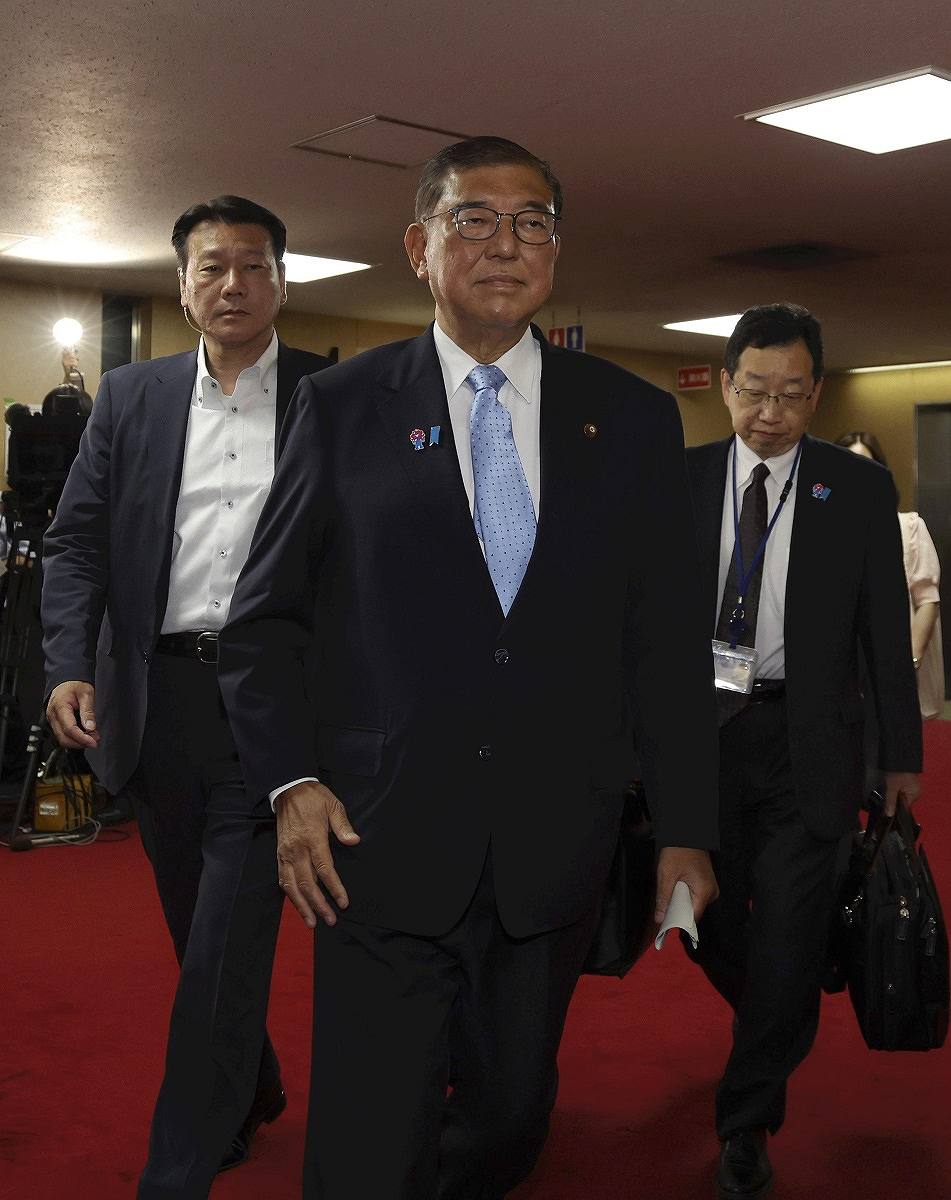
Prime Minister Shigeru Ishiba enters the Liberal Democratic Party headquarters in Chiyoda Ward, Tokyo, on Monday.
14:44 JST, July 22, 2025
An increasing number of Liberal Democratic Party lawmakers are demanding that Prime Minister Shigeru Ishiba, who is also LDP president, step down although he has expressed his intention to stay in the post.
LDP executives, wary of the possibility that the voices will develop to full-fledged moves to oust the prime minister, are trying to deter the move by saying that a political vacuum should be avoided.
But some of the critics voiced a stricter view that if Ishiba clings to the post of prime minister, it will result in party supporters’ turning their backs on the LDP.
Takayuki Kobayashi, a former minister in charge of economic security who competed with Ishiba in last year’s multicandidate LDP presidential election, told reporters Monday in Yachiyo, Chiba Prefecture, “We suffered big losses in two elections [including last year’s House of Representatives election]. I want him to recognize how heavy his responsibility is as the head of the party.”
While the LDP has become a minority force in both the lower house and the House of Councillors, many LDP members have criticized Ishiba’s stance of remaining in the prime minister’s post.
One of them said, “He is clowning around,” and another said, “Being unable to hand over power is like the ‘Prime Minister’s Office disease.’”
LDP Supreme Advisor Taro Aso and former party Secretary General Toshimitsu Motegi held a meeting in Tokyo on Monday and shared a view that if nobody takes responsibility, public distrust of the party will only increase.
Chief Cabinet Secretary Yoshimasa Hayashi, who also ran in last year’s LDP presidential election, held a meeting with party lawmakers who are close to him, including LDP Policy Research Council Chairperson Itsunori Onodera, at a Diet members’ office building on Monday evening. At the meeting, they exchanged opinions about the LDP’s current situation.
However, there is no overt move to oust Ishiba, and criticisms of the prime minister have not developed to large-scale action.
That is because even LDP lawmakers who hold critical views of the Ishiba administration appear to wish to avoid being regarded as engaging in fierce internal conflicts when the whole party is in extreme hardship and when such a conflict could obstruct the government’s tariff negotiations with the United States.
Some LDP lawmakers predict the prime minister’s management of his administration will become deadlocked sooner or later.
They are reluctant to openly attack Ishiba. One mid-ranking LDP member said, “I want to avoid standing on the very front line.”
But many LDP members also have a sense of crisis that if things go unchanged, members of the public may give up on the LDP.
In the past, moves inside the LDP to oust the party’s own prime ministers occurred in 2001, when Yoshiro Mori was prime minister, and in 2009, when Aso was prime minister.
The LDP’s internal rules state that if a majority of the party’s Diet members and prefectural branch federation heads demand it, the party can hold a presidential election earlier than scheduled. This is seen a de facto recall of the prime minister.
A former cabinet member said, “If the prime minister dares to continue to remain in the post, that rule should be used.”


Related Tags



Most Read
Most read in the last 24 hours
-

India's Arms Indigenization Quest for Self-Reliance / Desert Dril...
-

26-year-old U.S. National Falls While Climbing Mt. Fuji; Accompan...
-
Japan Passport Fees Going Down to ¥9,000 in July
-

Japanese Side Machida Zelvia Faces Ah-Ahli in Asian Champions Lea...
-

Transfer of Defense Equipment: Increase the Number of Like-minded...
-
Japan Eyes Trialing Dual-Use Tech Developed by Startups to Promot...
-

Charm of Meiji-Era Poet Takuboku Examined from Viewpoint of Donal...
-

Cherry Blossoms in Full Bloom in Hokkaido's Hakodate; Tourists Fl...
Most read in the last 7 days
-
Earthquake Hits Japan's Tohoku Region; 3-meter Tsunami Warning Is...
-

Trump Extends the Ceasefire with Iran but Keeps the Blockade
-

China, South Korea Object to Japanese PM Takaichi's Ritual Offeri...
-

India's Arms Indigenization Quest for Self-Reliance / New Delhi S...
-

Japan to Ban Use of Portable Chargers on Airplanes from April 24,...
-

¥1,000 Coins to Be Issued to Mark Anniversary of Beginning of Jap...
-

Most Serious Cyberattacks against the UK Now from Russia, Iran an...
-

New Challenges Await as Miura-Kihara Retires; Blade Maker, Ex-Coa...
Most read in the last 30 days
-
Earthquake Hits Japan's Tohoku Region; 3-meter Tsunami Warning Is...
-
Police Find Child's Shoe During Search for Missing Boy in Nantan,...
-
Body Found in Nantan, Kyoto Prefecture, During Search for 11-Year...
-
Cherry Blossoms, Rapeseed Flowers Perform Colorful ‘Duet’ in Niig...
-
Trump Extends the Ceasefire with Iran but Keeps the Blockade
-

Olympic Gold Medal-Winning Figure Skaters Riku-Ryu Announce Retir...
-

Nori Prices Surge in Japan Due to Poor Seaweed Production Amid Ri...
-
China, South Korea Object to Japanese PM Takaichi's Ritual Offeri...
Top Articles in Politics
-
India’s Arms Indigenization Quest for Self-Reliance / New Delhi Sticks to Its ‘All-Alignment’ Guns Even after Iran Warship Attack
-
Japan Aims to Enhance Deterrence, Defense Industry by Allowing Exports of Weapons
-

Former Japan PM Murayama’s Farewell Ceremony Held; Former Deputy PM Kono Vows to ‘Carry on Path Toward Peace’
-

Ritsumeikan Asia Pacific University Stripped of Certification for Simplified Visa Procedures Due to Document Failure
-

Japan’s PM Takaichi Seeks to Advance Policies Bearing Her Own ‘Color,’ Eyes Amending Constitution, Building Strong Economy
JN ACCESS RANKING
-
Earthquake Hits Japan’s Tohoku Region; 3-meter Tsunami Warning Issued (Update 1)
-
Police Find Child’s Shoe During Search for Missing Boy in Nantan, Kyoto Prefecture
-
Body Found in Nantan, Kyoto Prefecture, During Search for 11-Year-Old Boy in Area (Update 1)
-
Cherry Blossoms, Rapeseed Flowers Perform Colorful ‘Duet’ in Niigata
-
Trump Extends the Ceasefire with Iran but Keeps the Blockade
Most read in the last 24 hours
-
India's Arms Indigenization Quest for Self-Reliance / Desert Dril...
-
26-year-old U.S. National Falls While Climbing Mt. Fuji; Accompan...
-
Japan Passport Fees Going Down to ¥9,000 in July
-
Japanese Side Machida Zelvia Faces Ah-Ahli in Asian Champions Lea...
-
Transfer of Defense Equipment: Increase the Number of Like-minded...
Most read in the last 7 days
-
Earthquake Hits Japan's Tohoku Region; 3-meter Tsunami Warning Is...
-
Trump Extends the Ceasefire with Iran but Keeps the Blockade
-
China, South Korea Object to Japanese PM Takaichi's Ritual Offeri...
-
India's Arms Indigenization Quest for Self-Reliance / New Delhi S...
-
Japan to Ban Use of Portable Chargers on Airplanes from April 24,...
Most read in the last 30 days
-
Earthquake Hits Japan's Tohoku Region; 3-meter Tsunami Warning Is...
-
Police Find Child's Shoe During Search for Missing Boy in Nantan,...
-
Body Found in Nantan, Kyoto Prefecture, During Search for 11-Year...
-
Cherry Blossoms, Rapeseed Flowers Perform Colorful ‘Duet’ in Niig...
-
Trump Extends the Ceasefire with Iran but Keeps the Blockade