
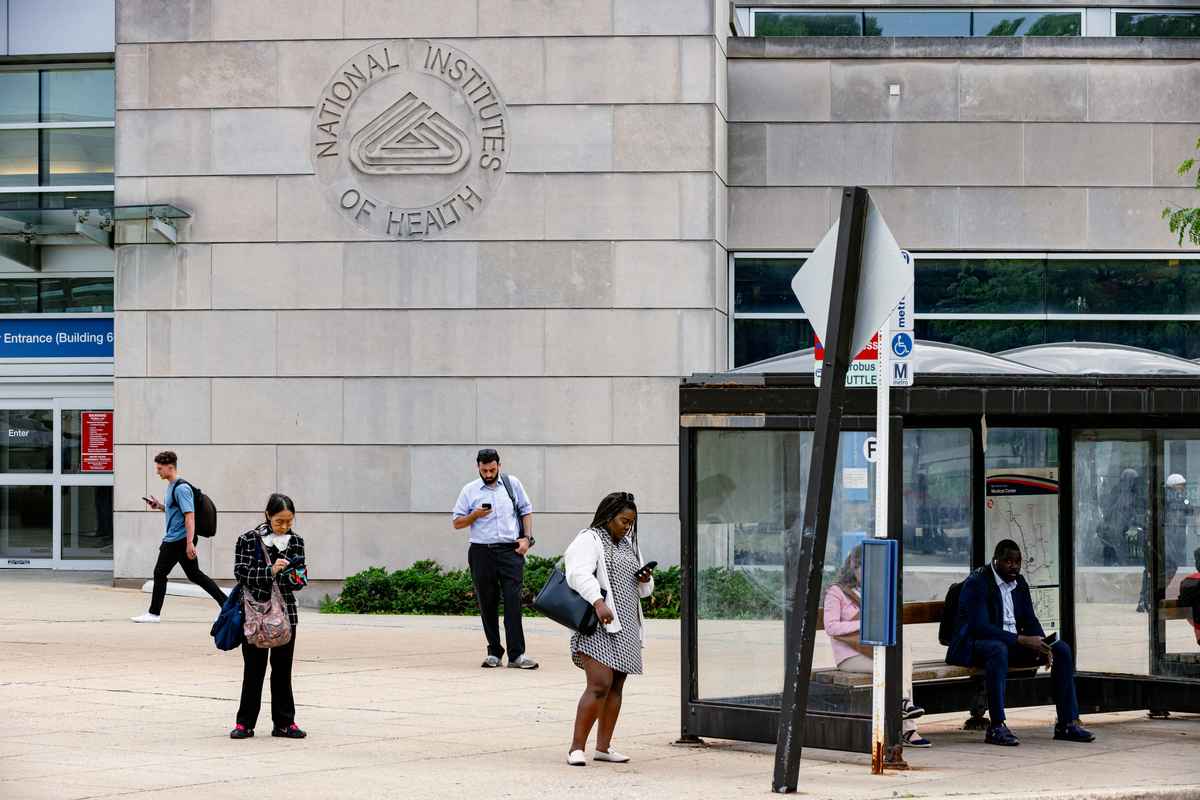
The National Institutes of Health in Bethesda, Maryland, in May.
16:24 JST, July 17, 2025
In May, President Donald Trump signed an executive order in the Oval Office surrounded by his top health officials, vowing a crackdown on “dangerous gain-of-function research” on viruses and pathogens that he alleged was occurring in the United States with inadequate oversight. “It’s a big deal,” Trump had said, alluding to the highly contested theory that the covid pandemic was caused by a lab leak related to such research in China.
Soon after, researchers at the National Institutes of Health spent weeks assessing experiments for risk and preparing a report for the White House on what studies to halt, according to internal emails obtained by The Washington Post and interviews with two career staffers familiar with the process.
But after the director of the NIH’s infectious-disease institute signed off on the findings, the politically appointed No. 2 in command at the NIH, Matthew Memoli, overrode career staff, according to the emails and staffers, who spoke on the condition of anonymity because they were not authorized to discuss internal deliberations.
Nearly a dozen tuberculosis studies that relied on long-standing research methods deemed safe by the reviewers were then added to the list.
For many years the scientific community has wrestled with the question of what constitutes “dangerous” research. The Trump administration’s recent actions have raised concern among some scientists that politics is playing too big a role in that debate and could block experiments that are safe and potentially lead to new treatments and medicines.
The administration’s moves are part of a full embrace of the lab leak theory for the origin of the coronavirus. The origin remains unknown, and the issue has divided the intelligence community. The scientific community largely favors a natural origin via a spillover from wild animals sold in a market.
A July 3 draft memo from Memoli to White House officials said the NIH is in the process of suspending funding for 40 experiments involving a range of pathogens because of fears that the research might be dangerous.
“Erring on the side of caution, all projects potentially meeting the definition are being suspended,” Memoli said in the memo, which was first reported by the journal Science.
“In line with President Trump’s executive order, the NIH is conducting a careful and science-driven review of research that may meet the definition of dangerous gain-of-function research which could result in significant societal consequences,” Andrew Nixon, a spokesman for the Department of Health and Human Services, said Wednesday.
“As part of that process and as directed by the White House Office of Science and Technology Policy, NIH is casting a wide net in identifying projects that have the potential to result in dangerous gain-of-function research.”
Gain-of-function research is not easily defined and has been controversial within the research community for many years, predating the pandemic. It involves the manipulation of viruses or other microbes to anticipate what might make them evolve naturally to become more transmissible or pathogenic, or have different attributes.
Scientists say it’s rarely done, and subject to review boards and strict biosafety measures.
During the review of experiments, NIH employees had to go through as many as 100 awards each, according to two staffers familiar with the review and the emails obtained by The Post.
At the end of the review, officers managing research into tuberculosis identified five studies that seemed to involve gain-of-function techniques as defined by Trump’s executive order. They also identified 11 other studies that could technically be classified as gain of function, but which involved common techniques that have been widely used by microbiologists for decades and are not unsafe, according to the emails and the staffers who spoke on the condition of anonymity because they were not authorized to speak publicly.
The career staff flagged these 11 studies to the acting director of the National Institute of Allergy and Infectious Diseases, Jeffery Taubenberger, at a June 23 meeting, according to the emails and staffers. Taubenberger agreed that the 11 should not be classified as gain of function and should not be paused.
But then on July 2, Taubenberger emailed with an update. “I talked to Matt [Memoli],” he wrote in a message obtained by The Post. “I have some clarification.”
Memoli wanted all 16 tuberculosis studies classified as “dangerous Gain of Function” – “dGOF” – and paused, not just the five studies that staff had flagged as potentially problematic, Taubenberger wrote. His email was forwarded to career staffers, who were instructed by an administrator to suspend “these additional awards” per Taubenberger’s instructions, according to more messages obtained by The Post.
A few days later on July 9, the NIH sent letters halting funding to the 11 additional tuberculosis researchers, according to messages obtained by The Post.
Taubenberger did not immediately respond to messages seeking comment.
In days since, the researchers targeted to have their work halted have told NIH staff they fear they will be harassed, labeled as imperiling public safety by their local communities and the news media, one staffer said.
Sarah Stanley is a researcher at the University of California at Berkeley who studies tuberculosis, a bacterial infection that killed more than 1.2 million people globally in 2023. One of her grants that already ended in May was marked for suspension. A second grant was flagged, she said, because she uses standard microbiology techniques to try to create mutant versions of TB that are less virulent and less fit.
She conducts the research in a biosafety level 3 laboratory, under the oversight of an institutional biosafety committee at her university.
“Every one of my protocols gets scrutinized, vetted and reviewed. It’s a decades-old technique,” Stanley said. “The goal is to find vulnerabilities in the bacteria that can eventually be used to develop new drugs.”
Renewing debate over covid’s origin
The unknown origin of covid-19, which has killed more than 1 million Americans, has intensified the debate over the risks and rewards of research on pathogens.
There is no evidence that the coronavirus, SARS-CoV-2, or its immediate precursor, was in any laboratory before the outbreak in late 2019. Peer-reviewed papers in scientific journals have said the virus most likely began infecting people via wild animals sold illegally in a Wuhan, China, market.
But the latest actions by the NIH reflect the administration’s muscular promotion of the lab leak theory. The White House redirected the covid.gov site to a webpage showing Trump framed by the words “LAB LEAK” and offering bullet points pointing to what the page called the “true origin” of covid.
Public opinion polls have shown growing support for the lab leak theory, advanced by independent internet sleuths and later in lengthy reports from congressional Republicans. The president’s partial budget request to Congress earlier this year, which called for cutting 40 percent of the appropriation for the NIH, mentioned NIH funding that supported experiments at the Wuhan Institute of Virology, a focus of lab leak conjectures.
“While evidence of the origins of the COVID-19 pandemic leaking from a laboratory is now confirmed by several intelligence agencies, the NIH’s inability to prove that its grants to the Wuhan Institute of Virology were not complicit in such a possible leak, or get data and hold recipients of Federal funding accountable is evidence that NIH has grown too big and unfocused,” the budget document stated.
Jay Bhattacharya, the director of the NIH, endorsed that view in an interview with Laura Ingraham on Fox News, saying the agency he now runs had helped fund “mad science experiments” in a Chinese lab in Wuhan.
“That experiment went astray. It leaked and caused the havoc that we faced for years,” he said.
Concerns over gain-of-function research extend beyond the debate over covid’s origins.
Experiments in the U.S. and the Netherlands on influenza viruses, and the attempt to publish the results, created an intense controversy about gain-of-function experiments more than a decade ago. Critics of the research feared that terrorists or other bad actors could use the findings to generate a bioweapon.
The federal government in 2014 put a moratorium on gain-of-function research pending an update of biosafety and biosecurity guidelines. In 2017, after new guidance for research had been adopted, the moratorium was lifted.
“GOF research is important in helping us identify, understand, and develop strategies and effective countermeasures against rapidly evolving pathogens that pose a threat to public health,” an NIH news release said at the time.
Robert Garry, a virologist at Tulane University who co-authored a 2020 Nature Medicine paper saying the virus was not engineered, said researchers already follow biosafety guidelines when studying viruses.
“Virologists are concerned about biosecurity and biosafety,” Garry said. “We live with the viruses every day. Nobody would want their staff and their students to get infected.”






Most Read
Popular articles in the past 24 hours
-

Japan's Snow-Clad Beauty: Camellia Flowers Seen in Winter Bloom a...
-

Monkey Strikes Junior High School Girl from Behind in Japan's Yam...
-

Genichiro Inokuma's Mural in Ueno Station That Gave Hope in Postw...
-

Foreign and Security Policy: Political Parties Must Discuss How T...
-

Senior Japanese Citizens Return to University to Gain Knowledge, ...
-

Heavy Snow Linked to 30 Deaths across Japan since Late Jan.; JMA ...
-

Tokyo Police Arrest Head of Resignation Assistance Firm
-

Japan’s Nikkei Stock Average Jumps near 4%, Closes at Record High...
Popular articles in the past week
-

Japan Institute to Use Domestic Commercial Optical Lattice Clock ...
-

Australian Woman Dies After Mishap on Ski Lift in Nagano Prefectu...
-

Foreign Snowboarder in Serious Condition After Hanging in Midair ...
-
Chinese Embassy in Japan Reiterates Call for Chinese People to Re...
-
Narita Airport, Startup in Japan Demonstrate Machine to Compress ...
-

Toyota Motor Group Firm to Sell Clean Energy Greenhouses for Stra...
-

Sakie Yokota, Last Surviving Parent of a North Korea Abductee, Ur...
-

Beer Yeast Helps Save Labor, Water Use in Growing Rice; Govt Hope...
Popular articles in the past month
-

Univ. in Japan, Tokyo-Based Startup to Develop Satellite for Disa...
-
JAL, ANA Cancel Flights During 3-day Holiday Weekend due to Blizz...
-
China Confirmed to Be Operating Drilling Vessel Near Japan-China ...
-

China Eyes Rare Earth Foothold in Malaysia to Maintain Dominance,...
-
Japan Institute to Use Domestic Commercial Optical Lattice Clock ...
-
M6.2 Earthquake Hits Japan's Tottori, Shimane Prefectures; No Tsu...
-

Japan, Qatar Ministers Agree on Need for Stable Energy Supplies; ...
-

Japan, Italy to Boost LNG Cooperation; Aimed at Diversifying Japa...
Top Articles in News Services
-

Arctic Sees Unprecedented Heat as Climate Impacts Cascade
-

Prudential Life Expected to Face Inspection over Fraud
-

South Korea Prosecutor Seeks Death Penalty for Ex-President Yoon over Martial Law (Update)
-
Trump Names Former Federal Reserve Governor Warsh as the Next Fed Chair, Replacing Powell
-

Japan’s Nagasaki, Okinawa Make N.Y. Times’ 52 Places to Go in 2026
JN ACCESS RANKING
-
Univ. in Japan, Tokyo-Based Startup to Develop Satellite for Disaster Prevention Measures, Bears
-
JAL, ANA Cancel Flights During 3-day Holiday Weekend due to Blizzard
-
China Confirmed to Be Operating Drilling Vessel Near Japan-China Median Line
-
China Eyes Rare Earth Foothold in Malaysia to Maintain Dominance, Counter Japan, U.S.
-
Japan Institute to Use Domestic Commercial Optical Lattice Clock to Set Japan Standard Time