
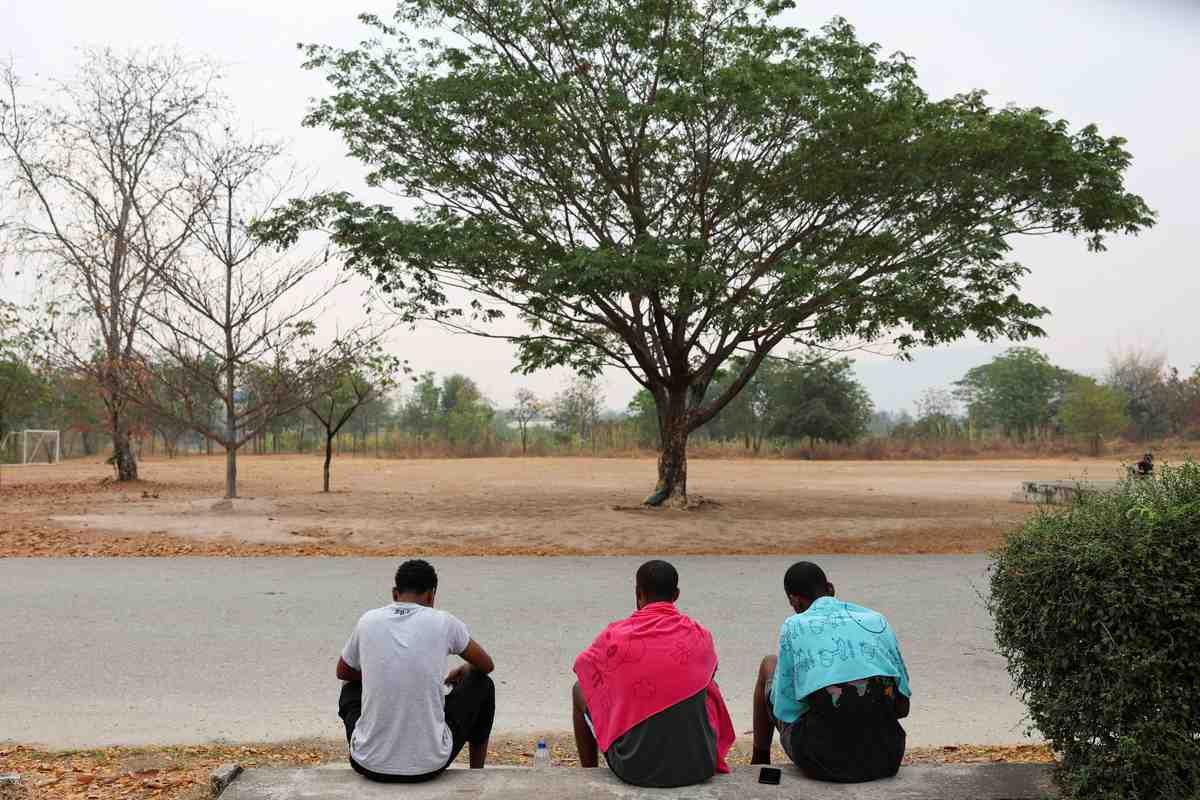
Ethiopian citizens, who were trafficked into working at scam centers in Myanmar and were sent to Thailand on Feb. 12 amid a mounting crackdown on scam centers operating along a porous border, wait for their embassies to pick them up at a shelter inside the 310th Military District (Fort Wachiraprakan), in Tak Province, Thailand on Feb. 19.
12:04 JST, February 25, 2025
BANGKOK (Reuters) – Thousands of foreigners freed from online scam-operating centers in Myanmar are stuck in limbo on the border with Thailand after a multinational crackdown on the compounds run by criminal gangs, three sources told Reuters on Monday.
In recent weeks, authorities from China, Thailand and Myanmar have attempted to dismantle scam centers and illegal online operations on the border, part of a network of illegal compounds across Southeast Asia where hundreds of thousands have been trafficked by gangs, according to the United Nations.
Thai and Cambodian police raided a building in a border town and freed 215 foreigners, a senior Thai official said on Sunday.
Two Myanmar armed groups – the Karen National Army (KNA) and the Democratic Karen Buddhist Army (DKBA) – are currently holding around 7,000 former scam center workers but are unable to send them to Thailand, a Thai security official and two aid workers said.
“Many are stuck in limbo and Thailand’s lack of response is causing great harm,” said one of aid workers, currently on the Thai side of the border. “It is like these victims are being revictimised again.”
Thailand’s foreign ministry said that agencies are currently planning for future handovers of those freed, which would “proceed based on the readiness of the embassies or the countries of origin.”
KNA and DKBA officials did not respond to calls from Reuters.
The majority of these workers are Chinese, with about 1,000 from other foreign countries, according to the aid workers.
Many of the former scam center workers are being held in dire conditions and local authorities are concerned about the lack of sanitation and health facilities, they said.
Thai Deputy Prime Minister Phumtham Wechayachai said last Thursday that Thailand doesn’t have the capacity to accept more people unless foreign embassies repatriate those crossing over.
Thailand this month accepted 260 scam center workers, more than half of whom were from Ethiopia, which has no embassy in the country.
Thai authorities also allowed China to repatriate 621 of its nationals via a series of flights from a border town last week.
Scam centers have been operating in the region for years, but face renewed scrutiny after the rescue of Chinese actor, Wang Xing, who was lured to Thailand with the promise of a job, and then abducted and taken to one such center in Myanmar.
Southeast Asian countries have since stepped up efforts to tackle scam centers, including Thailand cutting power, fuel and internet supply to areas linked with scam centers.
Since March 2022, financial losses incurred by victims of telecom scams in Thailand alone stand at 80 billion Thai baht ($2.4 billion), Thai Police Colonel Kreangkrai Puttaisong told reporters on Monday.




Most Read
Popular articles in the past 24 hours
-

Iran Situation: Significance of Rule of Law Must Be Conveyed
-

Trump Says Iran Had a New Site for Developing Nuclear Weapons
-

Alexander Brothers, Top NY Real Estate Brokers, Convicted at Sex ...
-
North Korean Leader's Sister Criticized US-South Korea for Procee...
-

Venezuelan Lawmakers Open Debate on a Mining Bill to Lure Foreign...
-

Trump Threatens to Escalate Iran War, but Says It Could End Soon
-

Five Iranian Women's Soccer Players Granted Humanitarian Visas in...
-

Crude Oil Prices Top $100: Measures Must Be Taken Before It’s Too...
Popular articles in the past week
-

Ibaraki Pref.'s 1st Foreign Bus Driver Hired in Tsukuba
-

Amid Strait of Hormuz Blockade, Shipping Companies Scramble to Ge...
-

2 Unpublished Early Novellas by Japan's Kenzaburo Oe Discovered, ...
-
Govt to Utilize ODA for Ensuring Economic Security; Securing Ener...
-
Japan Govt Survey Finds Just 10% of Workers Want Working Hours to...
-

Japan's 2nd Round of U.S. Investments May Be Worth Over $100 Bill...
-

Imperial Family Watches World Baseball Classic Game Against Austr...
-

Donald Keene’s Drinking Buddy and Translator Yukio Kakuchi Pays T...
Popular articles in the past month
-

Producer Behind Pop Group XG Arrested for Cocaine Possession
-

Japan PM Takaichi’s Cabinet Resigns en Masse
-

Man Infected with Measles Reportedly Dined at Restaurant in Tokyo...
-

Videos Plagiarized, Reposted with False Subtitles Claiming ‘Ryuky...
-

iPS Treatments Pass Key Milestone, but Broader Applications Far f...
-

Sanae Takaichi Elected Prime Minister of Japan; Keeps All Cabinet...
-

Nepal Bus Crash Kills 19 People, Injures 25 Including One Japanes...
-

Japan's Govt to Submit Road Map for Growth Strategy in March, PM ...
Top Articles in News Services
-
Survey Shows False Election Info Perceived as True
-

Japan’s Nikkei Stock Average Falls as US-Iran Tensions Unsettle Investors (UPDATE 1)
-
Japan’s Nikkei Stock Average Touches 58,000 as Yen, Jgbs Rally on Election Fallout (UPDATE 1)
-
Japan’s Nikkei Stock Average Rises on Tech Rally and Takaichi’s Spending Hopes (UPDATE 1)
-

Japan to Ban Use of Power Banks on Airplanes
JN ACCESS RANKING
-
Producer Behind Pop Group XG Arrested for Cocaine Possession
-
Japan PM Takaichi’s Cabinet Resigns en Masse
-
Man Infected with Measles Reportedly Dined at Restaurant in Tokyo Station
-
Videos Plagiarized, Reposted with False Subtitles Claiming ‘Ryukyu Belongs to China’; Anti-China False Information Also Posted in Japan
-
iPS Treatments Pass Key Milestone, but Broader Applications Far from Guaranteed