
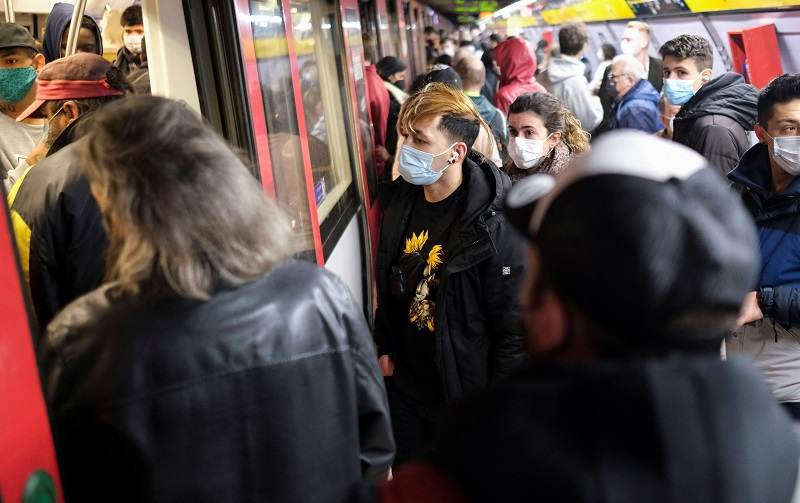
Commuters wait for the train at the subway station, amid the outbreak of the coronavirus disease (COVID-19) and after Omicron has become the dominant coronavirus variant in Europe, in Barcelona, Spain January 12, 2022.
17:14 JST, April 28, 2022
BRUSSELS (Reuters) – The European Commission said that between 60% and 80% of the EU population was estimated to have been infected with COVID-19, as the bloc enters a post-emergency phase in which mass reporting of cases was no longer necessary.
In preparing for this less acute phase, European Union governments should ramp up COVID-19 immunisations of children, the bloc’s executive body said, signallingit was considering plans to develop antivirals.
“It is estimated that between 60% to 80% of the EU population has by now had COVID,” EU health commissioner Stella Kyriakides told a news conference.
The EU public health agency said reported cases had covered about 30% of the European population so far, but if unreported infections were added, cases could be as high as 350 million, about 77% of the European population.
With a recent drop in infections and deaths linked to COVID-19, the EU is now shifting away from mass testing and reporting of cases, Kyriakides said, confirming what Reuters reported on Tuesday. Read full story
But fresh COVID-19 surges are likely as the virus is expected to continue mutating, and therefore countries should have in place plans to shift back into emergency mode, and should ramp up vaccinations, the commission said.
In a document outlining the strategy for the post-emergency phase of the pandemic, Brussels urged governments to continue pushing for the immunization of the unvaccinated, especially children before the start of the new school term in the autumn.
Immunization rates are below 15% among children aged between 5 and 9, the youngest age group for which COVID-19 vaccines have been authorized in Europe. That compares to over 70% of teens aged 15 to 17, the document says.
The Commission also said it could back the development of new drugs against COVID-19, especially antivirals that are easier to store and administer.
The EU “will explore possibilities to support projects targeting the development of antivirals,” it said.
Antiviral pills against COVID-19 developed by Pfizer PFE.N and Merck & Co MRK.N have been approved for use in the EU. But their uptake has so far been limited, due to a range of reasons including the slowing of the pandemic, high prices and complicated national procedures to prescribe them.
The EU executive also said it would work to support the development of the next generation of COVID-19 vaccines which it expects will offer more robust and longer-lasting protection against infection or transmission.








Most Read
Popular articles in the past 24 hours
-

Voters Using AI to Choose Candidates in Japan's Upcoming General ...
-

Japan's Snow-Clad Beauty: Camellia Flowers Seen in Winter Bloom a...
-
Monkey Strikes Junior High School Girl from Behind in Japan's Yam...
-

Genichiro Inokuma's Mural in Ueno Station That Gave Hope in Postw...
-

Senior Japanese Citizens Return to University to Gain Knowledge, ...
-

Foreign and Security Policy: Political Parties Must Discuss How T...
-
Heavy Snow Linked to 30 Deaths across Japan since Late Jan.; JMA ...
-

Tokyo Police Arrest Head of Resignation Assistance Firm
Popular articles in the past week
-

Japan Institute to Use Domestic Commercial Optical Lattice Clock ...
-

Australian Woman Dies After Mishap on Ski Lift in Nagano Prefectu...
-
Foreign Snowboarder in Serious Condition After Hanging in Midair ...
-
Chinese Embassy in Japan Reiterates Call for Chinese People to Re...
-
Narita Airport, Startup in Japan Demonstrate Machine to Compress ...
-

Toyota Motor Group Firm to Sell Clean Energy Greenhouses for Stra...
-

Sakie Yokota, Last Surviving Parent of a North Korea Abductee, Ur...
-

Beer Yeast Helps Save Labor, Water Use in Growing Rice; Govt Hope...
Popular articles in the past month
-
Univ. in Japan, Tokyo-Based Startup to Develop Satellite for Disa...
-
JAL, ANA Cancel Flights During 3-day Holiday Weekend due to Blizz...
-

China Confirmed to Be Operating Drilling Vessel Near Japan-China ...
-

China Eyes Rare Earth Foothold in Malaysia to Maintain Dominance,...
-
M6.2 Earthquake Hits Japan's Tottori, Shimane Prefectures; No Tsu...
-
Japan Institute to Use Domestic Commercial Optical Lattice Clock ...
-

Japan, Qatar Ministers Agree on Need for Stable Energy Supplies; ...
-

Japan, Italy to Boost LNG Cooperation; Aimed at Diversifying Japa...
Top Articles in News Services
-

Arctic Sees Unprecedented Heat as Climate Impacts Cascade
-

Prudential Life Expected to Face Inspection over Fraud
-

South Korea Prosecutor Seeks Death Penalty for Ex-President Yoon over Martial Law (Update)
-

Trump Names Former Federal Reserve Governor Warsh as the Next Fed Chair, Replacing Powell
-

Japan’s Nagasaki, Okinawa Make N.Y. Times’ 52 Places to Go in 2026
JN ACCESS RANKING
-
Univ. in Japan, Tokyo-Based Startup to Develop Satellite for Disaster Prevention Measures, Bears
-
JAL, ANA Cancel Flights During 3-day Holiday Weekend due to Blizzard
-
China Confirmed to Be Operating Drilling Vessel Near Japan-China Median Line
-
China Eyes Rare Earth Foothold in Malaysia to Maintain Dominance, Counter Japan, U.S.
-
Japan Institute to Use Domestic Commercial Optical Lattice Clock to Set Japan Standard Time