
Fatal Stabbing Raises Criticism Against Anti-Japanese Education; Chinese History Books, SNS Stirring Resentment

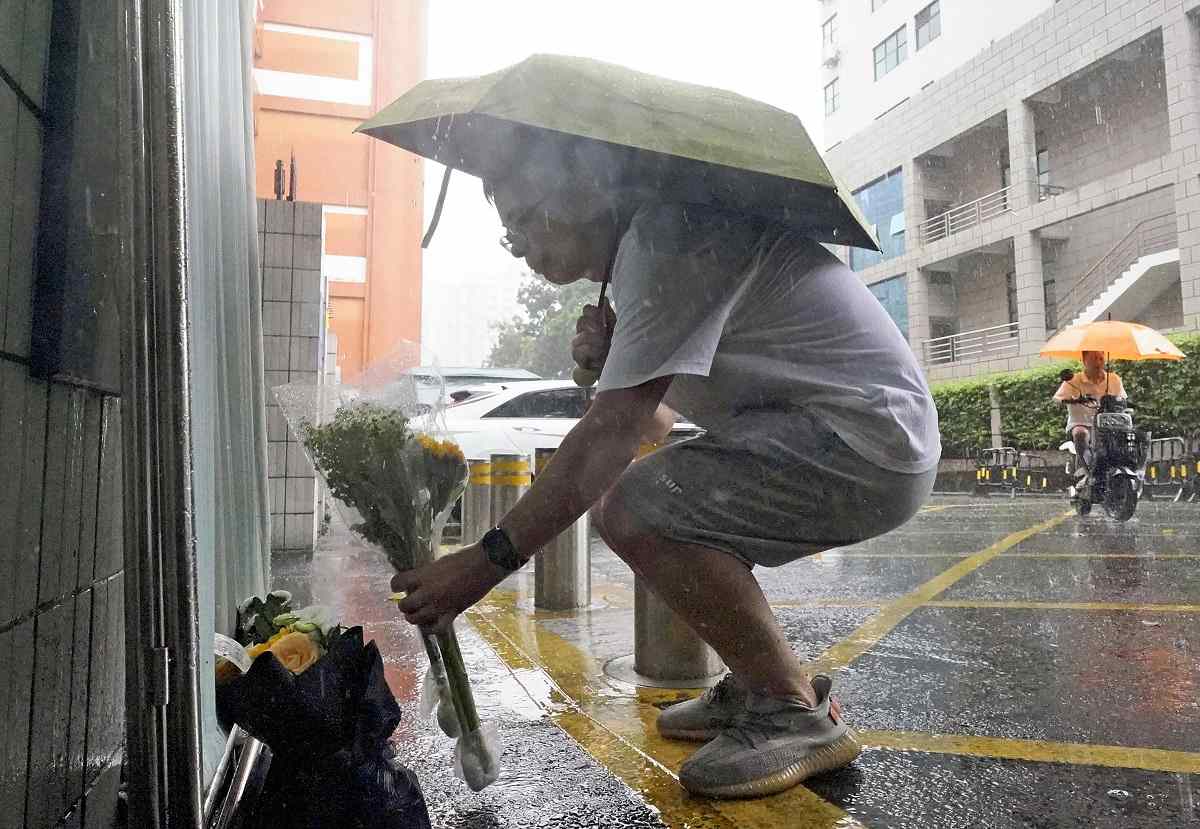
Left: Chinese women hug each other and cry at the Japanese school where they offered flowers Saturday in Shenzhen, Guangdong Province, China.
Right: A Chinese man offers flowers at the main entrance of the Japanese school in the heavy rain.
15:31 JST, September 22, 2024
SHENZHEN — The motivation behind the stabbing and killing of a 10-year-old boy attending a local Japanese school by a 44-year-old Chinese man in Shenzhen, Guangdong Province, remains unclear. The incident has prompted criticism among Chinese people against their own country.
On Saturday, Chinese people visited the Japanese school to offer flowers in the rain, and some criticized the country’s anti-Japanese education. A 40-year-old insurance company employee living nearby said she is skeptical about the content her 12-year-old and 9-year-old sons learn at school.
When Japan began discharging treated water from the Fukushima No.1 nuclear power plant last summer, her children only heard critical remarks against Japan from their teachers, according to the woman. “The content of many history textbooks stirs up resentment against foreign countries,” she said.
A 60-year-old housewife in the city tearfully said, “We should stop history education that triggers such vengeful thoughts.”
In China’s history education, anti-Japanese sentiment can be stirred among students when learning about the Japan-China war and other events. The new patriotic education law was enacted in January to increase patriotism and teach more about President Xi Jinping’s thoughts through history textbooks from this autumn.
Authorities vigilant
In June, three people, including a Japanese woman and her child, were attacked by a Chinese man. The Chinese government deemed it to be an isolated incident, and the same explanation was given for the latest murder in Shenzhen. There are few media reports on the latest case.
A 59-year-old part-time worker pointed out that the problem is that many Chinese people do not question the government’s tendency to hide facts. “This incident was caused by brainwashing in education,” he said.
Some Chinese people reflected further on the situation, also blaming the endless stream of social media posts saying things like: “Japan is pulling the strings behind the scenes” and “Chinese people are killed in Japan.” Chinese authorities are vigilant against an increasing anti-Japanese sentiment. An Internet media outlet reported Saturday that the video-sharing app KuaiShou suspended about 90 accounts that had gathered harmful information to stir up antagonism between Japan and China.





Most Read
Popular articles in the past 24 hours
-

Voters Using AI to Choose Candidates in Japan's Upcoming General ...
-

Japan's Snow-Clad Beauty: Camellia Flowers Seen in Winter Bloom a...
-

Monkey Strikes Junior High School Girl from Behind in Japan's Yam...
-

Genichiro Inokuma's Mural in Ueno Station That Gave Hope in Postw...
-

Senior Japanese Citizens Return to University to Gain Knowledge, ...
-

Foreign and Security Policy: Political Parties Must Discuss How T...
-

Heavy Snow Linked to 30 Deaths across Japan since Late Jan.; JMA ...
-

Tokyo Police Arrest Head of Resignation Assistance Firm
Popular articles in the past week
-

Japan Institute to Use Domestic Commercial Optical Lattice Clock ...
-
Australian Woman Dies After Mishap on Ski Lift in Nagano Prefectu...
-
Foreign Snowboarder in Serious Condition After Hanging in Midair ...
-

Chinese Embassy in Japan Reiterates Call for Chinese People to Re...
-

Narita Airport, Startup in Japan Demonstrate Machine to Compress ...
-

Toyota Motor Group Firm to Sell Clean Energy Greenhouses for Stra...
-

Sakie Yokota, Last Surviving Parent of a North Korea Abductee, Ur...
-

Beer Yeast Helps Save Labor, Water Use in Growing Rice; Govt Hope...
Popular articles in the past month
-

Univ. in Japan, Tokyo-Based Startup to Develop Satellite for Disa...
-

JAL, ANA Cancel Flights During 3-day Holiday Weekend due to Blizz...
-

China Confirmed to Be Operating Drilling Vessel Near Japan-China ...
-

China Eyes Rare Earth Foothold in Malaysia to Maintain Dominance,...
-
M6.2 Earthquake Hits Japan's Tottori, Shimane Prefectures; No Tsu...
-
Japan Institute to Use Domestic Commercial Optical Lattice Clock ...
-

Japan, Qatar Ministers Agree on Need for Stable Energy Supplies; ...
-

Japan, Italy to Boost LNG Cooperation; Aimed at Diversifying Japa...
Top Articles in World
-
China Confirmed to Be Operating Drilling Vessel Near Japan-China Median Line
-
China Eyes Rare Earth Foothold in Malaysia to Maintain Dominance, Counter Japan, U.S.
-
Japan, Qatar Ministers Agree on Need for Stable Energy Supplies; Motegi, Qatari Prime Minister Al-Thani Affirm Commitment to Cooperation
-

North Korea Possibly Launches Ballistic Missile
-

10 Universities in Japan, South Korea, Mongolia to Establish Academic Community to Promote ICC Activities, Rule of Law
JN ACCESS RANKING
-
Univ. in Japan, Tokyo-Based Startup to Develop Satellite for Disaster Prevention Measures, Bears
-
JAL, ANA Cancel Flights During 3-day Holiday Weekend due to Blizzard
-
China Confirmed to Be Operating Drilling Vessel Near Japan-China Median Line
-
China Eyes Rare Earth Foothold in Malaysia to Maintain Dominance, Counter Japan, U.S.
-
Japan Institute to Use Domestic Commercial Optical Lattice Clock to Set Japan Standard Time