
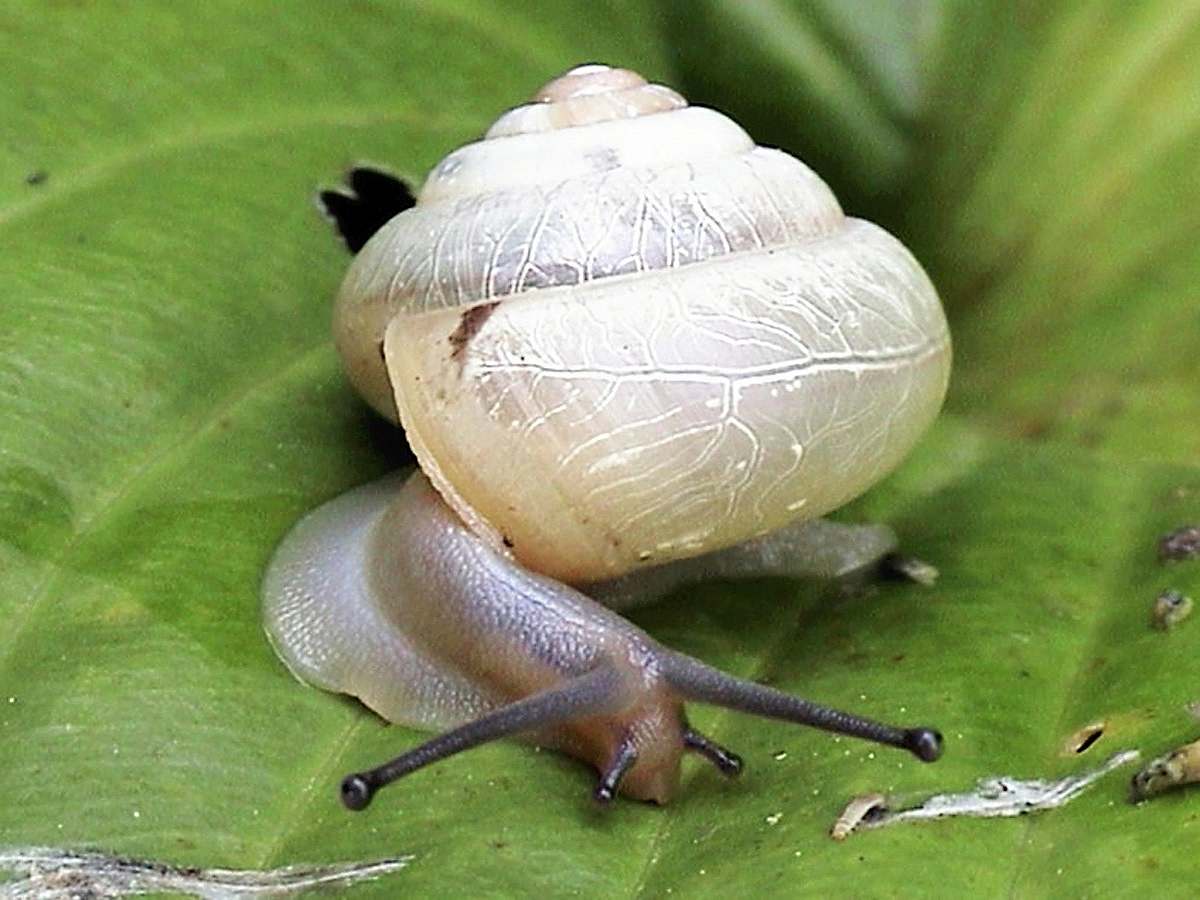
A Yakobi Maimai snail (Satsuma jacobii)
16:35 JST, July 27, 2024
OTSU (Jiji Press) — Snail sightings during the rainy season in Japan are becoming rarer as dry and urban areas increase, with half of the species in the Kinki region at risk of extinction, experts warn.
Efforts to create new green areas for snails to live in are unlikely to be very effective because it is difficult for them to move into such areas due to their poor mobility.
Snails are a type of shelled gastropod. There are some 800 species in Japan.
According to Katsuki Nakai, senior research scientist at the Lake Biwa Museum in Shiga Prefecture, snails are decreasing in places close to humans due to urbanization.
“Even if trees are planted nearby, [snails] cannot reach them by themselves to make them their homes” because they move only slowly using mucus, he said.
According to Nakai, about 100 of the roughly 200 species of snails in Kinki are threatened with extinction. Most live in forests, and many are believed to be affected by changes in vegetation and soil due to acid rain and feeding damage by deer.
Many species live in very small areas, meaning that the loss of a single habitat may significantly raise the risk of extinction. However, Nakai warned against artificial transfers of snails, saying that this may affect the ecology of native species.
Tsukasa Waki, associate professor at Toho University who researches shellfish parasites, cited expansion of dry areas as a factor behind the decrease in snails.
Snails are vulnerable to dry environments, and they prefer to live in moist places such as behind fallen leaves. They are “losing places to hide” as fallen leaves and rotten trees are often removed from parks in urban areas, Waki said.
“It’s important to continue protecting the habitats of snails that exist now,” in order to stop the decline in snail populations, Waki said. “It’s also important to encourage many people to know about the current situation and take interest.”
“There are endemic snail species in various parts of Japan, such as ‘Setouchi Maimai’ (Euhadra subnimbosa) and ‘Izumo Maimai’ (Euhadra idzumonis),” Waki said. “I hope people will first become familiar with local snails.”







Most Read
Popular articles in the past 24 hours
-

Japanese High School Student Aims to Share Kaiten History Through...
-

Business Hotels Expanding into Regional Areas in Japan, Aiming to...
-

Milano Cortina 2026: Japan Sees Leap in Olympic Performance Throu...
-

Chronic Issues Erode Thailand’s Economy as Political Confusion Pe...
-

Milano Cortina 2026: Japan's Satoshi Furuno Places 4th in Men's S...
-

Milano Cortina 2026: Speed Skater Takagi Finishes 6th in the 1,50...
-

Osaka: 40 Ninjas Display Shuriken Throwing Skills at Japan Champi...
-

Fiji Defense Minister Hopes Japan Will Support Stabilization of P...
Popular articles in the past week
-

Japan PM Takaichi’s Cabinet Resigns en Masse
-

Man Infected with Measles Reportedly Dined at Restaurant in Tokyo...
-

Sanae Takaichi Elected Prime Minister of Japan; Keeps All Cabinet...
-

Japan's Govt to Submit Road Map for Growth Strategy in March, PM ...
-

Bus Carrying 40 Passengers Catches Fire on Chuo Expressway; All E...
-

Milano Cortina 2026: Figure Skaters Riku Miura, Ryuichi Kihara Pa...
-

Japan, U.S. Name 3 Inaugural Investment Projects; Reached Agreeme...
-

U.S. Firm to Build Training Hub in Fukushima N-plant for Debris R...
Popular articles in the past month
-
Japan PM Takaichi’s Cabinet Resigns en Masse
-

Japan Institute to Use Domestic Commercial Optical Lattice Clock ...
-

Israeli Ambassador to Japan Speaks about Japan’s Role in the Reco...
-
Man Infected with Measles Reportedly Dined at Restaurant in Tokyo...
-

Videos Plagiarized, Reposted with False Subtitles Claiming ‘Ryuky...
-

Man Infected with Measles May Have Come in Contact with Many Peop...
-

Prudential Life Insurance Plans to Fully Compensate for Damages C...
-

Woman with Measles Visited Hospital in Tokyo Multiple Times Befor...
Top Articles in Science & Nature
-
Japan Institute to Use Domestic Commercial Optical Lattice Clock to Set Japan Standard Time
-

Japan to Face Shortfall of 3.39 Million Workers in AI, Robotics in 2040; Clerical Workers Seen to Be in Surplus
-

Record 700 Startups to Gather at SusHi Tech Tokyo in April; Event Will Center on Themes Like Artificial Intelligence and Robotics
-

iPS Treatments Pass Key Milestone, but Broader Applications Far from Guaranteed
-

iPS Cell Products for Parkinson’s, Heart Disease OK’d for Commercialization by Japan Health Ministry Panel
JN ACCESS RANKING
-
Japan PM Takaichi’s Cabinet Resigns en Masse
-
Japan Institute to Use Domestic Commercial Optical Lattice Clock to Set Japan Standard Time
-
Israeli Ambassador to Japan Speaks about Japan’s Role in the Reconstruction of Gaza
-
Man Infected with Measles Reportedly Dined at Restaurant in Tokyo Station
-
Videos Plagiarized, Reposted with False Subtitles Claiming ‘Ryukyu Belongs to China’; Anti-China False Information Also Posted in Japan