
Endangered Okinawa Rail Likely Being Struck by Cars While Collecting Food; Environment Ministry Steps up Efforts to Alert Drivers
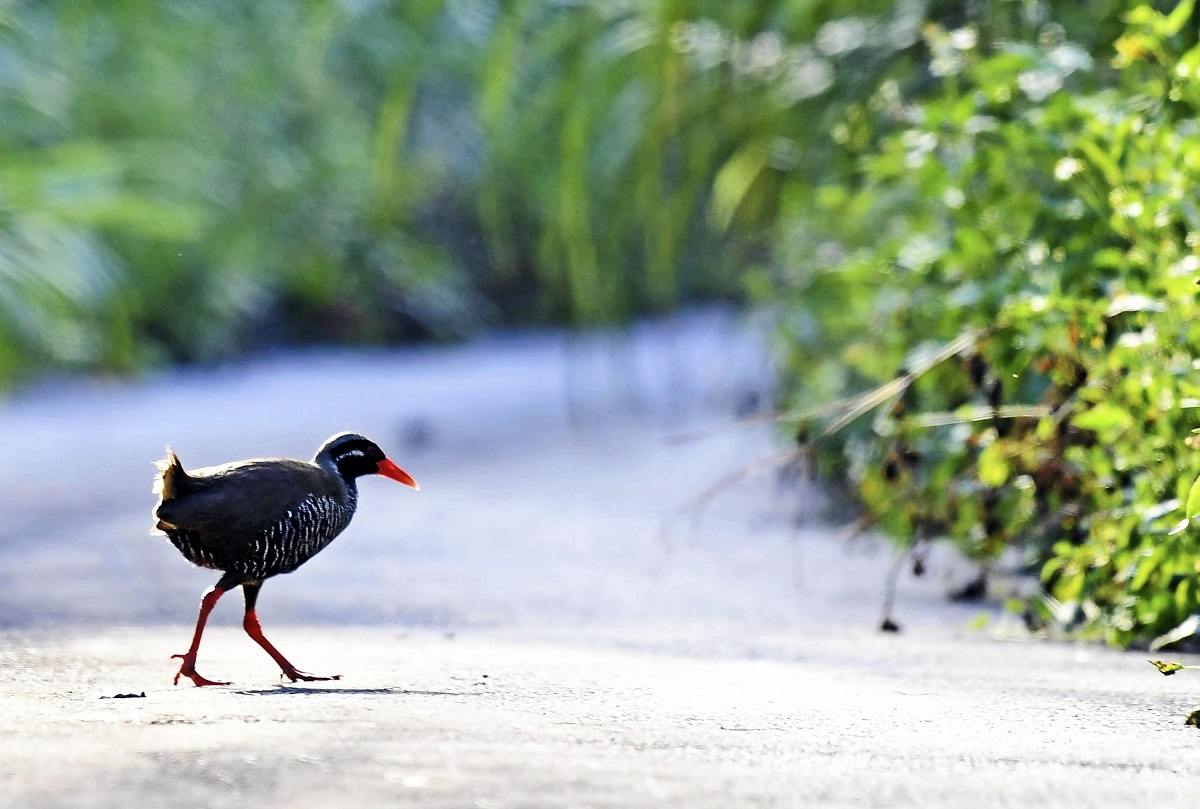
An Okinawa rail seen on a road in the village of Kunigami, Okinawa Prefecture
19:00 JST, June 17, 2024
An endangered Okinawan bird is likely being killed by vehicles as it picks up the carcasses of frogs and other creatures, according to a group of researchers.
The Okinawa rail, known as Yanbarukuina in Japanese, inhabits the Yanbaru region, the northern part of Okinawa Prefecture’s main island. An experiment conducted by a team from the University of the Ryukyus found that the birds would often enter roads during their breeding season between May and July.
According to the Environment Ministry, 517 Okinawa rails were found to have been killed in traffic accidents between last year and when the research began in 1995. The ministry has stepped up efforts to alert drivers, and even though authorities have implemented measures to protect the birds, such as setting up fences, about 20 to 30 of them are still killed each year.
The Yanbaru region is registered as a World Natural Heritage site and is home to many valuable amphibians and reptiles, including indigenous species. When such creatures were killed in traffic accidents, it was thought that the carcasses were taken away by crows and other predators, but what was happening remained a mystery.
After getting permission from the ministry, Prof. Kazuki Tsuji and others from the university used chicken wings that are about the same size as the indigenous Ryukyu tip-nosed frog. The chicken was placed at nine locations overnight on a prefectural road that passes through the Yanbaru region.
By the next morning, all 54 chicken wings had vanished. Automatic cameras captured 15 of the wings being collected, and of these, two were being carried by the rail.
“The bird is known to prey on snails and insects, but it was a big surprise to see that they may also eat carcasses,” said Yusuke Maruta, a graduate student of the university who reported the results at a meeting of the Japan Ethological Society.
“It will be necessary to verify the findings using real carcasses,” said Nobuhiko Kotaka, a researcher at the Forestry and Forest Products Research Institute. “Nevertheless, it shows that roads serve as feeding grounds for wild animals.”








Most Read
Popular articles in the past 24 hours
-
Japanese High School Student Aims to Share Kaiten History Through...
-

Business Hotels Expanding into Regional Areas in Japan, Aiming to...
-

Milano Cortina 2026: Japan Sees Leap in Olympic Performance Throu...
-

PM Takaichi Spells out Plans to Advance Bold Policy Shifts in Spe...
-

Chronic Issues Erode Thailand’s Economy as Political Confusion Pe...
-

Milano Cortina 2026: Japan's Satoshi Furuno Places 4th in Men's S...
-

Milano Cortina 2026: Speed Skater Takagi Finishes 6th in the 1,50...
-
Osaka: 40 Ninjas Display Shuriken Throwing Skills at Japan Champi...
Popular articles in the past week
-

Japan PM Takaichi’s Cabinet Resigns en Masse
-

Man Infected with Measles Reportedly Dined at Restaurant in Tokyo...
-

Sanae Takaichi Elected Prime Minister of Japan; Keeps All Cabinet...
-

Japan's Govt to Submit Road Map for Growth Strategy in March, PM ...
-

Bus Carrying 40 Passengers Catches Fire on Chuo Expressway; All E...
-

Milano Cortina 2026: Figure Skaters Riku Miura, Ryuichi Kihara Pa...
-

Japan, U.S. Name 3 Inaugural Investment Projects; Reached Agreeme...
-

U.S. Firm to Build Training Hub in Fukushima N-plant for Debris R...
Popular articles in the past month
-
Japan PM Takaichi’s Cabinet Resigns en Masse
-

Japan Institute to Use Domestic Commercial Optical Lattice Clock ...
-

Israeli Ambassador to Japan Speaks about Japan’s Role in the Reco...
-
Man Infected with Measles Reportedly Dined at Restaurant in Tokyo...
-

Videos Plagiarized, Reposted with False Subtitles Claiming ‘Ryuky...
-

Man Infected with Measles May Have Come in Contact with Many Peop...
-

Prudential Life Insurance Plans to Fully Compensate for Damages C...
-

Woman with Measles Visited Hospital in Tokyo Multiple Times Befor...
Top Articles in Science & Nature
-
Japan Institute to Use Domestic Commercial Optical Lattice Clock to Set Japan Standard Time
-
Japan to Face Shortfall of 3.39 Million Workers in AI, Robotics in 2040; Clerical Workers Seen to Be in Surplus
-

Record 700 Startups to Gather at SusHi Tech Tokyo in April; Event Will Center on Themes Like Artificial Intelligence and Robotics
-

iPS Treatments Pass Key Milestone, but Broader Applications Far from Guaranteed
-
iPS Cell Products for Parkinson’s, Heart Disease OK’d for Commercialization by Japan Health Ministry Panel
JN ACCESS RANKING
-
Japan PM Takaichi’s Cabinet Resigns en Masse
-
Japan Institute to Use Domestic Commercial Optical Lattice Clock to Set Japan Standard Time
-
Israeli Ambassador to Japan Speaks about Japan’s Role in the Reconstruction of Gaza
-
Man Infected with Measles Reportedly Dined at Restaurant in Tokyo Station
-
Videos Plagiarized, Reposted with False Subtitles Claiming ‘Ryukyu Belongs to China’; Anti-China False Information Also Posted in Japan