
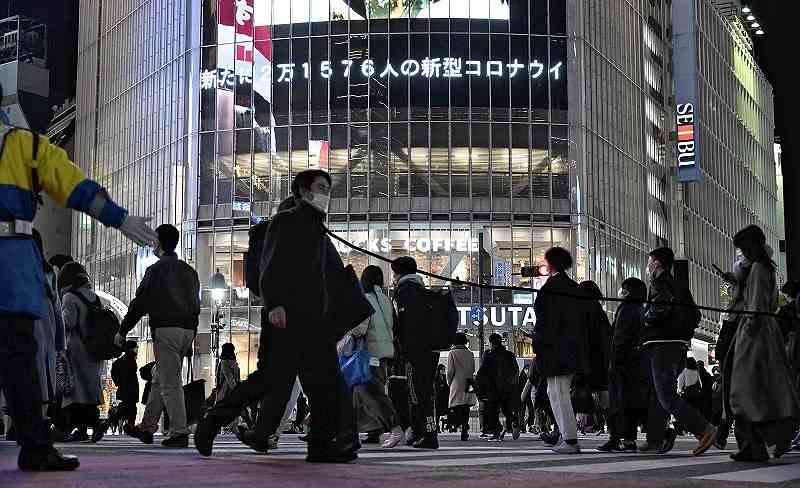
People cross an intersection in Shibuya Ward, Tokyo, on Feb. 2.
14:36 JST, March 21, 2022
New cases of coronavirus infection are expected to remain at about 6,000 a day in Tokyo after the March 21 expiration of quasi-emergency measures, according to a research team at the Nagoya Institute of Technology.
The team is also projecting that the daily number of seriously ill COVID-19 patients will fall to less than 20, as more and more people are receiving booster shots. However, if the flow of people increases, new cases in Tokyo could again exceed 10,000 per day.
Using artificial intelligence, the team predicted that new cases in the capital would drop to a weekly average of about 6,000 daily in late March, down from the current level of about 8,000. However, the figure is expected to level off in April.
If foot traffic increases to the same level as during the most recent year-end and New Year holidays, which was before the sixth wave of infections started, Tokyo could see a resurgence in early April, with daily tally reaching nearly 14,000 in the middle of the month.
In contrast, the daily number of COVID-19 patients who develop serious symptoms is expected to decrease to less than 20 by mid-April and stay at that level, regardless of people’s movements. This is believed to stem from progress in administering booster vaccinations to the elderly, who are more likely to become seriously ill.
“Even if there are fewer serious cases, the burden on medical institutions will increase if the number of new cases rises,” said Akimasa Hirata, a Nagoya Institute of Technology professor and a member of the research team. “Measures should continue to be implemented, including entry limits at restaurants, as people become more active around this time of the year on occasions such as graduation ceremonies and spring vacation.”
The university’s analysis did not take into account the possibility of the omicron variant being replaced by BA2, a more contagious subvariant of omicron.
The National Institute of Infectious Diseases has estimated that the BA2 subvariant will account for 70% of infections in early April.
If the subvariant becomes dominant, “infections could increase, as well as the number of hospitalized people,” said Takaji Wakita, director general of the institute and the chair of an advisory panel to the Health, Labor, and Welfare Ministry.





Most Read
Popular articles in the past 24 hours
-

Milano Cortina 2026: Kaori Sakamoto Wins Silver, Ami Nakai Takes ...
-

Approval of Takaichi Cabinet Stands at 73%; Yomiuri Survey Finds ...
-

New Japanese Animated Film ‘A New Dawn’ Applauded at Berlin Inter...
-

Baby Monkey Punch Captures Hearts at Chiba Pref. Zoo, on Social M...
-

Ex-ROK President Yoon Gets Life Sentence: Declaration of Martial ...
-

CARTOON OF THE DAY (February 20)
-

Milano Cortina 2026: Russian Skating Dynasty Leaves Milan with No...
-

Milano Cortina 2026: Sakamoto’s Final Olympic Skate Ends in...
Popular articles in the past week
-

Japan PM Takaichi’s Cabinet Resigns en Masse
-

Man Infected with Measles Reportedly Dined at Restaurant in Tokyo...
-

Videos Plagiarized, Reposted with False Subtitles Claiming ‘Ryuky...
-

Sanae Takaichi Elected 105th Prime Minister of Japan; Keeps All C...
-

Japan's Govt to Submit Road Map for Growth Strategy in March, PM ...
-

Milano Cortina 2026: Figure Skaters Riku Miura, Ryuichi Kihara Pa...
-

Bus Carrying 40 Passengers Catches Fire on Chuo Expressway; All E...
-

Tokyo’s New Record-Breaking Fountain Named ‘Tokyo Aqua Symphony’
Popular articles in the past month
-
Japan PM Takaichi’s Cabinet Resigns en Masse
-

Japan Institute to Use Domestic Commercial Optical Lattice Clock ...
-

Israeli Ambassador to Japan Speaks about Japan’s Role in the Reco...
-
Man Infected with Measles Reportedly Dined at Restaurant in Tokyo...
-

Man Infected with Measles May Have Come in Contact with Many Peop...
-
Videos Plagiarized, Reposted with False Subtitles Claiming ‘Ryuky...
-

Prudential Life Insurance Plans to Fully Compensate for Damages C...
-

Woman with Measles Visited Hospital in Tokyo Multiple Times Befor...
Top Articles in Society
-
Man Infected with Measles Reportedly Dined at Restaurant in Tokyo Station
-
Man Infected with Measles May Have Come in Contact with Many People in Tokyo, Went to Store, Restaurant Around When Symptoms Emerged
-
Woman with Measles Visited Hospital in Tokyo Multiple Times Before Being Diagnosed with Disease
-

Australian Woman Dies After Mishap on Ski Lift in Nagano Prefecture
-

Foreign Snowboarder in Serious Condition After Hanging in Midair from Chairlift in Nagano Prefecture
JN ACCESS RANKING
-
Japan PM Takaichi’s Cabinet Resigns en Masse
-
Japan Institute to Use Domestic Commercial Optical Lattice Clock to Set Japan Standard Time
-
Israeli Ambassador to Japan Speaks about Japan’s Role in the Reconstruction of Gaza
-
Man Infected with Measles Reportedly Dined at Restaurant in Tokyo Station
-
Man Infected with Measles May Have Come in Contact with Many People in Tokyo, Went to Store, Restaurant Around When Symptoms Emerged