
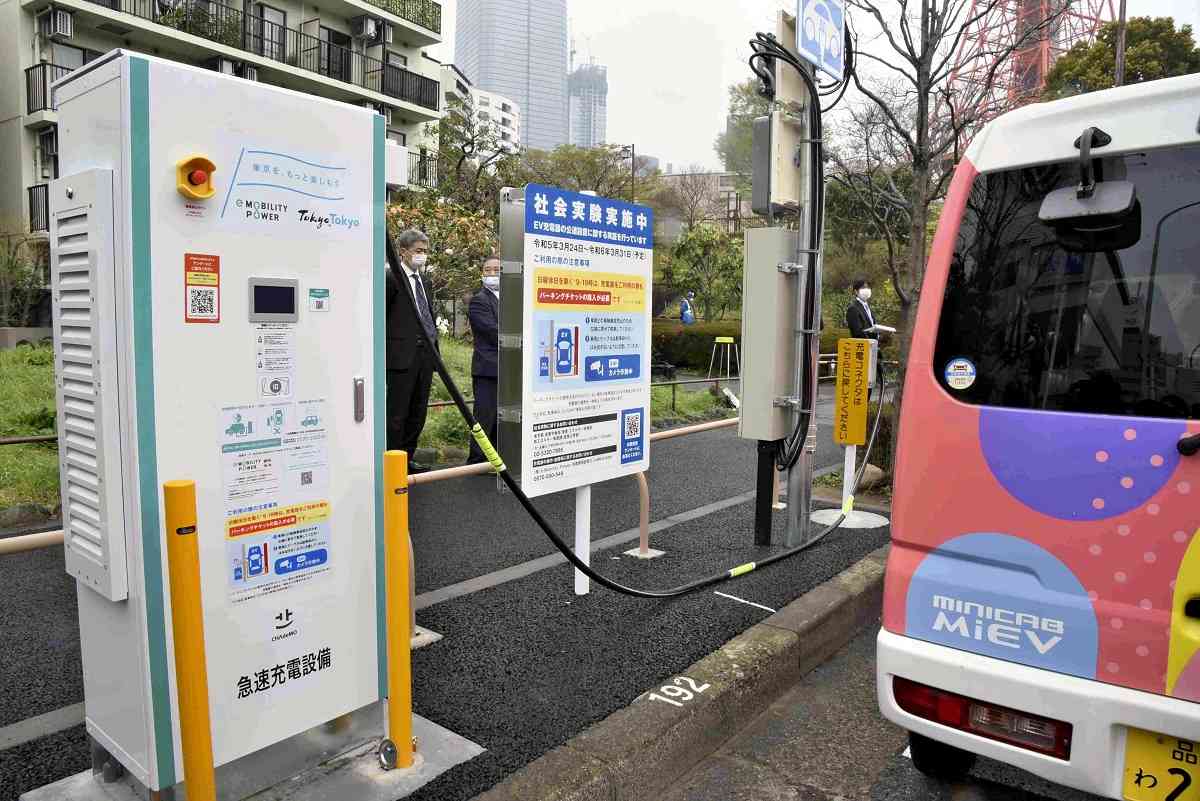
An EV charger installed by the Tokyo metropolitan government is seen in the capital’s Minato Ward in March.
20:00 JST, September 3, 2023
The government has decided to double its current EV charger installation target to 300,000 by 2030. With EVs growing in popularity around the world, the government hopes the increased availability of charging stations across the nation will encourage a similar trend in Japan.
The Economy, Trade and Industry Ministry has presented draft guidelines for its plan to an expert panel.
Japan currently has about 30,000 EV chargers. Under the new plan, additional chargers will be available at public spaces such as expressway rest stops, Michi-no-Eki roadside rest areas and commercial facilities.
To clarify enumeration, the ministry will replace the term “charger” with “connector,” as newer devices can charge multiple EVs simultaneously.
The government had initially set a target of 150,000 charging stations by 2030 in its Green Growth Strategy, which was revised in 2021. But with Japanese manufacturers such as Toyota Motor Corp. expected to increase domestic sales of EVs, the government concluded that it is necessary to revise its target for chargers, which are key to the spread of EVs.
Quicker charging
Shortening vehicle-charging times is also part of the government’s new plan. The higher a charger’s output, the shorter the charging time. About 60% of “quick chargers” currently available have an output of less than 50 kilowatts. The government plans to install quick chargers with an output of at least 90 kilowatts for expressways, and chargers with at least a 50-kilowatt output elsewhere. Under the plan, relevant subsidies will be offered to road administrators to encourage the installation of quick chargers.
Charging fees are usually based on the amount of time a charger is used. However, the government aims to introduce by the end of fiscal 2025 a system in which fees are based on the amount of electricity used.
The government has set a goal for all new cars sold to be electrically powered by 2035. In fiscal 2022, domestic sales of EVs totaled 77,000 units representing about 2% of all passenger cars, lagging China and Europe.
Charging station installation has been sluggish in Japan, with numbers hovering at about 30,000 since 2018. Poor availability and low power output are the main factors behind the slow domestic spread of EVs.
Major nations in which EV uptake is on the rise have seen a concomitant increase in the number of charging points. In 2022, there were 1.76 million charging stations in China, 128,000 in the United States, 84,000 in France and 77,000 in Germany.
Germany has set a goal of increasing the number of such facilities to 1 million by the end of 2030, while the United States and France are eyeing figures of 500,000 and 400,000, respectively.






Most Read
Popular articles in the past 24 hours
-

Voters Using AI to Choose Candidates in Japan's Upcoming General ...
-

Japan's Snow-Clad Beauty: Camellia Flowers Seen in Winter Bloom a...
-
Monkey Strikes Junior High School Girl from Behind in Japan's Yam...
-
Genichiro Inokuma's Mural in Ueno Station That Gave Hope in Postw...
-

Senior Japanese Citizens Return to University to Gain Knowledge, ...
-

Foreign and Security Policy: Political Parties Must Discuss How T...
-

Heavy Snow Linked to 30 Deaths across Japan since Late Jan.; JMA ...
-

Tokyo Police Arrest Head of Resignation Assistance Firm
Popular articles in the past week
-

Japan Institute to Use Domestic Commercial Optical Lattice Clock ...
-
Australian Woman Dies After Mishap on Ski Lift in Nagano Prefectu...
-
Foreign Snowboarder in Serious Condition After Hanging in Midair ...
-

Chinese Embassy in Japan Reiterates Call for Chinese People to Re...
-
Narita Airport, Startup in Japan Demonstrate Machine to Compress ...
-

Toyota Motor Group Firm to Sell Clean Energy Greenhouses for Stra...
-

Sakie Yokota, Last Surviving Parent of a North Korea Abductee, Ur...
-

Beer Yeast Helps Save Labor, Water Use in Growing Rice; Govt Hope...
Popular articles in the past month
-
Univ. in Japan, Tokyo-Based Startup to Develop Satellite for Disa...
-
JAL, ANA Cancel Flights During 3-day Holiday Weekend due to Blizz...
-
China Confirmed to Be Operating Drilling Vessel Near Japan-China ...
-

China Eyes Rare Earth Foothold in Malaysia to Maintain Dominance,...
-
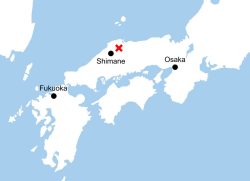
M6.2 Earthquake Hits Japan's Tottori, Shimane Prefectures; No Tsu...
-
Japan Institute to Use Domestic Commercial Optical Lattice Clock ...
-

Japan, Qatar Ministers Agree on Need for Stable Energy Supplies; ...
-

Japan, Italy to Boost LNG Cooperation; Aimed at Diversifying Japa...
Top Articles in Politics
-
Japan Seeks to Enhance Defense Capabilities in Pacific as 3 National Security Documents to Be Revised
-
Japan Tourism Agency Calls for Strengthening Measures Against Overtourism
-

Japan’s Prime Minister: 2-Year Tax Cut on Food Possible Without Issuing Bonds
-
Japan-South Korea Leaders Meeting Focuses on Rare Earth Supply Chains, Cooperation Toward Regional Stability
-
Japanese Government Plans New License System Specific to VTOL Drones; Hopes to Encourage Proliferation through Relaxed Operating Requirements
JN ACCESS RANKING
-
Univ. in Japan, Tokyo-Based Startup to Develop Satellite for Disaster Prevention Measures, Bears
-
JAL, ANA Cancel Flights During 3-day Holiday Weekend due to Blizzard
-
China Confirmed to Be Operating Drilling Vessel Near Japan-China Median Line
-
China Eyes Rare Earth Foothold in Malaysia to Maintain Dominance, Counter Japan, U.S.
-
Japan Institute to Use Domestic Commercial Optical Lattice Clock to Set Japan Standard Time